Relativity of Simultaneity: Observers Perceiving 3 Events

Click For Summary

Discussion Overview

The discussion revolves around the relativity of simultaneity in the context of three events perceived by different observers. Participants explore how mathematical frameworks, particularly Lorentz transformations, can quantify the time differences experienced by observers moving at different velocities. The conversation includes theoretical implications and practical examples, including the Andromeda Paradox.

Discussion Character

  • Exploratory
  • Technical explanation
  • Conceptual clarification
  • Debate/contested
  • Mathematical reasoning

Main Points Raised

  • One participant seeks to understand the potential time differences perceived by observers of three events as they shift between different frames of simultaneity.
  • Another participant explains the Lorentz transformations and how they relate time coordinates in different frames, suggesting that varying relative velocities can yield a range of time differences.
  • A participant emphasizes that simultaneity implies different observers can perceive the same events in varying orders, with the intervals between events increasing with relative speed.
  • There is a discussion about the limitations of light speed affecting the range of perceived time differences, with one participant asking for a layman's explanation of these limits.
  • One participant mentions that the distance between events significantly impacts the perceived time differences, referencing the Andromeda Paradox as an example.
  • Another participant clarifies that relativistic effects are considered after accounting for light travel time, challenging the notion that light travel time is the sole factor in perceived differences.
  • There is a query about whether information regarding a future event can exist in some context or frame, leading to a discussion about causality and the agreement among observers on the timing of events.
  • One participant asserts that if an event is causally connected to an observer, all observers will agree on the sequence of events, reinforcing the principle that causes precede effects.

Areas of Agreement / Disagreement

Participants express differing views on the implications of simultaneity and the interpretation of time differences, indicating that multiple competing perspectives remain unresolved. There is no consensus on the layman's terms for the range of time differences or the implications of causality in relation to future events.

Contextual Notes

Limitations include the dependence on specific definitions of simultaneity and the unresolved nature of how to communicate complex mathematical concepts in simpler terms. The discussion also highlights the complexity of relativistic effects and their implications for different observers.

NTHstars
Messages
12
Reaction score
0
In looking at this light cone diagram, I'm focusing on the part in purple. I'm interested to know if mathematics reveals the exact potential difference in time perceived by observers of three events as they shift between their different planes of simultaneity.
This makes more sense using this gif diagram here: https://en.wikipedia.org/wiki/Relat...File:Relativity_of_Simultaneity_Animation.gif

In other words, across the different potential frames of reference allowed by relativity how much sooner and later can they potentially perceive a or c relative to b (relative to each other). Thanks!
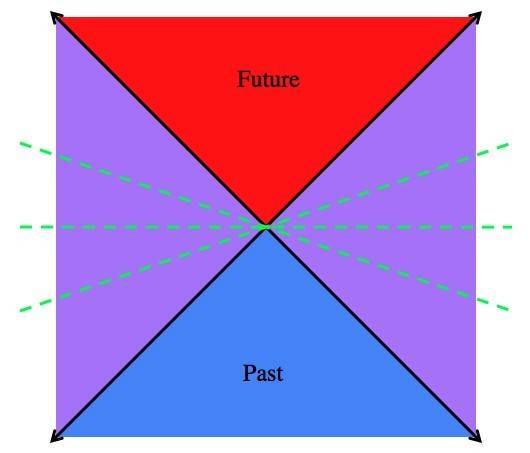
pastandfuture.jpg
 

Attachments

  • pastandfuture.jpg
    pastandfuture.jpg
    14.6 KB · Views: 702
Last edited:
Physics news on Phys.org
The Lorentz transforms relate coordinate times used in one frame to those in another moving at speed ##v##. The transform that gives the time coordinate in the moving frame of an event ##(t,x)## is ##t'=\gamma(t-vx/c^2)##, where ##\gamma=1/(1-v^2/c^2)##.

Your two events have the same ##t## but different ##x##. What range of time differences can you get by varying ##v##?
 
Ok, I think I forgot to include the second observer to generate the difference of opinion of simultaneity. Sorry. My point is, simultaneity is asserting that observers can view the same three events in different orders. It appears those different orders have longer intervals between them (between different observers) the faster they are going relative to one another. Can (and does) the mathematics illuminate the range of the different intervals the observers can experience the same events relative to each other? Thanks!
 
The maths I gave above does exactly that. What part are you stuck with?
 
The math lol. You are saying, yes, you can do that, and here is how you do that. Obviously the speed of light gives this a limit, a range. I'm trying to figure out what that range is in laymen's terms. Upper end, lower end, in day-to-day terms (seconds, days, whatever). Is that logical? If not I apologize, but that is an answer in itself.
 
NTHstars said:
The math lol. You are saying, yes, you can do that, and here is how you do that. Obviously the speed of light gives this a limit, a range. I'm trying to figure out what that range is in laymen's terms. Upper end, lower end, in day-to-day terms (seconds, days, whatever). Is that logical? If not I apologize, but that is an answer in itself.
It depends on the relative velocities and the distance.

For an extreme example of how the distance can matter, google for the "Andromeda Paradox" - two people walking in different directions on the surface of the Earth (relative velocity is just walking speed) can disagree by millions of years about when two events in a distant galaxy have happened. If the two events are just down the street, the difference will be unmeasurably small.
 
  • Like
Likes   Reactions: m4r35n357
NTHstars said:
The math lol.
You marked the thread level I, meaning you have undergrad understanding of this material. My answer is appropriate to that. If you want a lower level of answer, mark your threads B.

The two events A and C occur at the same time, say ##T## but at different places, say ##X_1## and ##X_1+\Delta x##. Substituting those values into the Lorentz transform I stated above gives you that, in a moving frame, one event occurs at ##t'=\gamma(T-vX/c^2)## and the other at ##t'=\gamma(T-vX/c^2-v\Delta x/c^2)##. The time difference in the moving frame is therefore ##\gamma v\Delta x/c^2##. ##\gamma## can take any value greater than equal to one, so for any ##\Delta x\neq 0## there is no limit to the possible time difference.
 
Nugatory said:
It depends on the relative velocities and the distance.

For an extreme example of how the distance can matter, google for the "Andromeda Paradox" - two people walking in different directions on the surface of the Earth (relative velocity is just walking speed) can disagree by millions of years about when two events in a distant galaxy have happened. If the two events are just down the street, the difference will be unmeasurably small.
I actually am familiar with the Andromeda Paradox, so that's a good example. The difference, in millions of years, it's just related to the time it takes light to reach different observers, right? Here what I'm getting at: Say there's an event in my future I'm causally connected to. Can information about that future event, in principle, exist somewhere, in some context/frame? That's regardless if such information can never be shared. Sounds like science fiction on the face of it, but I'm curious. Thanks!
 
NTHstars said:
The difference, in millions of years, it's just related to the time it takes light to reach different observers, right?
No. All reference frame calculations, including the Minkowski diagrams you showed in the first post, have subtracted out the travel time of light. Relativistic effects, including time dilation and the relativity of simultaneity, are what's left after you've accounted for the travel time of light.
NTHstars said:
Here what I'm getting at: Say there's an event in my future I'm causally connected to. Can information about that future event, in principle, exist somewhere, in some context/frame?
Simultaneously with you, now? No. At the event in the middle of your diagram ("you, now"), all events in your causal future are in the red area or on the boundary of the red and purple region. All events that might be regarded by any frame as simultaneous with the event in the middle of the diagram lie in the purple region.
 
Last edited:
  • #10
NTHstars said:
I actually am familiar with the Andromeda Paradox, so that's a good example. The difference, in millions of years, it's just related to the time it takes light to reach different observers, right?
No. The time at which an event happened is determined by noting when light from that event reaches an observer and then subtracting the light travel time to get the time when the light started on its way. Observers in different locations who are at rest relative to one another (and have synchronized their clocks) may receive the light at very different times but after they subtract out the light travel time they will come up with the same time for when the light was emitted.

Each dashed green line corresponds to some frame's notion of "now"; all events on one of those lines happen at the same time (that is, have the same ##t## coordinate) in some frame. Using the frame in which you are at rest, the "now" line is horizontal. It would be a good exercise to satisfy yourself that any observer who is at rest relative to you (that is, their path through spacetime is straight up in the diagram, just like yours) and you also will agree that all the events on a horizontal line happen at the same time. You can also try this for an observer moving relative to you, so that their path through space time is slanted from straight up (but not by more than 45 degrees - that would imply a relative speed greater than ##c##), and you'll find that the "now" lines are slanted. The greater the relative speed between two frames, the greater the angle between their "now" lines; but none of them will ever be steeper than 45 degrees.

Because these lines diverge, the farther out you go the further apart they can be, and that's the root of the Andromeda paradox.
Here what I'm getting at: Say there's an event in my future I'm causally connected to. Can information about that future event, in principle, exist somewhere, in some context/frame?
No. If you are causally connected to an event in your future (which is to say if it lies in the red region of the diagram, assuming that right now you are at the center of the diagram where all the lines come together) then all observers everywhere will agree that this event happens after the event that you are calling "I am right here right now", the one in the center of the diagram where all the lines come together. This guarantees that in all frames causes will always precede their effects.
(This might be a good time to mention that "X happened" and "light from X reached Y's eyes" are different events, and there is no frame in which the second event happens before the first).
 

Similar threads

  • · Replies 6 ·
Replies
6
Views
2K
  • · Replies 12 ·
Replies
12
Views
2K
  • · Replies 17 ·
Replies
17
Views
2K
  • · Replies 20 ·
Replies
20
Views
3K
  • · Replies 20 ·
Replies
20
Views
2K
  • · Replies 13 ·
Replies
13
Views
3K
  • · Replies 16 ·
Replies
16
Views
2K
  • · Replies 51 ·
2
Replies
51
Views
5K
  • · Replies 6 ·
Replies
6
Views
2K
  • · Replies 221 ·
8
Replies
221
Views
17K