Rod in equilibrium, and find its angle to the vertical plane

Click For Summary
SUMMARY

The discussion centers on the analysis of a rod in equilibrium and determining its angle to the vertical plane. Participants emphasize the importance of creating a free body diagram to visualize the forces acting on the rod. This foundational step is crucial for applying principles of static equilibrium, allowing for the calculation of angles and forces effectively. The conversation highlights that understanding the forces involved is essential for solving such problems accurately.

PREREQUISITES
  • Static equilibrium principles
  • Free body diagram creation
  • Basic trigonometry for angle calculations
  • Understanding of forces (tension, weight)
NEXT STEPS
  • Study the principles of static equilibrium in detail
  • Practice drawing free body diagrams for various scenarios
  • Learn how to apply trigonometric functions to solve for angles
  • Explore case studies involving rods and beams in equilibrium
USEFUL FOR

Students in physics or engineering, educators teaching mechanics, and anyone interested in understanding the principles of static equilibrium and force analysis.
jmao15
Messages
1
Reaction score
0
Homework Statement
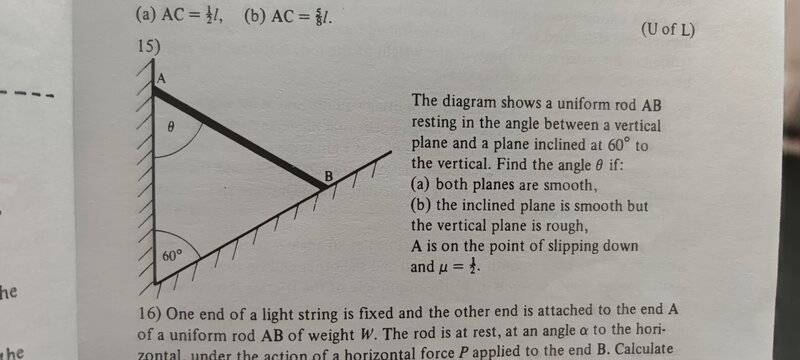
The diagram shows a uniform rod AB resting in the angle between a vertical plane and a plane inclined at 60° to the vertical. Find the angle theta if: (a) both planes are smooth, (b) the inclined plane is smooth but the vertical plane is rough, A is on the point of slipping down and μ =0.5
Relevant Equations
Lami's theorem??
Literally, don't know how to start.
IMG_20210530_172134.jpg
 
Physics news on Phys.org
jmao15 said:
Literally, don't know how to start.
Always start with a free body (force) diagram.
 
The book claims the answer is that all the magnitudes are the same because "the gravitational force on the penguin is the same". I'm having trouble understanding this. I thought the buoyant force was equal to the weight of the fluid displaced. Weight depends on mass which depends on density. Therefore, due to the differing densities the buoyant force will be different in each case? Is this incorrect?

Similar threads

  • · Replies 6 ·
Replies
6
Views
1K
  • · Replies 16 ·
Replies
16
Views
2K
  • · Replies 45 ·
2
Replies
45
Views
4K
  • · Replies 7 ·
Replies
7
Views
3K
Replies
2
Views
1K
Replies
4
Views
2K
  • · Replies 5 ·
Replies
5
Views
2K
Replies
12
Views
2K
  • · Replies 13 ·
Replies
13
Views
2K
Replies
19
Views
3K