Discussion Overview
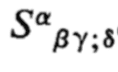
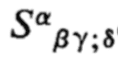
The discussion revolves around the use of semicolon notation in the context of covariant derivatives, specifically whether it serves as a compact notation for components or if it can be expanded in a certain way. The scope includes theoretical aspects of tensor notation and covariant derivatives.
Discussion Character
- Technical explanation
- Conceptual clarification
- Debate/contested
Main Points Raised
- Some participants inquire about the meaning of the semicolon in tensor notation, questioning if it indicates a covariant derivative or serves as a compact notation for components.
- One participant asserts that the semicolon can indeed represent the covariant derivative, providing the equation $$S^\alpha{}_{\beta\gamma;\delta} = \nabla_\delta \, S^{\alpha}{}_{\beta\gamma}$$ as an example.
- Another participant suggests that any tensor can be expressed as a sum of its components multiplied by basis vectors and co-vectors, indicating that the covariant derivative of a tensor remains a tensor of higher rank.
- There is a request for clarification on how to type equations, with a participant sharing that LaTeX is used for this purpose on the forum.
Areas of Agreement / Disagreement
The discussion contains multiple viewpoints regarding the interpretation of the semicolon notation, and no consensus is reached on its usage. Participants express uncertainty and seek clarification on the topic.
Contextual Notes
Some assumptions about the familiarity with tensor notation and the properties of covariant derivatives may not be explicitly stated, which could affect understanding.