Serial controlled variable speed motor

Click For Summary

Discussion Overview

The discussion revolves around creating a circuit to control the speed of a 12V DC motor using serial data. Participants explore various methods for implementing this control while addressing concerns about back EMF and the safety of the circuit with respect to a computer's motherboard.

Discussion Character

  • Technical explanation
  • Debate/contested
  • Experimental/applied

Main Points Raised

  • Sam describes a circuit using a potentiometer for speed control and seeks advice on modifying it to use serial data instead.
  • One participant questions the efficiency of using a series resistor for speed control and suggests using a MOSFET as an on/off switch in a pulse-width modulation (PWM) controller.
  • Another participant proposes using diodes to protect the MOSFET and motherboard from inductive spikes caused by back EMF.
  • A different suggestion involves using an opto-isolator for protecting the motherboard from back EMF.
  • One participant recommends using a microcontroller to receive RS-232 commands and send PWM signals to a motor controller, highlighting potential limitations in control reliability and speed adjustment.
  • Another participant questions the necessity of RS-232, suggesting that model car speed controllers use a simpler pulse width scheme for speed control.

Areas of Agreement / Disagreement

Participants express differing views on the best method for controlling the motor speed and protecting the circuit from back EMF. There is no consensus on a single approach, and multiple competing ideas are presented.

Contextual Notes

Participants mention various methods and components, such as MOSFETs, diodes, opto-isolators, and microcontrollers, but do not resolve the technical details or assumptions underlying these suggestions.

Who May Find This Useful

Individuals interested in motor control, circuit design, and those working with serial communication in electronics may find this discussion relevant.

mooseboi
Messages
6
Reaction score
0
Hello all, I am trying to create a circuit that allows me to use serial data to control the speed of a 12v dc motor I removed from an electric drill. So far I have successfully made the circuit in diagram (a) using a 100k pot to alter the speed. So the next problem to solve is how I can instead use serial data as the controller.

Diagram (a)
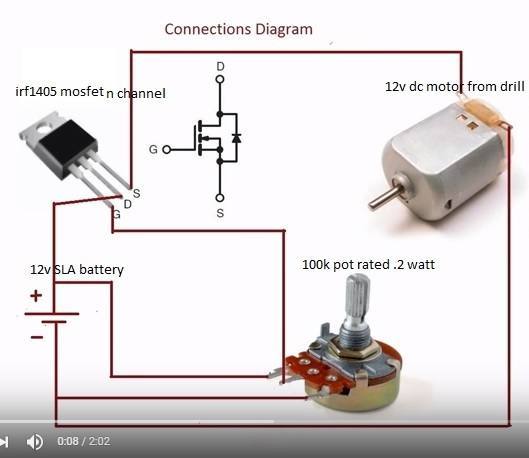
speed controller circuit with pot.jpg


Diagram (b)
mosfet circuit.jpg


Now, the creator of the circuit depicted in diagram (b) stated "I suppose with really beefy motors and really beefy motor power supplies, there might be some danger of getting the backEMF spikes onto the motherboard, causing problems, so ... don't do that." However, someone suggested using diodes to solve this problem of backEMF to protect the computer from spikes. So with all this information considered, my question is now this: What modifications need to be made to the circuit in diagram (b) to make it safe to use so to avoid any nasty backEMF and other potential harm to my computer when using serial data to control the MOSFET?

Many thanks,
Sam.
 
Last edited:
Engineering news on Phys.org
You're not concerned about the low efficiency of the "series resistor" type of speed control? You could get considerably better efficiency were the MOSFET to be used as an on/off switch in a variable pulse-width switching controller. How many amps will the motor draw at full load?

You'll never want the controller to reverse the motor? If not, then a diode across the MOSFET and another across the motor terminals will catch inductive spikes and protect your MOSFET; the diodes oriented so as to be reverse-biased by the motor's power supply.

What exactly are you wanting your repurposed drill motor to do?
 
The proper solution is a uP receiving RS-232 commands and then sending PWM to a motor controller like the TB6612

This board is a proper example:
http://www.robotshop.com/en/pololu-qik-dual-serial-motor-controller.html

Here is a board you can connect to an arduino:
https://www.sparkfun.com/products/9457

What you have proposed is essentially creating PWM (ON-OFF-ON-OFF) signals via the TX pin of the serial port. There are two ways to do that (from a control perspective). Send serial data patterns to produce the PWM ratios you desire (pulse density modulation), or use the firmware to manually toggle the Tx signal.

IN either case, the control will be unreliable to the extent that the firmware might be usurped for another task. Also, the degree of speed control is limited.

But, what you have shown can cause the motor to turn on and turn off at some rate. It does need a protection diode.
 
Does it have to be RS232? The speed controllers used in model cars/planes use a simple pulse width scheme. Typically they need a 1-2mS long pulse repeated every 20mS. The duration of the pulse sets the speed so 1mS might be OFF and 2mS = Max speed.
 

Similar threads

Replies
17
Views
3K
Replies
30
Views
3K
  • · Replies 11 ·
Replies
11
Views
2K
  • · Replies 15 ·
Replies
15
Views
2K
  • · Replies 26 ·
Replies
26
Views
6K
Replies
18
Views
3K
  • · Replies 14 ·
Replies
14
Views
4K
Replies
3
Views
2K
  • · Replies 3 ·
Replies
3
Views
3K
  • · Replies 16 ·
Replies
16
Views
3K