Solar Activity and Space Weather Update thread
Join the discussion
Registration is free. Ask a follow-up in this thread, or start your own.
468 replies · 81K views · last reply
Astronomy news on Phys.org
Brian in Victoria BC
- 34
- 31
I doubt it, It was in the complete northern half of the sky, with some in the southern half. People who had lived in northern British Columbia, (my tenant for one, and my friend who lived in Dawson Creek for a while) knew all about it so even at the start when it just looked like a weird cloud formation above us (wider lines than later at night) and there were no Aurora at all, he called me out, saying that it was "starting". Later on it felt like we were in a planetarium and someone had painted the longitude lines in the sky above us. Obviously they had painted it in the wrong place because the lines came together as a "pole" just south of the middle of the sky. Presumably this was because the sun was at the other side of the earth at that stage and the particles whipped round the earth from all sides and some converged there. (I said latitude earlier by mistake). I presume the moisture content was just right and the charged particles traveling along the magnetic lines of the earth were ionizing and causing condensation just like in a cloud chamber, maybe even protons were combining high up with oxygen up there. It waxed and waned with the aurora. So, 2 people I personally know were not surprised at all to see it. I bet if you find more people who live in northern Canada or southern Alaska, I have no doubt they will confirm it. I grew up in Ireland where you will see nearly every cloud formation known to man, but I never saw anything like that before.Tom.G said:Could those White Lines be the Aurora itself shining thru thin clouds?
Astranut
- 10
- 49
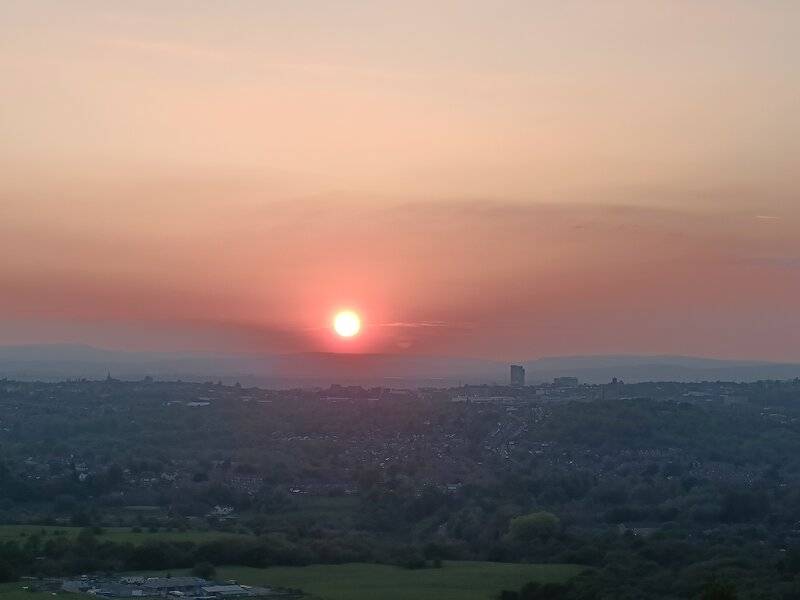
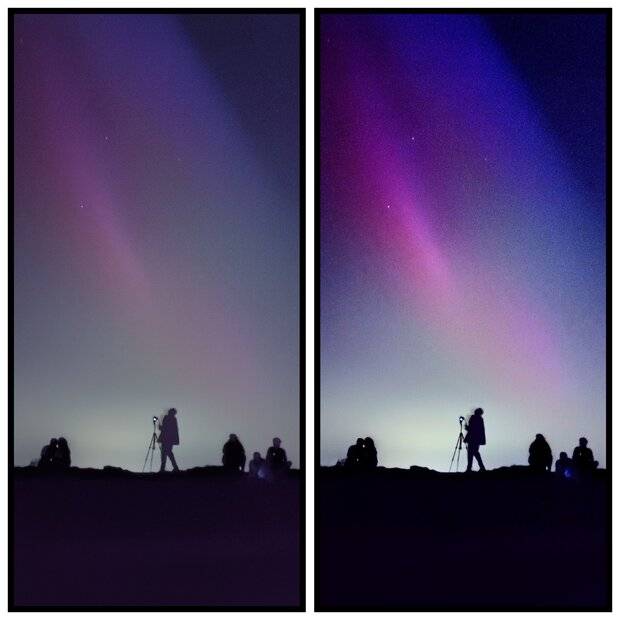
Aurora Borealis, viewed over the night of Fri 10th to Sat 11th May 2024. From Hartshead Pike Ashton-under-Lyne Greater Manchester England.
Watching the sunset whilst waiting for the Aurora.
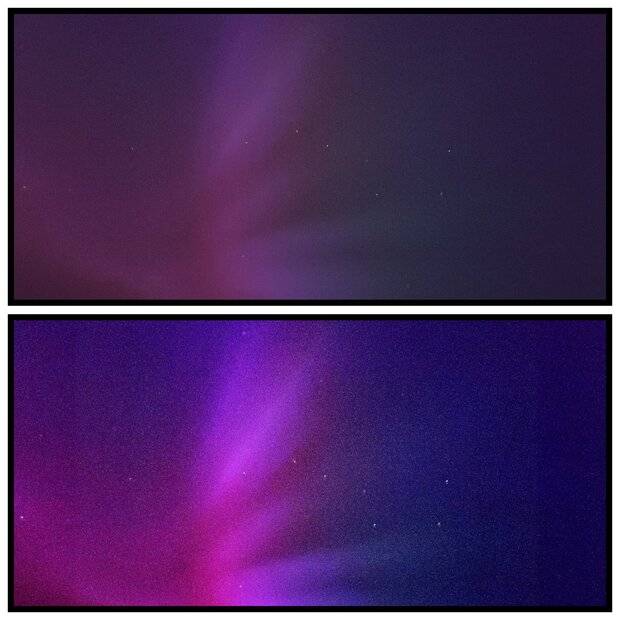
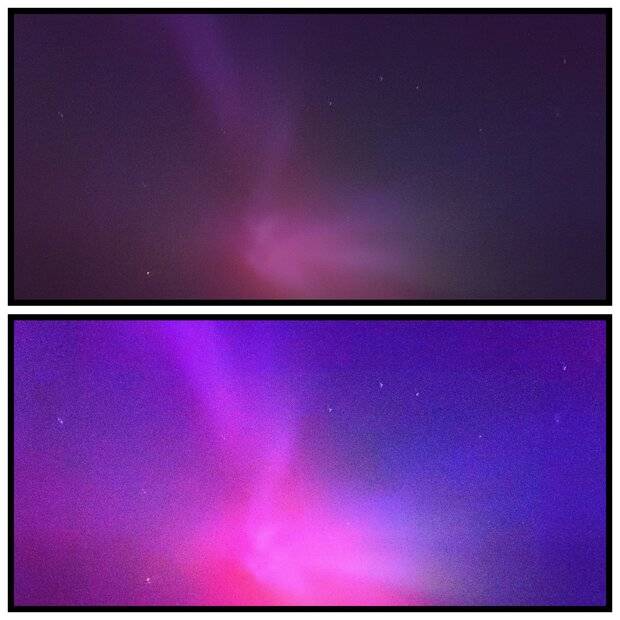
Raw image top, enhanced below.
Ursa Major is visible with Arcturus to the bottom left.
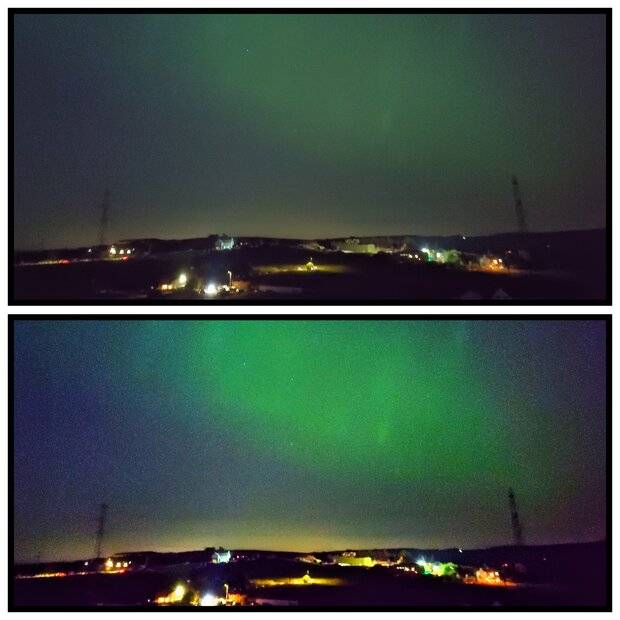
Looking towards the Pennines, Mossley in the foreground.
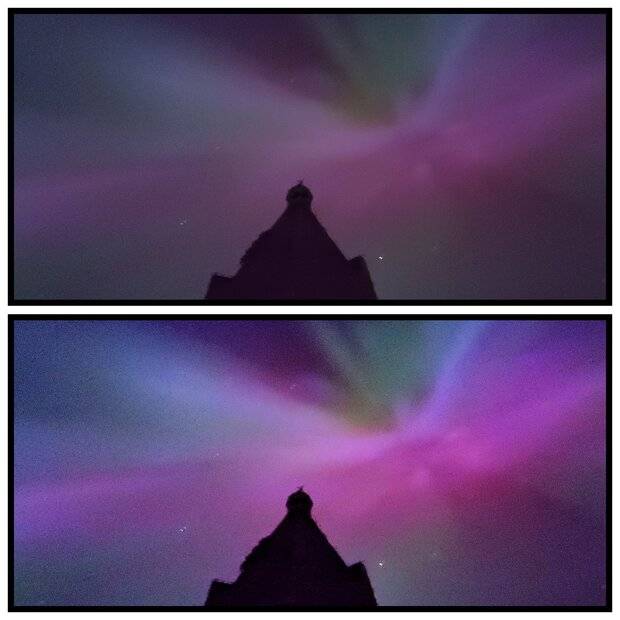
As above raw top enhanced below. Right above, the Corona. With Hartshead Pike in the foreground.
Watching the sunset whilst waiting for the Aurora.
Raw image top, enhanced below.
Ursa Major is visible with Arcturus to the bottom left.
Looking towards the Pennines, Mossley in the foreground.
As above raw top enhanced below. Right above, the Corona. With Hartshead Pike in the foreground.
Last edited:
Astranut
- 10
- 49
Final image, about 50 people came to view and image the event. Raw left, enhanced right, all taken with a cell phone. Care of excessive badgering by Pinball.
Astranut
- 10
- 49
Arcturus on this one not in the above, bottom left, apologies.
pinball1970
Gold Member
2025 Award
- 3,893
- 6,219
Took your time.Astranut said:
Stavros Kiri
- 1,149
- 1,016
Wow! for the photos above etc. ...
News just came in. The monster sunspot didn't stop there:
Tue May 14, 2024
THE BIGGEST SOLAR FLARE OF THE CURRENT SOLAR CYCLE: Earth-orbiting satellites have just detected the most intense solar flare of the current solar cycle (so far)--an X8.7-category blast from giant sunspot AR3664. Extreme ultraviolet radiation from the flare ionized the top of Earth's atmosphere and caused a deep shortwave blackout over the Americas.
Adding some more details about the phenomenon from spaceweather.com :
"Because the sunspot is behind the edge of the solar disk, the flare was partially eclipsed. It was probably even stronger than it appeared. "X8.7" is almost certainly an underestimate of the flare's true strength.
Extreme ultraviolet radiation from the flare ionized the top of Earth's atmosphere, causing a deep shortwave radio blackout over the Americas. Ham radio operators, aviators and mariners may have noticed a sudden loss of signal at all frequencies below 30 MHz.
Subatomic debris from this event might soon reach Earth, guided toward our planet by the Parker Spiral (read the story below for more information). Also, a CME might be in the offing. Stay tuned for updates! (...)
EARTH IS CONNECTED TO SUNSPOT AR3664: Giant sunspot AR3664 is no longer facing Earth. That makes it extra dangerous. The Carrington-class sunspot is passing over the sun's western limb--a region of the sun that is magnetically connected to our planet. Indeed, we are feeling the effects of that connection right now; take a look at this map of ongoing radio blackouts:
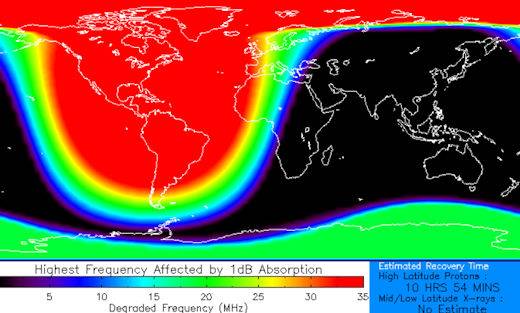
Red zones in the map show where shortwave radio signals are being absorbed. Inside the Arctic Circle, frequencies below 30 MHz are almost completely blacked out, a nuisance for polar aviators and ham radio operators.
What's causing this? Protons accelerated by solar flares in the magnetic canopy of AR3664 are following the Parker Spiral back to Earth. Think of it as a magnetic superhighway. The arriving particles are funneled by our planet's magnetic field toward the poles where they ionize the atmosphere and interfere with the normal transmission of shortwave radio.
This polar cap absorption event could last for days, especially if it is boosted by more flares from AR3664. You can can monitor its progress here. "
News just came in. The monster sunspot didn't stop there:
Tue May 14, 2024
THE BIGGEST SOLAR FLARE OF THE CURRENT SOLAR CYCLE: Earth-orbiting satellites have just detected the most intense solar flare of the current solar cycle (so far)--an X8.7-category blast from giant sunspot AR3664. Extreme ultraviolet radiation from the flare ionized the top of Earth's atmosphere and caused a deep shortwave blackout over the Americas.
|
|
Adding some more details about the phenomenon from spaceweather.com :
"Because the sunspot is behind the edge of the solar disk, the flare was partially eclipsed. It was probably even stronger than it appeared. "X8.7" is almost certainly an underestimate of the flare's true strength.
Extreme ultraviolet radiation from the flare ionized the top of Earth's atmosphere, causing a deep shortwave radio blackout over the Americas. Ham radio operators, aviators and mariners may have noticed a sudden loss of signal at all frequencies below 30 MHz.
Subatomic debris from this event might soon reach Earth, guided toward our planet by the Parker Spiral (read the story below for more information). Also, a CME might be in the offing. Stay tuned for updates! (...)
EARTH IS CONNECTED TO SUNSPOT AR3664: Giant sunspot AR3664 is no longer facing Earth. That makes it extra dangerous. The Carrington-class sunspot is passing over the sun's western limb--a region of the sun that is magnetically connected to our planet. Indeed, we are feeling the effects of that connection right now; take a look at this map of ongoing radio blackouts:
Red zones in the map show where shortwave radio signals are being absorbed. Inside the Arctic Circle, frequencies below 30 MHz are almost completely blacked out, a nuisance for polar aviators and ham radio operators.
What's causing this? Protons accelerated by solar flares in the magnetic canopy of AR3664 are following the Parker Spiral back to Earth. Think of it as a magnetic superhighway. The arriving particles are funneled by our planet's magnetic field toward the poles where they ionize the atmosphere and interfere with the normal transmission of shortwave radio.
This polar cap absorption event could last for days, especially if it is boosted by more flares from AR3664. You can can monitor its progress here. "
Last edited:
Stavros Kiri
- 1,149
- 1,016
A. This is awesome:
"AURORAS OVER THE GRAND CANYON: You know a solar storm is big when ... it produces auroras over the Grand Canyon. Brian A. Klimowski photographed the rare display on May 11, 2024:
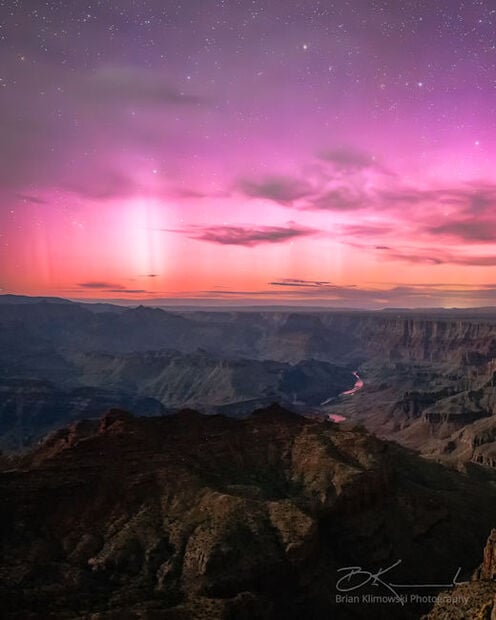
"This was just the afterglow of a more intense G5 storm on May 10th, but still so beautiful over the Canyon!" says Klimowski .
Geologists say that the Colorado River has been carving the Grand Canyon for 5 or 6 million years. No one knows how often auroras have been seen during that time. This is what we do know: The auroras of May 10-11, 2024, were among the most widespread of the past 500 years. We will be writing a story about that in a few days."
B.
"MONSTER SUNSPOT TARGETS MARS: First Earth, now Mars. Carrington-class sunspot AR3664 is now directly facing the Red Planet. NASA's Mars rover Perseverance saw it yesterday through the dusty air of Jezero Crater:
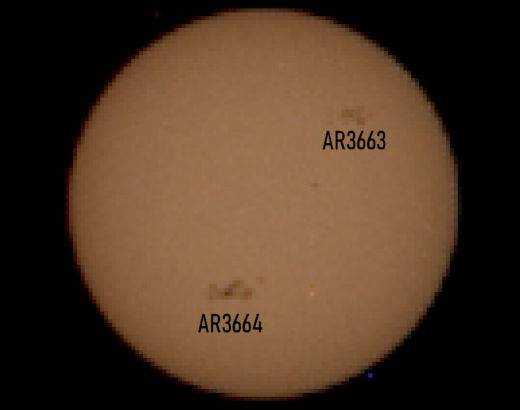
On May 14th, AR3664 produced an X8.6-class solar flare, the strongest flare of the solar cycle, and hurled a corresponding CME directly toward Mars. NASA models suggest it should hit Mars on May 17th, potentially sparking global auroras.
"We're bracing for impact!" says says Nick Schneider of the University of Colorado's Laboratory for Atmospheric and Space Physics (LASP). Schneider works with an ultraviolet camera on NASA's MAVEN spacecraft, which may be able to observe the display. (...)"
"AURORAS OVER THE GRAND CANYON: You know a solar storm is big when ... it produces auroras over the Grand Canyon. Brian A. Klimowski photographed the rare display on May 11, 2024:
"This was just the afterglow of a more intense G5 storm on May 10th, but still so beautiful over the Canyon!" says Klimowski .
Geologists say that the Colorado River has been carving the Grand Canyon for 5 or 6 million years. No one knows how often auroras have been seen during that time. This is what we do know: The auroras of May 10-11, 2024, were among the most widespread of the past 500 years. We will be writing a story about that in a few days."
B.
"MONSTER SUNSPOT TARGETS MARS: First Earth, now Mars. Carrington-class sunspot AR3664 is now directly facing the Red Planet. NASA's Mars rover Perseverance saw it yesterday through the dusty air of Jezero Crater:
On May 14th, AR3664 produced an X8.6-class solar flare, the strongest flare of the solar cycle, and hurled a corresponding CME directly toward Mars. NASA models suggest it should hit Mars on May 17th, potentially sparking global auroras.
"We're bracing for impact!" says says Nick Schneider of the University of Colorado's Laboratory for Atmospheric and Space Physics (LASP). Schneider works with an ultraviolet camera on NASA's MAVEN spacecraft, which may be able to observe the display. (...)"
Brian in Victoria BC
- 34
- 31
Just a note that what I and my tenants saw, "the lines of longitude" ( converging above my head) during the aurora event is called the "corona". A UK facebook user whose husband is an astronomer told me. Another person saw it too, but their lines were pale pink, and they didn't know it was aurora associated (because where they were, they didn't see the actual northern lights. I found a nice bbc video about the auroras. https://www.bbc.com/reel/video/p0hn4861/why-northern-lights-viewing-is-about-to-get-more-magical There are actually a couple of pictures like what I saw in it (but much more colorful and less defined). I saw thin white lines coming from the "pole" above my head. A picture shows a similar thing with diffuse colours.
Staff Emeritus
Science Advisor
Gold Member
2025 Award
- 22,723
- 7,825
The solar dynamo begins near the surface. (Open Access)
Nature | Vol 629 | 23 May 2024 | 769
https://www.nature.com/articles/s41586-024-07315-1
Nature | Vol 629 | 23 May 2024 | 769
https://www.nature.com/articles/s41586-024-07315-1
Abstract
The magnetic dynamo cycle of the Sun features a distinct pattern: a propagating region of sunspot emergence appears around 30° latitude and vanishes near the equator every 11 years (ref. 1). Moreover, longitudinal flows called torsional oscillations closely shadow sunspot migration, undoubtedly sharing a common cause2. Contrary to theories suggesting deep origins of these phenomena, helioseismology pinpoints low-latitude torsional oscillations to the outer 5–10% of the Sun, the near-surface shear layer3,4. Within this zone, inwardly increasing differential rotation coupled with a poloidal magnetic field strongly implicates the magneto-rotational instability5,6, prominent in accretion-disk theory and observed in laboratory experiments7. Together, these two facts prompt the general question: whether the solar dynamo is possibly a near-surface instability. Here we report strong affirmative evidence in stark contrast to traditional models8 focusing on the deeper tachocline. Simple analytic estimates show that the near-surface magneto-rotational instability better explains the spatiotemporal scales of the torsional oscillations and inferred subsurface magnetic field amplitudes9. State-of-the-art numerical simulations corroborate these estimates and reproduce hemispherical magnetic current helicity laws10. The dynamo resulting from a well-understood near-surface phenomenon improves prospects for accurate predictions of full magnetic cycles and space weather, affecting the electromagnetic infrastructure of Earth.
Stavros Kiri
- 1,149
- 1,016
So how did it go that day?berkeman said:Yeah, this could be a pain. I have a medical shift tomorrow morning in two remote locations a few hours apart, and I was relying on Google Maps and GPS to get me there. Now I've printed out hard copies of the directions as backups. Yikes, we get so used to technology!
Anyone else having to report problems in e.g. internet, communications, electric lines, transformers etc. ? (for those big storms back then etc. ...)
More aurora fun photos are of course welcome too etc. (e.g. for posting ...) ...
More news ahead, and new research article (see above post by @Astronuc ...) etc. ...
Stavros Kiri
- 1,149
- 1,016
Thanks for posting that! ...Brian in Victoria BC said:Just a note that what I and my tenants saw, "the lines of longitude" ( converging above my head) during the aurora event is called the "corona". A UK facebook user whose husband is an astronomer told me. Another person saw it too, but their lines were pale pink, and they didn't know it was aurora associated (because where they were, they didn't see the actual northern lights. I found a nice bbc video about the auroras. https://www.bbc.com/reel/video/p0hn4861/why-northern-lights-viewing-is-about-to-get-more-magical There are actually a couple of pictures like what I saw in it (but much more colorful and less defined). I saw thin white lines coming from the "pole" above my head. A picture shows a similar thing with diffuse colours.
Great valuable new valid article of new genuine true Solar Research ... - thanks for posting that! ... (I was looking for it too ...).Astronuc said:The solar dynamo begins near the surface. (Open Access)
Nature | Vol 629 | 23 May 2024 | 769
https://www.nature.com/articles/s41586-024-07315-1
---------------------------
New latest Important Solar News:
HISTORIC SUNSPOT RETURNS: Could it happen again? Sunspot AR3664, which caused the historic May 10th superstorm, is returning following a two-week trip around the farside of the sun. It announced itself today with an X2.8-class solar flare.
|
...
(stay tuned ...)
Admin
- 69,809
- 25,727
LOL, my Google Maps navigation (on my Pixel 6 cellphone) locked up twice that day. First time was on my way to the first part of the shift, and then again while driving to the second part of my shift. I'm not 100% sure it was due to the storm, but I've had pretty much zero issues with navigation using that phone (except one time a couple years ago when I went through a short tunnel in San Francisco).Stavros Kiri said:So how did it go that day?
It was definitely a good thing that I had printed directions as a backup, and had previewed the routes on Google Maps ahead of time.

Staff Emeritus
Science Advisor
Gold Member
2025 Award
- 22,723
- 7,825
So how is current activity compared with predictions at the beginning of Solar Cycle 25 (relative to Solar Cycle 1 in 1755)?
Back in 2020 - https://www.weather.gov/news/201509...r Cycle 25 is forecast,a peak of 115 sunspots.
It seems a bit more active than predicted. Perhaps?
https://www.sidc.be/SILSO/ssngraphics
https://www.sidc.be/SILSO/dayssnplot
FYI - https://solarscience.msfc.nasa.gov/interior.shtml
Back in 2020 - https://www.weather.gov/news/201509...r Cycle 25 is forecast,a peak of 115 sunspots.
https://www.swpc.noaa.gov/news/solar-cycle-25-forecast-updateSolar Cycle 25 is forecast to be a fairly weak cycle, the same strength as cycle 24. Solar maximum is expected in July 2025, with a peak of 115 sunspots.
It seems a bit more active than predicted. Perhaps?
https://www.sidc.be/SILSO/ssngraphics
https://www.sidc.be/SILSO/dayssnplot
FYI - https://solarscience.msfc.nasa.gov/interior.shtml
Stavros Kiri
- 1,149
- 1,016
I agree it was probably due to the storm, but one is never sure 100% ...berkeman said:LOL, my Google Maps navigation (on my Pixel 6 cellphone) locked up twice that day. First time was on my way to the first part of the shift, and then again while driving to the second part of my shift. I'm not 100% sure it was due to the storm, but I've had pretty much zero issues with navigation using that phone (except one time a couple years ago when I went through a short tunnel in San Francisco).
It was definitely a good thing that I had printed directions as a backup, and had previewed the routes on Google Maps ahead of time.
I remember the good old "old maps & no cell-phone" times (e.g. triple A [AAA] maps) back in the 80s and our preparation before every trip, after receiving the 'pack of maps' (e.g. by AAA) in the mail etc. ! ...
Science Advisor
Gold Member
- 5,661
- 4,509
When I am going someplace unusual, I usually have my wife and her tablet or cell phone along. (they are decent navigators between them)
But I still have a Thomas Brothers map book in the car... and an older one in the house.
They come in handy when the Internet or the power go on vacation.
But I still have a Thomas Brothers map book in the car... and an older one in the house.
They come in handy when the Internet or the power go on vacation.
Stavros Kiri
- 1,149
- 1,016
EARTH IS BACK IN THE STRIKE ZONE: Returning sunspot AR3664 is picking up where it left off two weeks ago. Today, it unleashed a long-duration X1.4-class solar flare, which caused a deep shortwave radio blackout over the Americas. From now on, every explosion will be geoeffective as the sunspot turns to squarely face our planet in the days ahead.
.
|
Stavros Kiri
- 1,149
- 1,016
"GEOMAGNETIC STORM WATCH (G2): NOAA forecasters say that G2-class geomagnetic storms are possible on May 31st when a CME is expected to graze Earth's magnetic field. It was hurled into space by an X1.4-flare on May 29th. This forecast is uncertain. NOAA's model predicts a stiff glancing blow, while NASA's model suggests a near miss. If an impact does occur, the resulting storm could extend into June 1st."
Also ([Important note] from May 29):
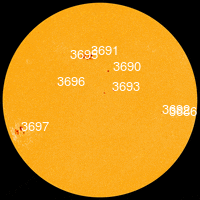
"QUIRKY SUNSPOT NAMING TRADITIONS: The most famous sunspot in decades just had its name changed. AR3664, which caused the great May 10th superstorm, has been re-numbered AR3697 following a 2-week trip around the farside of the sun. This is an old tradition in solar physics that started long ago when astronomers had no way to track the continuity of farside sunspots. We will continue to use the old name for clarity."
"Daily Sun: 30 May 24
Expand: labels | no labels | Carrington
Per tradition, sunspot AR3664 has been re-numbered for its second trip across the Earthside of the sun. It is now AR3697. Both AR3691 and 97 have 'beta-gamma-delta' magnetic fields that harbor energy for X-class solar flares. Credit: SDO/HMI"
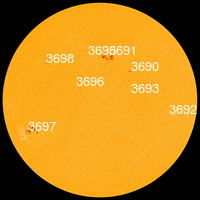
And latest view, today, May 31, 2024:
"Solar wind
speed: 362.6 km/sec
density: 5.39 protons/cm3
more data: ACE, DSCOVR
Updated: Today at 0627 UT
X-ray Solar Flares
6-hr max: C9 0337 UT May31
24-hr: M1 0713 UT May30
explanation | more data
Updated: Today at: 0630 UT
Daily Sun: 31 May 24
Expand: labels | no labels | Carrington
Sunspots AR3691 and 3697 have 'beta-gamma-delta' magnetic fields that harbor energy for X-class solar flares. Credit: SDO/HMI"
And the Kp index (index for auroras) seems to be increasing ... (at 4.67 right now ...).
Also ([Important note] from May 29):
"QUIRKY SUNSPOT NAMING TRADITIONS: The most famous sunspot in decades just had its name changed. AR3664, which caused the great May 10th superstorm, has been re-numbered AR3697 following a 2-week trip around the farside of the sun. This is an old tradition in solar physics that started long ago when astronomers had no way to track the continuity of farside sunspots. We will continue to use the old name for clarity."
"Daily Sun: 30 May 24
Expand: labels | no labels | Carrington
Per tradition, sunspot AR3664 has been re-numbered for its second trip across the Earthside of the sun. It is now AR3697. Both AR3691 and 97 have 'beta-gamma-delta' magnetic fields that harbor energy for X-class solar flares. Credit: SDO/HMI"
And latest view, today, May 31, 2024:
"Solar wind
speed: 362.6 km/sec
density: 5.39 protons/cm3
more data: ACE, DSCOVR
Updated: Today at 0627 UT
X-ray Solar Flares
6-hr max: C9 0337 UT May31
24-hr: M1 0713 UT May30
explanation | more data
Updated: Today at: 0630 UT
Daily Sun: 31 May 24
Expand: labels | no labels | Carrington
Sunspots AR3691 and 3697 have 'beta-gamma-delta' magnetic fields that harbor energy for X-class solar flares. Credit: SDO/HMI"
And the Kp index (index for auroras) seems to be increasing ... (at 4.67 right now ...).
Last edited:
Stavros Kiri
- 1,149
- 1,016
A. Update on the previous (May 29) X-flare:
"EARTH-DIRECTED X-FLARE AND CME: Old sunspot AR3664 isn't as big as it used to be, but it is still very active. On May 29th (1437 UT), it produced an X1.4-class solar flare:
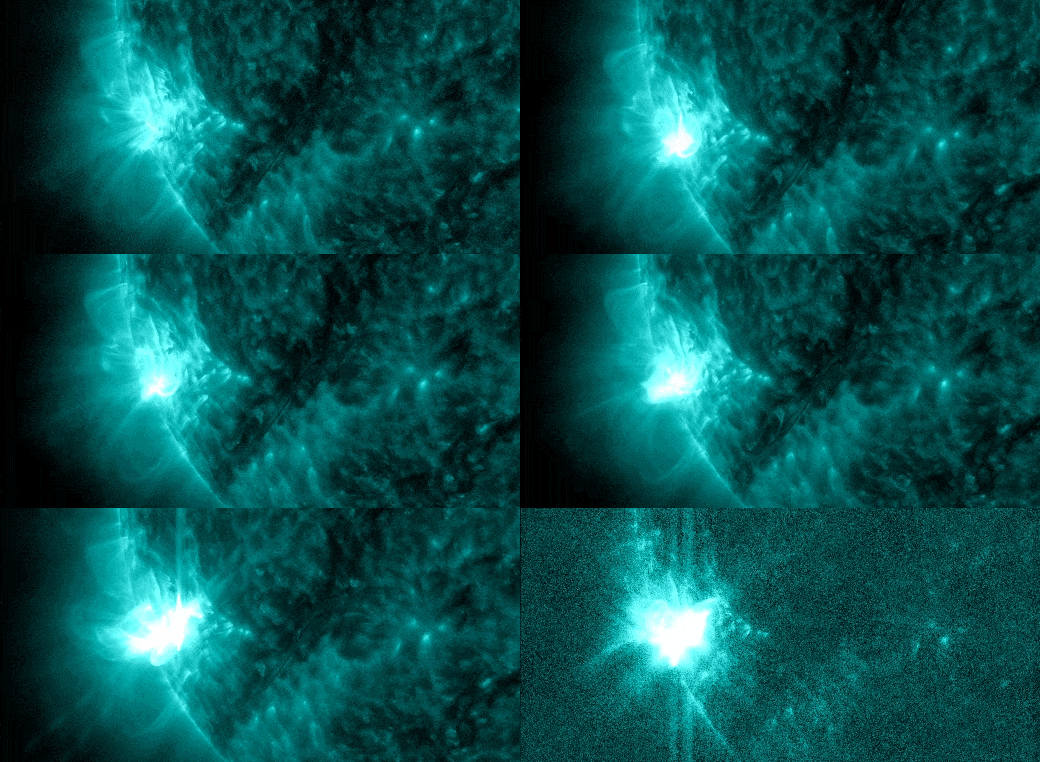
Note: The jiggling of the sun in this movie is not caused by the X-flare. Calibration offsets were underway during the flare. Credit: NASA/Solar Dynamics Observatory.
A pulse of extreme ultraviolet radiation produced a deep shortwave radio blackout over the Americas. Ham radio operators may have noticed loss of signal at all frequencies below 30 MHz for 60 to 90 minutes following the onset of the flare.
This explosion was remarkable for its duration. The X-class phase alone lasted more than an hour--plenty of time to lift a CME out of the sun's atmosphere. Indeed, SOHO coronagraphs have detected a bright CME emerging from the blast site. NOAA models suggest it will reach Earth during the late hours of May 31st (around 2200 UT), delivering a glancing blow strong enough to spark a G2-class geomagnetic storm."
B. A few hours ago (May 31 - June 1 [depending on time zone]) :
"ANOTHER X-FLARE: Sunspot AR3664 (a.k.a. AR3697) has decayed, but it is still potent. It just emitted another X-flare, the third this week. NASA's Solar Dynamics Observatory captured the extreme ultraviolet flash from the X1.1-class explosion:
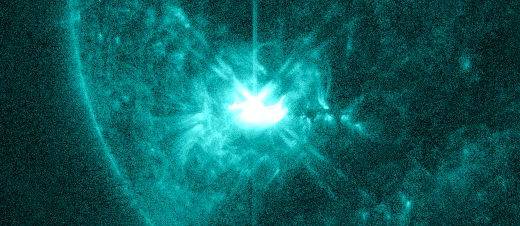
Radiation from the flare ionized the top of Earth's atmosphere, briefly causing a shortwave radio blackout over the Pacific side of North America. Signals below 30 MHz faded for as much as 30 minutes after the flare's peak (2203 UT).
This flare may have been too brief to lift a significant CME out of the sun's atmosphere. Stay tuned for confirmation."
"EARTH-DIRECTED X-FLARE AND CME: Old sunspot AR3664 isn't as big as it used to be, but it is still very active. On May 29th (1437 UT), it produced an X1.4-class solar flare:
Note: The jiggling of the sun in this movie is not caused by the X-flare. Calibration offsets were underway during the flare. Credit: NASA/Solar Dynamics Observatory.
A pulse of extreme ultraviolet radiation produced a deep shortwave radio blackout over the Americas. Ham radio operators may have noticed loss of signal at all frequencies below 30 MHz for 60 to 90 minutes following the onset of the flare.
This explosion was remarkable for its duration. The X-class phase alone lasted more than an hour--plenty of time to lift a CME out of the sun's atmosphere. Indeed, SOHO coronagraphs have detected a bright CME emerging from the blast site. NOAA models suggest it will reach Earth during the late hours of May 31st (around 2200 UT), delivering a glancing blow strong enough to spark a G2-class geomagnetic storm."
B. A few hours ago (May 31 - June 1 [depending on time zone]) :
"ANOTHER X-FLARE: Sunspot AR3664 (a.k.a. AR3697) has decayed, but it is still potent. It just emitted another X-flare, the third this week. NASA's Solar Dynamics Observatory captured the extreme ultraviolet flash from the X1.1-class explosion:
Radiation from the flare ionized the top of Earth's atmosphere, briefly causing a shortwave radio blackout over the Pacific side of North America. Signals below 30 MHz faded for as much as 30 minutes after the flare's peak (2203 UT).
This flare may have been too brief to lift a significant CME out of the sun's atmosphere. Stay tuned for confirmation."
Last edited:
Stavros Kiri
- 1,149
- 1,016
1)
ROCKS AND SOIL ELECTRIFIED BY THE SOLAR SUPERSTORM: The May 10th solar superstorm did more than spark worldwide auroras. It also electrified rocks and soil. NOAA and USGS models of the storm reveal "very high" geoelectric fields in parts of the United States.
2)
THE ANTI-TAIL OF COMET 12P: Comet tails are supposed to point *away* from the sun. Comet 12P/Pons-Brooks just grew a tail in the opposite direction. It's an "anti-tail" visible while Earth passes through the comet's orbital plane.
.
ROCKS AND SOIL ELECTRIFIED BY THE SOLAR SUPERSTORM: The May 10th solar superstorm did more than spark worldwide auroras. It also electrified rocks and soil. NOAA and USGS models of the storm reveal "very high" geoelectric fields in parts of the United States.
|
2)
THE ANTI-TAIL OF COMET 12P: Comet tails are supposed to point *away* from the sun. Comet 12P/Pons-Brooks just grew a tail in the opposite direction. It's an "anti-tail" visible while Earth passes through the comet's orbital plane.
|
Stavros Kiri
- 1,149
- 1,016
HARD RADIATION STORM: A powerful explosion on the sun today (June 8, 2024) peppered Earth and nearby spacecraft with "hard" protons. The radiation storm fogged satellite cameras for hours. Following close behind, a CME is heading for Earth, and its arrival on June 10th could spark G2-class geomagnetic storms.
.
|
Staff Emeritus
Science Advisor
Gold Member
2025 Award
- 22,723
- 7,825
https://www.msn.com/en-us/weather/t...ongest-radiation-storm-since-2017/ar-BB1nYl0ESunspot AR3697 has made headlines again just before it makes another exit. The sunspot region, formerly known as AR3664, produced the historic geomagnetic storm that led to May's global auroras.
On Saturday (June 8), the sunspot fired off a M9.7-class solar flare, the second strongest type on the classification scale. The flare was powerful enough that it produced the strongest radiation storm since 2017, according to NOAA's Space Weather Prediction Center (SWPC). These types of events can pose a risk of impact to space launch operations and satellites, and can also disrupt shortwave radio signals.
There should be some activity tonight.
On Monday (June 10), Region 3697 fired off an even stronger solar flare, a X1.5-class at 7:08 a.m. EST (1108 GMT). Parts of Earth's sunlit side could experience temporary or complete loss of high frequency (HF) radio signals. According to the SWPC forecast, solar activity is expected to be at minor to moderate levels the next few days as Region 3697 rotates out of sight.
Stavros Kiri
- 1,149
- 1,016
"INEFFECTIVE CME IMPACT: As predicted, a CME struck Earth's magnetic field on June 10th (1725 UT). However, the weak impact was ineffective; it did not cause a geomagnetic storm. The CME was hurled into space by an M9.7-class flare from sunspot AR3664/3697 on June 8th."
[The said sunspot, as already mentioned in the previous post above, is departing once again ...- see below]
"Solar wind
speed: 437.3 km/sec
density: 3.64 protons/cm3
more data: ACE, DSCOVR
Updated: Today at 0821 UT
X-ray Solar Flares
6-hr max: C9 0443 UT Jun11
24-hr: X1 1108 UT Jun10
explanation | more data
Updated: Today at: 0825 UT
Daily Sun: 11 Jun 24

Expand: labels | no labels | Carrington
Sunspot AR3709 has a 'beta-gamma' magnetic field that harbors energy for M-class solar flares. Credit: SDO/HMI"
"Current Auroral Oval (for the American continent):

Credit: NOAA/Ovation
Planetary K-index
Now: Kp= 4.00 unsettled
24-hr max: Kp= 4.33 unsettled
explanation | more data "
[The said sunspot, as already mentioned in the previous post above, is departing once again ...- see below]
"Solar wind
speed: 437.3 km/sec
density: 3.64 protons/cm3
more data: ACE, DSCOVR
Updated: Today at 0821 UT
X-ray Solar Flares
6-hr max: C9 0443 UT Jun11
24-hr: X1 1108 UT Jun10
explanation | more data
Updated: Today at: 0825 UT
Daily Sun: 11 Jun 24
Expand: labels | no labels | Carrington
Sunspot AR3709 has a 'beta-gamma' magnetic field that harbors energy for M-class solar flares. Credit: SDO/HMI"
"Current Auroral Oval (for the American continent):
Credit: NOAA/Ovation
Planetary K-index
Now: Kp= 4.00 unsettled
24-hr max: Kp= 4.33 unsettled
explanation | more data "
Last edited:
Stavros Kiri
- 1,149
- 1,016
THE MAY 10TH SUPERSTORM ELECTRIFIED EARTH'S ATMOSPHERE: The geomagnetic superstorm of May 10, 2024, did more than spark widespread auroras. New data show that it also electrified Earth's atmosphere. Fair weather electric fields jumped as much as 15% for four days after the storm.
.
|
Stavros Kiri
- 1,149
- 1,016
GREEN GHOSTS IN A GEOMAGNETIC STORM: Last week, a photographer in South Dakota caught Green Ghosts in a geomagnetic storm. Green Ghosts are a relatively new discovery. They appear when sprites shoot into the atmosphere above strong thunderstorms. This may be the first time the mysterious ghosts have been photographed surrounded by auroras.
.
|
Staff Emeritus
Science Advisor
Gold Member
2025 Award
- 22,723
- 7,825
Sun news July 23: An X14 flare on sun’s far side this morning?
https://earthsky.org/sun/sun-news-activity-solar-flare-cme-aurora-updates/Today’s top story: Something big and powerful is causing a ruckus on the sun’s far side. Around 0 UTC this morning (July 23), a large farside eruption caused a huge halo CME (see the image above). That’s when a coronal mass ejection (CME) is situated on the sun so that an expanding cloud of an cloud of solar material and magnetic fields looms larger and larger, forming a “halo” around our star as seen from Earth. And experts are now estimating that this particular event might have started with an X14 flare! Halo CMEs often mean there’s a CME headed toward Earth. This CME is not headed our way, but, if it had been, it night have caused a dazzling (and perhaps scary) geomagnetic event, such as the one of October 28, 2003.
Last 24 hours: In the past day, solar activity has been moderate, with one M flare. Between 11 UTC yesterday and 11 UTC today, we saw solar activity on the sun’s near side reduce from 31 flares yesterday to nine flares today: an M flare and eight C flares. The largest flare was an M1.5 on July 22 at 13 UTC from AR3744. An R1 (minor) radio blackout affected an area over the Atlantic Ocean off the west coast of Africa. Following this M flare, another flare that narrowly missed becoming an M (C9.0) came from AR3762 at 15:26 UTC on July 22. The lead flare producer of the period was sunspot region AR3762 with three flares. Today the sun has two active regions showing a beta-gamma-delta magnetic complexity: AR3751 and AR3762. Sunspot AR3761 kept its magnetic complexity at a beta-gamma level. The southwest quadrant has the two largest sunspot regions in size. The remaining regions have simple alpha or beta magnetic complexity. The sun has nine numbered active regions.
Next 24 hours: The chance for C flares is 99%. The chance for M flares is 60%. The chance for X flares is 15%.
Next expected CME: Yesterday’s (late July 21) dark spray from a filament eruption created a halo coronal mass ejection (CME) that is expected to reach Earth on July 24. No new Earth-directed CMEs were in the available imagery.
I was looking for more information on the July 21 CME.
https://www.earth.com/news/geomagnetic-storm-warning-issued-astronauts-auroras/
https://www.swpc.noaa.gov/
Stavros Kiri
- 1,149
- 1,016
GEOMAGNETIC STORM WATCH: Two plumes of dark plasma flew away from the sun yesterday, launching a coronal mass ejection (CME) toward Earth. NOAA forecast models suggest the halo CME will strike our planet during the early UT hours of July 24th, sparking a G2-class geomagnetic storm. Photographers in northern-tier US States may be able to catch auroras after the CME arrives.
Stavros Kiri
- 1,149
- 1,016
MAJOR FARSIDE SOLAR FLARE: Europe's Solar Orbiter (SolO) spacecraft just detected the most intense solar flare of the current solar cycle. The X14-category explosion sprayed energetic particles throughout the solar system, causing high dose rates on Mars and even hitting Earth on the opposite side of the sun. The source of the flare could turn to face our planet late next week.
Stavros Kiri
- 1,149
- 1,016
Sun July 28, 2024
CANNIBAL CME ALERT: Multiple CMEs are heading toward Earth following a series of strong M-class solar flares this weekend. Two of the CMEs may be merging to form a potent Cannibal CME. The action begins on July 30th and 31st when the CMEs are expected to arrive, possibly sparking strong G3-class geomagnetic storms.
.
CANNIBAL CME ALERT: Multiple CMEs are heading toward Earth following a series of strong M-class solar flares this weekend. Two of the CMEs may be merging to form a potent Cannibal CME. The action begins on July 30th and 31st when the CMEs are expected to arrive, possibly sparking strong G3-class geomagnetic storms.
|
Stavros Kiri
- 1,149
- 1,016
Mon. July 29, 2024
"SOLAR ACTIVITY IS HIGH: Sunspot complex AR3765-67 is crackling with strong flares--and they're getting stronger. An impulsive X1.5 flare this morning at 0237 UT caused a deep shortwave radio blackout over Japan, southeast Asia and Australia (map). More X-flares are in the offing as the sunspot complex turns directly toward Earth later today."
"Daily Sun: 29 Jul 24

Expand: labels | no labels | Carrington
Sunspot complex AR3765-67 is crackling with strong almost X-class solar flares. Credit: SDO/HMI" .
"SOLAR ACTIVITY IS HIGH: Sunspot complex AR3765-67 is crackling with strong flares--and they're getting stronger. An impulsive X1.5 flare this morning at 0237 UT caused a deep shortwave radio blackout over Japan, southeast Asia and Australia (map). More X-flares are in the offing as the sunspot complex turns directly toward Earth later today."
"Daily Sun: 29 Jul 24
Expand: labels | no labels | Carrington
Sunspot complex AR3765-67 is crackling with strong almost X-class solar flares. Credit: SDO/HMI" .