July 4 & 5, 2026:
"
MIDSUMMER GEOMAGNETIC STORM: Midsummer auroras are rare, but on the night of July 3/4 they blanketed the USA. The display was caused by
a CME strike, which sparked a strong
G3-class geomagnetic storm.
"The auroras were visible with the naked eye alone, a really strong and active display," reports Aaron Watson, who photographed dancing curtains of red above the West Elk Mountains of Colorado:
"I set up this timelapse on my camera and watched with just my eyes," he adds. "I loved watching the pillars of diffuse light grow and drift over the horizon with some nice moments of jaw dropping awe... wow!"
We've received aurora reports from
New Mexico,
Nebraska,
Texas,
Kentucky,
Utah,
Colorado,
Washington,
Pennsylvania,
New York,
Idaho,
Virginia,
Wyoming,
Ohio,
Oregon,
Nevada,
California,
Arizona--and almost every northern-tier state near the US-Canadian border.
It is unusual to have such a strong display so close to the summer solstice. Two reasons: (1) Short summer nights narrow the observing window. (2) Auroras dislike solstices. The same
Russell-McPherron Effect that
boosts auroras around equinoxes also
suppresses auroras around solstices. Yin-yang.
It took an "X-class CME" to overcome these obstacles.The storm cloud that hit us on July 3rd was launched by
an X1-class solar flare three days earlier."
&
"The display was caused by
a CME strike on July 3rd, which was hurled in our direction by an X1-class solar flare three days earlier. After the impact, observers in more than 30 US states reported seeing auroras.
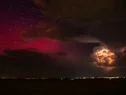
Holy smokes!" says Roger Hill, who photographed the geomagnetic glow through an electrical storm over Bennett, Colorado (+39.8N latitude):
"The geomagnetic storm became strong just as a cluster of severe thunderstorms formed east of our house," says Hill. "The result? A *really cool* photo-op." "
So, it finally happened ... (and as 4th of July gift, perhaps ...).