Solve Bound Charge Question: Griffith's Book Example

  • Thread starter Thread starter Tony Hau
  • Start date Start date
  • Tags Tags
    Bound Charge
Click For Summary

Homework Help Overview

This discussion revolves around a problem from Griffith's book concerning bound charge and the calculation of electric potential in a polarized medium. The original poster presents a potential solution involving surface and volume charge densities, while others engage in exploring the implications of Laplace's equation and boundary conditions.

Discussion Character

  • Exploratory, Conceptual clarification, Mathematical reasoning, Problem interpretation, Assumption checking

Approaches and Questions Raised

  • Participants discuss the formulation of the potential using surface charge density and question the integration approach. There are considerations of boundary conditions and the implications of Laplace's equation in different regions. Some participants suggest alternative forms for the potential and explore the conditions that must be satisfied at the boundary.

Discussion Status

The discussion is active with various interpretations being explored. Some participants have provided insights into potential formulations and boundary conditions, while others express uncertainty about the correct approach. There is no explicit consensus, but productive lines of reasoning are being developed.

Contextual Notes

Participants note the absence of volume charge density and the implications this has on the potential. The original poster's reference to Griffith's book suggests that the problem is framed within a specific educational context, which may impose certain assumptions or constraints on the discussion.

Tony Hau
Messages
107
Reaction score
30
Homework Statement
Find the electric field produced by a uniformly polarized sphere of radius R.
Relevant Equations
Potential of a polarized object: ##V(\mathbf r) = \frac{1}{4 \pi \epsilon_o} \oint_{S} \frac{\sigma_b}{r}{da} + \frac{1}{4\pi \epsilon_o} \int_V \frac{\rho_b}{r} d{\tau} ##

Charged density of bound charge: ##\rho_b \equiv - \nabla \cdot \mathbf P##

Surface charge density of bound charge: ##\sigma_b \equiv \mathbf P \cdot \hat {\mathbf n} ##
This is an example of Griffith's book on bound charge, and the following is the solution to this example.

We choose the z-axis to conincide with the direction of polarization.

By $$\sigma_b \equiv \mathbf P \cdot \hat {\mathbf n} $$ and $$\rho_b \equiv - \nabla \cdot \mathbf P$$ we can see that ##\rho_b## is 0 and ##\sigma_b = Pcos\theta##.

The book then gives the solution to the potential without steps, which is: $$V(r,\theta) =
\begin{cases}
\frac{P}{3 \epsilon_o} rcos\theta & \text{for} \text{ }r \leq R \\
\frac{P}{3\epsilon_o}\frac{R^3}{r^2}cos\theta & \text{for } \text{ }r \geq R
\end{cases} $$

This is a figure from the book:
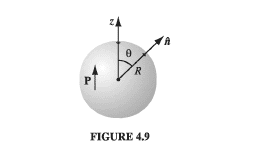
1599034816989.png

My attempt to the solution is like this:
$$V(\mathbf r) = \frac{1}{4 \pi \epsilon_o} \oint_{S} \frac{\sigma_b}{r}{da} $$, because ##\rho_b = 0##.

Then, ##\oint_{S} \frac{\sigma_b}{r}da= \int_0^ {\pi}\int_0^{2\pi} \frac{Pcos\theta}{R} R^{2}sin\theta d\theta d\phi##

I think the variable r is a constant because it is integrating over a surface; the r is fixed. However, it is not the case for the solution. Can anyone help?
 
Last edited:
Physics news on Phys.org
I don't think the integral formulation will necessarily help you; I believe it should be <br /> V(\mathbf{r}) = \int_S \frac{\sigma_b}{\|\mathbf{r} - \mathbf{r}&#039;\|}\,dS&#039; where the integration is with respect to the primed variable.

I would instead note that since \rho = 0 the potential satisfies \nabla^2 V = 0 in r &lt; R and r &gt; R.

I don't know enough EM to say what boundary condition it must satisfy at r = R due to the charged sphere (presumably Griffiths will tell you), but I suspect that it will end up being a condition of the form \frac{\partial V}{\partial r} = A\cos\theta for some constant A. That would suggest looking for solutions of the form V(r) = f(r) \cos \theta.
 
  • Like
Likes   Reactions: Tony Hau
pasmith said:
I don't think the integral formulation will necessarily help you; I believe it should be <br /> V(\mathbf{r}) = \int_S \frac{\sigma_b}{\|\mathbf{r} - \mathbf{r}&#039;\|}\,dS&#039; where the integration is with respect to the primed variable.

I would instead note that since \rho = 0 the potential satisfies \nabla^2 V = 0 in r &lt; R and r &gt; R.

I don't know enough EM to say what boundary condition it must satisfy at r = R due to the charged sphere (presumably Griffiths will tell you), but I suspect that it will end up being a condition of the form \frac{\partial V}{\partial r} = A\cos\theta for some constant A. That would suggest looking for solutions of the form V(r) = f(r) \cos \theta.
The Laplace's equation ##\nabla ^{2} V =0##, has the following solution in spherical coordinates: $$V = \sum_{l=0}^{\infty} (A_l r^l + \frac{B_l}{r^{l+1})P_{l}(cos\theta) $$.

The potential boundary condition can be calculated by letting ##V_{in} = V_{out}##. But I don't know as well how you can satisfy the boundary condition for this case. The book hasn't mentioned it.
 
Last edited:
pasmith said:
I don't think the integral formulation will necessarily help you; I believe it should be <br /> V(\mathbf{r}) = \int_S \frac{\sigma_b}{\|\mathbf{r} - \mathbf{r}&#039;\|}\,dS&#039; where the integration is with respect to the primed variable.

I would instead note that since \rho = 0 the potential satisfies \nabla^2 V = 0 in r &lt; R and r &gt; R.

I don't know enough EM to say what boundary condition it must satisfy at r = R due to the charged sphere (presumably Griffiths will tell you), but I suspect that it will end up being a condition of the form \frac{\partial V}{\partial r} = A\cos\theta for some constant A. That would suggest looking for solutions of the form V(r) = f(r) \cos \theta.
You are totally correct and smart! Thanks.
Here is the solution I have worked out:

The potetial for the interior of the sphere in spherical coordinates is: $$V_{in} = \sum_{l=0}^\infty A_l r^l P_l(cos\theta)$$

By the boundary condition that: $$V_{in} = V_{out}$$ and $$\frac{\partial V_{out}}{\partial r} - \frac{\partial V_{in}}{\partial r} = -\frac{\sigma}{\epsilon_o}$$ at ## r=R##, we obtain $$\sum_{l=0}^{\infty}(2l+1)A_l R^{l-1} P_l (cos\theta) = \frac {\sigma}{\epsilon_o}$$ $$= \frac{Pcos\theta}{\epsilon_o}$$

Obviously only the term for ##l=1## survives, and ##A_1 = \frac{P}{3\epsilon_o}##.

Subsituting ##A_1 = \frac{P}{3\epsilon_o}## into ##V_{in} = \sum_{l=0}^\infty A_l r^l P_l(cos\theta)##, we get $$V_{in}=\frac{P}{3\epsilon_o}r cos\theta$$
 
Last edited:
Having now checked my copy of Grant & Phillips, it appears that if \mathbf{D}_1 is the field inside the sphere and \mathbf{D}_2 the field outside then at r = R the condition is <br /> (\mathbf{D}_2 - \mathbf{D}_1) \cdot \mathbf{e}_r = \sigma with V continuous. In the absence of volume charge density we have \mathbf{D} = \epsilon_0\mathbf{E} = -\epsilon_0\nabla V.
 
  • Like
Likes   Reactions: Tony Hau

Similar threads

  • · Replies 1 ·
Replies
1
Views
4K
Replies
4
Views
5K
  • · Replies 6 ·
Replies
6
Views
3K
  • · Replies 1 ·
Replies
1
Views
2K
Replies
16
Views
2K
Replies
6
Views
4K
  • · Replies 6 ·
Replies
6
Views
1K
  • · Replies 19 ·
Replies
19
Views
3K
  • · Replies 5 ·
Replies
5
Views
1K
  • · Replies 1 ·
Replies
1
Views
2K