Solving a complex trigonometric equation

Click For Summary

Homework Help Overview

The discussion revolves around solving a complex trigonometric equation involving the sine function and hyperbolic cosine. The original poster is tasked with finding all solutions to the equation sin(z) = √(3) and plotting the solutions.

Discussion Character

  • Exploratory, Assumption checking, Problem interpretation

Approaches and Questions Raised

  • The original poster attempts to solve the equation by setting cosh(y) = √(3) after concluding that sin(x) ≠ √(3). Some participants question this reasoning, suggesting that the relationship between the equations needs to be reconsidered. There is discussion about the simultaneous nature of the equations and the implications of setting y = 0.

Discussion Status

Participants are actively engaging with the problem, exploring various interpretations and checking assumptions. Some have provided guidance on the relationships between the variables, while others are clarifying the implications of their findings. The discussion is ongoing, with participants working towards a better understanding of the problem.

Contextual Notes

There is a focus on the constraints of the equations involved, particularly regarding the values of x and y that satisfy both equations. The original poster is also navigating homework requirements that emphasize the need for exact answers and careful plotting of solutions.

frozenguy
Messages
186
Reaction score
0
Hi, thank you for looking.

Homework Statement


Solve the following complex equation and carefully plot at least 3 solutions for each. State ALL solutions to each! State exact answers!
Sin(z)=√(3)

The Attempt at a Solution


Here is my work.

I was a little confused how to tell what function from each case (A or B) I should set equal to solve for the variable. I found sin(x) ≠ √(3) so went with cosh(y)=√(3)

Since I had an answer for y I went with cos(x) = 0 for the next instead of sinh(y) = 0.

Is this a reasonable process?
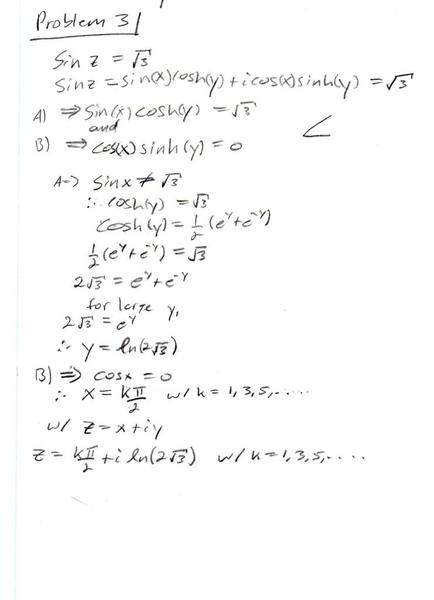

MATHW2prob3-1.jpg
 
Last edited:
Physics news on Phys.org
You have sin(x)cosh(y) = \sqrt 3. While it is true enough that
\sin(x) \ne \sqrt 3 why do you conclude that cosh(y) = \sqrt 3? You need to re-think that step and keep in mind that this is a simultaneous system of equations you are solving.
 
LCKurtz said:
You have sin(x)cosh(y) = \sqrt 3. While it is true enough that
\sin(x) \ne \sqrt 3 why do you conclude that cosh(y) = \sqrt 3? You need to re-think that step and keep in mind that this is a simultaneous system of equations you are solving.

Well I thought it was an odd step as well but it was similar to an example the professor did on the board..
I guess I don't know how else to approach the problem from there. You can't solve for/sub x or y between the imaginary and real parts can you?
 
Remember the x and y values you get must satisfy both equations. Since you can figure out what x and y can satisfy your second equation, that limits what you can try in the first equation.
 
Ok, well sinh(y)=0 therefore y=0.

But if y=0, then cosh(y)=1 and would require sin(x)=√(3)
 
frozenguy said:
Ok, well sinh(y)=0 therefore y=0.

But if y=0, then cosh(y)=1 and would require sin(x)=√(3)

Right, so that doesn't work. There are two things that make equation B work and you have just ruled out one for equation A. What about the other one?
 
Sinh(y)=0 only at y=0.

So cos(x)=0 at \frac{k\pi}{2} with k=1,3,5,...
But then its the same as the original assumption I made in A.
Because if I sub \frac{\pi}{2} for x in sin(x) I get 1. or -1 for k=3,7,11
 
Last edited:
frozenguy said:
Sinh(y)=0 only at y=0.

So cos(x)=0 at \frac{k\pi}{2} with k=1,3,5,...
But then its the same as the original assumption I made in A.
Because if I sub \frac{\pi}{2} for x in sin(x) I get 1. or -1 for k=3,7,11

Yes. So now you are getting close to understanding and giving me the answer to my original question in first post. You have shown that B is satisfied if either sinh(y) = 0 or cos(x) = 0. So those are the only candidates for A. Then you showed y = 0 doesn't lead anywhere. So now you have the only possible values for x, and hence for sin(x). Since sin(x) can be ±1, that both explains why you set that equation =\sqrt 3 in the first place and corrects it to using \pm\sqrt 3.

Also, another notation thing you might like is to write the values for x like this:

x = \frac \pi 2 + k\pi,\ k \hbox{ integer.}
to avoid the every other integer thing.
 
LCKurtz said:
Yes. So now you are getting close to understanding and giving me the answer to my original question in first post. You have shown that B is satisfied if either sinh(y) = 0 or cos(x) = 0. So those are the only candidates for A. Then you showed y = 0 doesn't lead anywhere. So now you have the only possible values for x, and hence for sin(x). Since sin(x) can be ±1, that both explains why you set that equation =\sqrt 3 in the first place and corrects it to using \pm\sqrt 3.

Also, another notation thing you might like is to write the values for x like this:

x = \frac \pi 2 + k\pi,\ k \hbox{ integer.}
to avoid the every other integer thing.

Ahh thank you.. It's clicking now.

So when I go about graphing this,
It will be a set of points spread apart by \frac{\pi}{2}+k\pi w/ k= int. at y=ln[2√(3)]Thank you again for your help.
 
Last edited:

Similar threads

Replies
9
Views
2K
  • · Replies 4 ·
Replies
4
Views
1K
  • · Replies 18 ·
Replies
18
Views
3K
Replies
2
Views
1K
  • · Replies 4 ·
Replies
4
Views
2K
  • · Replies 17 ·
Replies
17
Views
2K
  • · Replies 27 ·
Replies
27
Views
2K
Replies
7
Views
3K
Replies
5
Views
2K