Solving a parallel LC circuit with DC current

Click For Summary

Discussion Overview

The discussion revolves around analyzing a parallel LC circuit connected to a DC voltage source, focusing on the behavior of currents over time, particularly between the initial moment of connection and a steady state. Participants explore the mathematical modeling of the circuit, including the use of Laplace transforms and differential equations.

Discussion Character

  • Exploratory
  • Technical explanation
  • Debate/contested
  • Mathematical reasoning

Main Points Raised

  • One participant sets up equations to solve for the currents in the circuit but encounters complex integrals and seeks assistance.
  • Another participant suggests using Laplace transforms to analyze the circuit and mentions the oscillation of currents in the upper and middle wires.
  • A different participant emphasizes the need to differentiate equations to derive relationships between the currents and proposes using matrix methods to solve the system of equations.
  • There is a discussion about the nature of the currents, with some participants asserting that oscillations will occur due to the LC connection, while others express skepticism about oscillations in a DC circuit.
  • One participant questions the timing of oscillations and how the battery interacts with the circuit during these oscillations, seeking intuitive understanding.
  • Another participant clarifies that the oscillation of voltage across the capacitor and inductor will also affect the resistor and the DC source, implying an alternating current through these components.

Areas of Agreement / Disagreement

Participants express differing views on whether oscillations occur in a DC circuit with an LC connection. While some assert that oscillations will happen due to disturbances, others argue that in the long term, the circuit stabilizes without oscillations. The discussion remains unresolved regarding the exact nature and timing of these oscillations.

Contextual Notes

Participants note the complexity of the mathematical modeling involved, including the use of differential equations and Laplace transforms, and highlight the potential for confusion when applying these concepts to a DC circuit. There are also references to assumptions about the behavior of the circuit components over time.

Who May Find This Useful

This discussion may be of interest to those studying electrical engineering, circuit analysis, or anyone looking to understand the dynamics of LC circuits connected to DC sources.

DoobleD
Messages
259
Reaction score
20
Take the following circuit (capacitor initially not charged) :
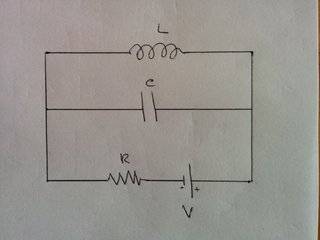
IMG_20151018_154550.jpg


I am trying to solve for the current everywhere as a function of time. I set up the following equations (are they right ?) :
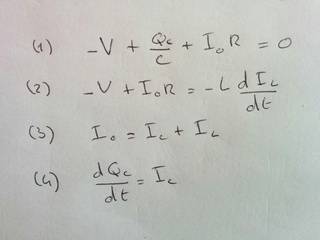
IMG_20151018_154920.jpg


Then, any way I try it, I end up with some messy integrals. Even using wolfram alpha to get those integrals solutions, I can't find out I_0 (current in the bottom wire with the battery), I_C (current in the middle wire with the capacitor), and I_L (current in the upper wire with the inductor) as functions of time.

I suspect it shouldn't be that messy, I must miss something somewhere. Can anyone solve this for me?

I understand that :

- at first (t = 0, battery just plugged) the current must be 0 in the inductor (upper wire) and equal to VR in the middle and lower wires
- after a long time (t = infinity), current must be 0 in the capacitor (middle wire) and equal to VR in the inductor (upper wire) and in the resistance (lower wire)

What I am trying to understand is what happens in between t = 0 and t = infinity.
 
Physics news on Phys.org
Do you know about Laplace transforms?

The impedance in the upper wire will be: sL.
In the middle wire: 1/sC.
In the lower wire: R.

Now, sketch a model of the circuit and solve the transfer functions as for the currents, when the battery is connected.
DoobleD said:
What I am trying to understand is what happens in between t = 0 and t = infinity.
The currents through upper and middle wire will oscillate.

The input function when you switch on the the battery will be: V/s. ( step function ).
 
Last edited:
It would help if you drew in the currents and labeled the potential drops across each element.

If you differentiate (1) and use (4), you get
$$\frac{dI_0}{dt} = \frac{1}{RC} I_C.$$ Then use (3) to eliminate ##I_C## to get
$$\frac{dI_0}{dt} = \frac{1}{RC} I_0 - \frac{1}{RC} I_L.$$ Rewriting (2) slightly gives
$$\frac{dI_L}{dt} = \frac VL - \frac RL I_0.$$ You can solve this system using matrix methods. Alternately, you can solve the bottom equation for ##I_0## and then substitute the result into the second equation to get a second-order differential equation for ##I_L##.
 
Hesch said:
Do you know about Laplace transforms?

I don't, sadly. Is it really necessary here?

Hesch said:
The impedance in the upper wire will be: sL.
In the middle wire: 1/sC.

Hmm, that looks like what I know, if you refer to s as the driving frequency. However, the voltage source here is DC, not AC.

Hesch said:
The currents through upper and middle wire will oscillate.

Are you sure? This is DC current. One thing seems pretty sure, at t = infinity, nothing oscillates. Do you mean there are oscillations before that time? Why? My guess would have been that the current trough the capacitor decreases continuously while it increases in the inductor.

vela said:
You can solve this system using matrix methods. Alternately, you can solve the bottom equation for I0I_0 and then substitute the result into the second equation to get a second-order differential equation for ILI_L.

Thanks. Sadly I don't know yet how to solve 2nd order differential equations. Do the matrix methods you refer need linear algebra? I don't know those as well. But nice to get the right equation to solve!
 
DoobleD said:
I don't, sadly.
Then forget about it.
But anyway:
DoobleD said:
Hmm, that looks like what I know, if you refer to s as the driving frequency. However, the voltage source here is DC, not AC.
S is not a driving frequency. Say you have a time function: f(t). If you Laplace transform it to f(s). Then:

L(df(t)/dt) = s*f(s)

and

L( ∫ f(t)dt ) = f(s)/s
DoobleD said:
Are you sure? This is DC current.
Yes I am. A LC-connenction will oscillate by any disturbance, such as beeing connected to a battery.
DoobleD said:
at t = infinity, nothing oscillates.
You are right because also the voltage across the LC will oscillate, thus giving some losses in the resistor. But if you disconnect the resistor just after the oscillation has started, the remaining LC-circuit will in principle oscillate forever, because no resistance is included in the coil.
DoobleD said:
My guess would have been that the current trough the capacitor decreases continuously while it increases in the inductor.
No, the energy will by turns be stored in L ( E = ½*L*I2 ) or in C ( E = ½*V2*C ). The current/voltage will overshoot all the time.
 
  • Like
Likes   Reactions: DoobleD
Thank you for the answers, and sorry for the delay.

Hesch said:
Yes I am. A LC-connenction will oscillate by any disturbance, such as beeing connected to a battery.

Ok. I kind of instinctively, and incorrectly, thought it was different with DC.

Hesch said:
You are right because also the voltage across the LC will oscillate, thus giving some losses in the resistor. But if you disconnect the resistor just after the oscillation has started, the remaining LC-circuit will in principle oscillate forever, because no resistance is included in the coil.

Ok. It's really hard to picture. With simple LC or RLC circuits in series, it's easier to understand. Is there some intuitive way to understand this ?

Some of my main interrogations are :

When does the oscillation starts ? Right after current starts to flow, inductance prevents current in the upper part, so does the oscillation really starts just after current is prevented, right when some of it starts to flow through the inductor ?
How does the battery reacts to this oscillation ? Does it recharge/discharge at each oscillation, while always discharging a little more at each cycle due to heat dissipated by R ?
 
With an oscillating voltage across C and L there will be that same voltage across R + the DC source. So, yes, this means an alternating current through R and through the voltage source.
 
  • Like
Likes   Reactions: DoobleD

Similar threads

  • · Replies 4 ·
Replies
4
Views
2K
  • · Replies 6 ·
Replies
6
Views
3K
  • · Replies 15 ·
Replies
15
Views
2K
Replies
152
Views
8K
  • · Replies 6 ·
Replies
6
Views
930
  • · Replies 7 ·
Replies
7
Views
3K
  • · Replies 4 ·
Replies
4
Views
3K
  • · Replies 27 ·
Replies
27
Views
17K
  • · Replies 22 ·
Replies
22
Views
2K
  • · Replies 28 ·
Replies
28
Views
2K