Solving a Water Pressure Problem: Gauge Pressure at B

Click For Summary

Discussion Overview

The discussion revolves around a water pressure problem involving the application of Bernoulli's equation to find the gauge pressure at point B in a fluid system. Participants explore the implications of fluid dynamics principles, particularly in the context of varying cross-sectional areas and the effects of side branches in a pipe system.

Discussion Character

  • Technical explanation
  • Debate/contested
  • Mathematical reasoning

Main Points Raised

  • One participant presents a calculation for the velocity at point B, suggesting that the velocity is 9.0 m/s based on the continuity equation.
  • Another participant challenges the initial calculation of velocity at B, asserting that there is no factor of 2 in Bernoulli's equation due to the nature of energy conservation in fluid flow.
  • A participant expresses uncertainty about the shape of the ducts, indicating that the lack of specification could affect the calculations.
  • It is noted that as long as the pipe cross sections are similar figures, the shape does not matter, and the ratio of areas is what is significant.
  • A question is raised regarding the distinction between pressure and the hydrostatic term in Bernoulli's equation, leading to clarification about their differences and the relevance of height differences.

Areas of Agreement / Disagreement

Participants express differing views on the application of Bernoulli's equation, particularly regarding the treatment of side branches and the calculation of velocities. There is no consensus on the correctness of the initial calculations or the implications of the pipe shapes.

Contextual Notes

Participants mention potential errors in the area calculations and the importance of specifying the shape of the ducts, which could influence the results. The discussion reflects uncertainty regarding the assumptions made in applying Bernoulli's equation.

Coop
Messages
40
Reaction score
0
Hi,

I am working on this water pressure problem,
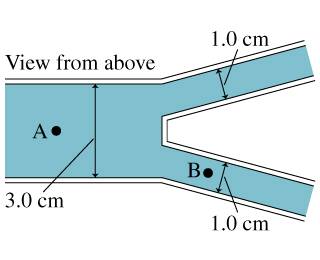
jfk.Figure.P13.34.jpg


given:

v_A = 2.0 \frac{m}{s}
gauge pressure_A = 50 kPa
the view is from above, no height changes

find: gauge pressure @ B

so,

A_Av_A=2(A_Bv_B)
1.5*10^{-2}m^2(2.0\frac{m}{s})=2(5*10^{-3}m^2v_B)
v_B=9.0\frac{m}{s}

Bernoulli's equation (w/o the \rho gh components bc height is constant):

p_A+\frac{1}{2}\rho _Av_A^2=p_B+\frac{1}{2}\rho _Bv_B^2

My question is, how come the right side of the equation is not 2(p_B+\frac{1}{2}\rho _Bv_B^2)? Shouldn't there be a coefficient of two, because the pipe splits in half?

Thanks
 
Physics news on Phys.org
1st: I think you made a mistake in the calculation of vB

2nd: No there is no factor of 2. why should there be one? Bernoulli equation is just the energy conservation for some parcel of water as if follows its path along the tubes. Side branches have no effect.
 
  • Like
Likes   Reactions: 1 person
dauto said:
Side branches have no effect.

Thanks

And what mistake do you think I made for v_B? It worked out giving me the right answer :o.
 
I got 3/s from the middle equation. May be the middle equation is wrong and the final result is correct. Hard to tell since you never specified the shape of the ducts (circular cross section I assume, but is it?).
 
dauto said:
I got 3/s from the middle equation. May be the middle equation is wrong and the final result is correct. Hard to tell since you never specified the shape of the ducts (circular cross section I assume, but is it?).

Oh you're right, sorry. Yeah they are circular pipes but I just wrote down the area incorrectly. I wrote down the pipes' radii for their area when I shouldn't wrote their radii^2*pi. Thanks for the help!
 
As long as the pipe cross sections are similar figures, the shape doesn't matter (assuming no turbulence) as it's only the ratio of the areas that counts.
The factor of two, because of two pipes, has been 'used' in the calculation of the output velocity.
Pressure and velocity are intensive variables so the number of pipes doesn't matter, once you've calculated the velocity.
 
  • Like
Likes   Reactions: 1 person
in bernoulli's equation P+ρ g h =constant , are P and ρ g h different ? aren't they the same? thanks.
 
In general, they are different.
In particular, h depends on the arbitrary definition of zero height. You can choose whatever you like, as only height differences have a physical relevance.
 

Similar threads

  • · Replies 14 ·
Replies
14
Views
2K
  • · Replies 7 ·
Replies
7
Views
1K
  • · Replies 67 ·
3
Replies
67
Views
6K
  • · Replies 3 ·
Replies
3
Views
2K
  • · Replies 32 ·
2
Replies
32
Views
12K
  • · Replies 1 ·
Replies
1
Views
3K
  • · Replies 4 ·
Replies
4
Views
2K
  • · Replies 3 ·
Replies
3
Views
2K
  • · Replies 13 ·
Replies
13
Views
24K
  • · Replies 4 ·
Replies
4
Views
6K