Sound waves produced by an aircraft

Click For Summary

Discussion Overview

The discussion revolves around the behavior of sound waves produced by an aircraft, particularly focusing on the differences in wavefront patterns when the aircraft is moving at or below the speed of sound. Participants explore concepts related to sonic booms and the nature of wavefronts in these scenarios.

Discussion Character

  • Exploratory
  • Technical explanation
  • Debate/contested

Main Points Raised

  • One participant suggests that sound waves from a stationary aircraft would spread uniformly in a spherical manner, while an aircraft traveling at the speed of sound would produce overlapping sound spheres.
  • Another participant questions the assumption that the aircraft is at the center of spherical wavefronts when moving slower than the speed of sound, noting that the aircraft's motion affects the position of the wavefronts.
  • A later reply acknowledges the oversight regarding the displacement of the aircraft affecting the wavefronts.
  • Participants discuss the transition of wavefronts from spherical to conical as the aircraft's speed increases.
  • There is a suggestion that sonic booms are a well-understood phenomenon, prompting questions about the necessity of creating new explanations.
  • One participant mentions the concept of the Mach angle, indicating a known phenomenon related to the discussion.

Areas of Agreement / Disagreement

Participants express differing views on the nature of wavefronts produced by moving aircraft, particularly regarding the effects of the aircraft's speed on the shape and position of these wavefronts. The discussion remains unresolved with multiple competing perspectives on the topic.

Contextual Notes

Some assumptions about the behavior of sound waves and the effects of the aircraft's motion on wavefronts are not fully explored, leading to potential gaps in understanding the phenomenon of sonic booms.

kent davidge
Messages
931
Reaction score
56
Suppose that an aircfract somehow is not moving. Then I would expect the sound waves it produces to spread out uniformely in a spherical fashion. Now imagine a airplane traveling at approximately the speed of sound. In this case, if the airplane produces a wave at point A and after a time T the sound sphere has a radius R, then at R the airplane will produce another sound wave. The centre of this later sound sphere would always lie at the surface of the earlier sound sphere, because both are traveling at the same speed. The result in a time lapse would be like this
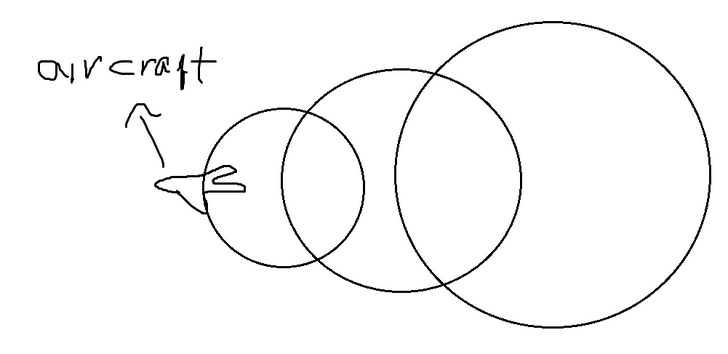
P4as5TQg.png


As opposed to this, an aircraft traveling at a lower than sound speed would draw a pattern like this
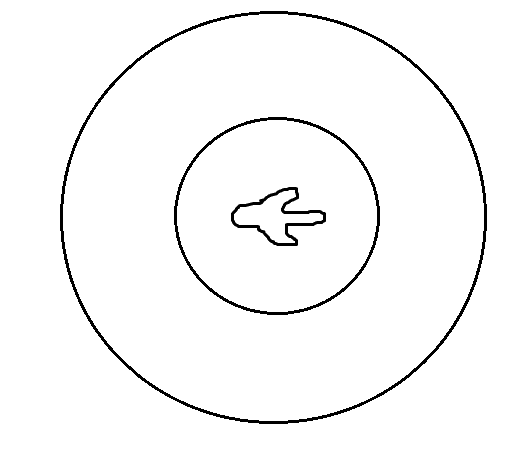
ZDJvdXn.png

The main difference being that the two sphere surfaces don't "meet".

Now this reasoning is from my nearly zero understanding of waves.This is an attempt to explain sonic boom in simple terms. I did a previous search on web to find out whether this is correct or not, but didn't find any pictures like these above.
 

Attachments

  • P4as5TQg.png
    P4as5TQg.png
    11.4 KB · Views: 747
  • ZDJvdXn.png
    ZDJvdXn.png
    2.8 KB · Views: 662
Physics news on Phys.org
Why do you think that, for the case of v<vsound, that the airplane is at the center of the spherical wavefronts? The wavefronts are traveling at the speed of sound in air, but the aircraft is also moving in one direction. So it should be closer to the wavefront in front of it than the wavefront behind it.

And each subsequent wavefronts are not "concentric" with the previous wavefronts, because the center of the source of sound (the airplane) have moved.

Zz.
 
ZapperZ said:
Why do you think that, for the case of v<vsound, that the airplane is at the center of the spherical wavefronts? The wavefronts are traveling at the speed of sound in air, but the aircraft is also moving in one direction. So it should be closer to the wavefront in front of it than the wavefront behind it.

And each subsequent wavefronts are not "concentric" with the previous wavefronts, because the center of the source of sound (the airplane) have moved.

Zz.
Oh yea, I should have considered the displacement of the airplane.
 
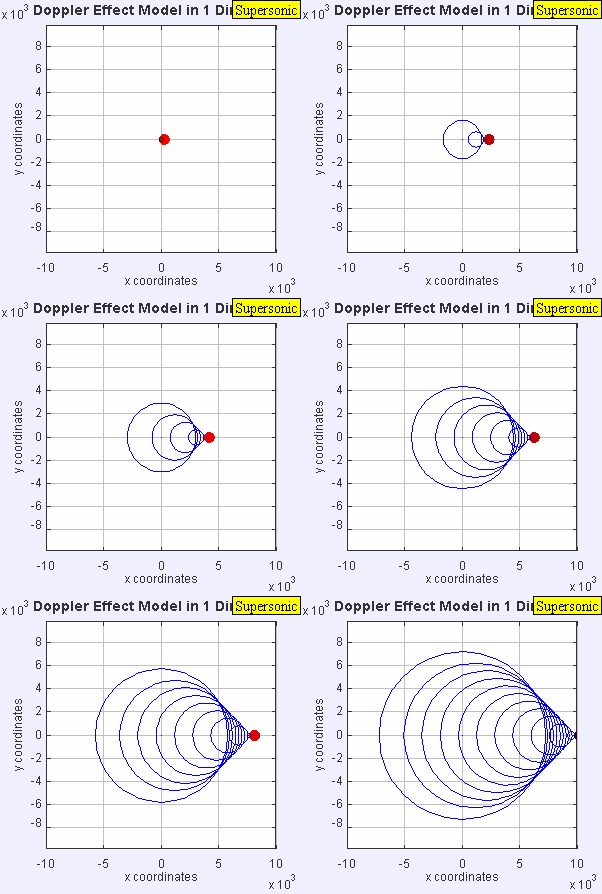
Does this animation answer your question?

[URL='http://By Lookang many thanks to Fu-Kwun Hwang and author of Easy Java Simulation = Francisco Esquembre - Own work said:
Dopplereffectsourcemovingrightatmach1.4.gif
 
anorlunda said:
Does this animation answer your question?
It helps. How can we use it to explain the sonic boom?
 
Another picture may help. Note how the character of the wave front changes from spherical to conical as the airplane speed increases.
http://www.bloodhoundssc.com/project/car/aerodynamics said:
sonic_boom%5B1%5D.jpg
 

Attachments

  • sonic_boom%5B1%5D.jpg
    sonic_boom%5B1%5D.jpg
    21.9 KB · Views: 1,117
kent davidge said:
It helps. How can we use it to explain the sonic boom?
Have you done any research on your own regarding sonic booms? They are a well understood phenomenon and there is plenty of information available so I don't understand why you think it is necessary to try to create a new explanation.
 
  • Like
Likes   Reactions: boneh3ad
kent davidge said:
It helps. How can we use it to explain the sonic boom?

You can't, but you have independently stumbled across the well-known phenomenon known as a Mach angle.
 

Similar threads

  • · Replies 31 ·
2
Replies
31
Views
5K
  • · Replies 5 ·
Replies
5
Views
3K
  • · Replies 11 ·
Replies
11
Views
6K
  • · Replies 19 ·
Replies
19
Views
8K
  • · Replies 4 ·
Replies
4
Views
3K
  • · Replies 3 ·
Replies
3
Views
2K
  • · Replies 2 ·
Replies
2
Views
2K
  • · Replies 10 ·
Replies
10
Views
3K
  • · Replies 8 ·
Replies
8
Views
2K
  • · Replies 49 ·
2
Replies
49
Views
5K