Stability and concavity of the entropy function

Click For Summary
SUMMARY

The discussion centers on the stability and concavity of the entropy function S(U) as described in Callen's thermodynamics framework. Participants highlight that a positive concavity in S leads to a negative temperature gradient (dT/dU < 0), which contradicts thermodynamic principles. The conversation emphasizes the importance of understanding convexity and concavity in functions, particularly in relation to isolated systems that do not reach thermal equilibrium, resulting in internal inhomogeneities. The implications of these concepts are critical for accurately interpreting thermodynamic behavior.

PREREQUISITES
  • Understanding of thermodynamic principles, specifically entropy and temperature relationships.
  • Familiarity with convex and concave functions in mathematical contexts.
  • Knowledge of isolated systems and thermal equilibrium concepts.
  • Basic grasp of differential calculus as it applies to thermodynamic equations.
NEXT STEPS
  • Study the implications of convexity and concavity in thermodynamic functions.
  • Review the derivation and significance of equation dS/dU = 1/T in thermodynamics.
  • Explore the concept of internal inhomogeneities in thermodynamic systems.
  • Investigate the relationship between entropy changes and thermal equilibrium in isolated systems.
USEFUL FOR

This discussion is beneficial for physicists, thermodynamicists, and students studying advanced thermodynamics, particularly those focusing on entropy, stability, and the mathematical foundations of thermodynamic functions.

Est120
Messages
54
Reaction score
3
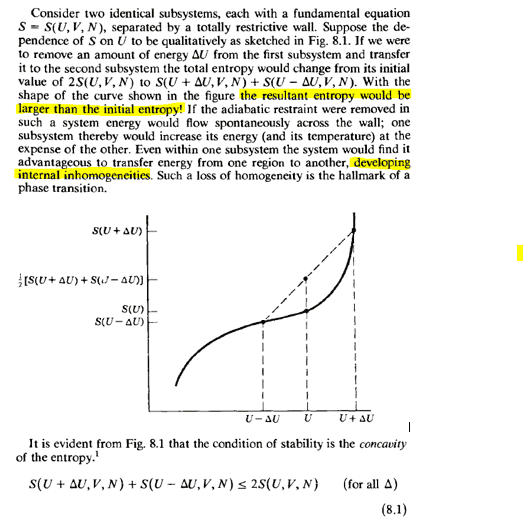
I am struggling to understand Callen's explanation for stability, I understand that the concavity of S(U) must be negative because otherwise we can show that this means that the temperature increases as the internal energy decreases (dT/dU<0) but I cannot understand equation (8.1) which basically says that the entropy must decrease and if the system is isolated that is absurd, in addition to what it refers to with "internal inhomogeneities"

the worst thing is that the text says that it is evident, it is geometrically clear, but what physical meaning does a final entropy resulting less than the initial one have? imagining 2 bodies isolated from the outside

I honestly believe that only the author understood that book
Callen stability.png
 
Science news on Phys.org
@Est120

Right, not an explanation that is simply followed, since it is a bit brief.
Anyways, the graph is an example of how the system does not work.
Note that for the graph, if the two isolated systems start out at U-ΔU and at U+ΔU, they never come to equilibrium, as they are at a ( maximal ) entropy greater than that at state U.

This is more of a mathematical problem in convexity rather than that of just for entropy

You should review convexity of functions for more understanding.
And how some definitions with what one is familiar with may not be that which another interprets.

Equation 8.1 does not represent the graph, which can be said to be convex or concave depending upon whether one wants to add the words upwards or downwards.

See the example which has :
1606620973685.png

( or cancave upward )

in
https://www.math24.net/convex-functions/

or
https://www.ge.infn.it/~zanghi/FS/ConvexThermoTEXT.pdf

You could search also for concavity of entropy, and you might come up with something better.
 
correct let me see if I understand, as they are identical systems in theory they should reach thermal equilibrium in U but that would mean a lower total entropy which cannot happen (considering the 2 subsystems isolated from the outside) so they stay as they are? also it is an easy proof to show that a positive concavity in S implies dt/dU <0 which is nonsense but i can't understand what callen's tries to say with "internal inhomogeneities" anyway your explanation is pretty good
 
Est120 said:
correct let me see if I understand, as they are identical systems in theory they should reach thermal equilibrium in U but that would mean a lower total entropy which cannot happen (considering the 2 subsystems isolated from the outside) so they stay as they are? also it is an easy proof to show that a positive concavity in S implies dt/dU <0 which is nonsense but i can't understand what callen's tries to say with "internal inhomogeneities" anyway your explanation is pretty good
@Est120
The two isolated systems not reaching equilibrium is the counter proof, resulting in the concept that S(U ) is concave. Inhomogeneties ( pockets of increased density, condensation, .. ) would be a consequence of the counterproof. The energy in the counterproof can result in being not spread evenly across the system.

a positive concavity in S implies dt/dU <0
dS/dU = 1/T --> the slope of the S(U) function is 1/T

We have two isolated systems prepared to be identical.
1606806087865.png

The S curve S(U, V , N ) for both isolated systems is as given in the graph, each with an internal energy U and entropy S. Removing, or adding an amount of E from either system, will affect the internal energy of either system giving U1 and U2. The entropy will move along the curve to S1 and S2 respectively.( This act can be either reversible - moving along the curve-, or irreversible - not along the curve for intermediate states-, but in either case the final state 1 and 2 will be the same reversible of irreversible ).

For a stable system, as Callen states,
1606807052112.png


You could put some numbers in there such as S1 = 1, S2 = 5 and S = 4
S1 +S2 ? 2S
1 +5 < 8
Surely this would not happen spontaneously for a stable system, as the entropy has decreased.
For isolated systems, the entropy is constant or can increase.

Going the other way, with a hotter and colder systems in contact, reaching equilibrium, the entropy would increase. The lower temperature S1 dominates over the higher temperature S2.

( Hopefully I have my ups and downs correct, as I think this is a difficult subject to keep straight, even though it should be straight forward, it really isn't )
 

Similar threads

  • · Replies 13 ·
Replies
13
Views
4K
  • · Replies 2 ·
Replies
2
Views
421
  • · Replies 4 ·
Replies
4
Views
3K
  • · Replies 4 ·
Replies
4
Views
3K
Replies
5
Views
595
  • · Replies 2 ·
Replies
2
Views
2K
  • · Replies 1 ·
Replies
1
Views
2K
  • · Replies 22 ·
Replies
22
Views
6K
  • · Replies 2 ·
Replies
2
Views
2K
  • · Replies 3 ·
Replies
3
Views
4K