Static friction between two stacked blocks a 3rd law pair?

Join the discussion
Registration is free. Ask a follow-up in this thread, or start your own.
8 replies · 5K views
jmoney
Messages
2
Reaction score
0
I'm trying to get my head around this scenario:
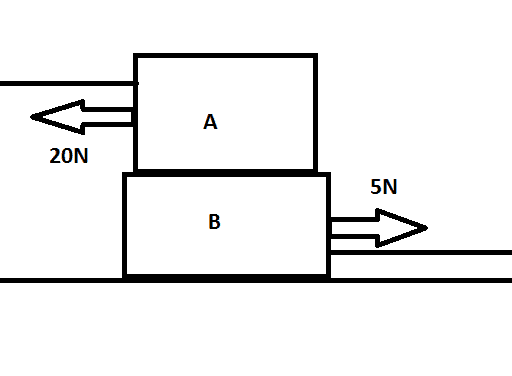
2yjrmfs.png


The blocks are at rest, despite the tension forces acting on them.
It is obvious that the static friction acting on A from B is 20N to the right for A to remain at rest (the max might be a lot higher).

But does this produce an equal and opposite reaction on B? It seems to me that the static friction should have some reaction... but it also seems silly to think that A could exert a leftward force on B when A isn't even moving.

Are the forces acting on B (before possible floor friction)
20N <--- B --> 5N or just B--->5N

Thank you, and I hope I have been clear enough! This is my first post on this forum.
 
Physics news on Phys.org
it also seems silly to think that A could exert a leftward force on B when A isn't even moving.
Why "silly"?

You are told that the blocks are stationary?
Than means the net force on A is zero ... so what are the forces on A?

Note: if the forces are not strong enough to overcome static friction - doesn't that mean the two blocks are stuck together?
 
Okay, "silly" was a poor choice. I think that the static force from B to A that holds A in place applies an opposite force on B.

Assuming that is the case, and they're stationary:

A is stationary because the vertical net force is Fn-Fg=0, and horizontally because of Fsf-Ft=0.
B is also stationary, the vertical forces are Fn(floor)-Fn(A)-Fg=0,
horizontally: Ft-Fsf(reaction from A)=-15, but it must be 0.
So there is either 15N of static friction from the floor, or, there could be another static force that is keeping B from moving left; and the floor could be frictionless in that case.

Would the reaction force from the static friction acting on A still be considered static friction for B? Can B have static friction acting in both directions?
 
Last edited:
jmoney said:
Would the reaction force from the static friction acting on A still be considered static friction for B?
Sure. Think of the friction force as an interaction between two objects: A and B exert a static friction force on each other.

Can B have static friction acting in both directions?
Why not? The two friction forces acting on B would act on different surfaces.
 
Additional notes:
1. friction of A on B and friction of B on A are not action/reaction pairs.
2. how does the situation change if the blocks were nailed together?
3. if the blocks were not stationary - but both moving with the same constant velocity wrt the floor - how would that change your analysis?
 
Simon Bridge said:
Additional notes:
1. friction of A on B and friction of B on A are not action/reaction pairs.
Why do you say that?
 
Simon Bridge said:
Could be a source of the puzzlement ... 3rd-law pairs don't cancel out.
True. But why did you say:
Simon Bridge said:
Additional notes:
1. friction of A on B and friction of B on A are not action/reaction pairs.