jonjacson
- 450
- 38
Hi to everybody.
I´m reading a book about statics and I cannot understand this chapter. I have been calculating moments of forces in hundreds of problems, when I found a force acting on a body I needed to fix a coordinate system, then calculating the moment arms of that force around a point and then using the equation M= r x f, or M=fd if it was a simple case on a plane.
Now they start talking about calculating the center of gravity and using the moments principle (the sum of the moments has a resultant that passes through the center of gravity) they give this equation:
x = ∫xdw/ W
The point is that x is the moment arm of the force dw (differential weight) around the x-axis if I am right.
Well if that is true, What is the meaning of this advice some pages later in the book?
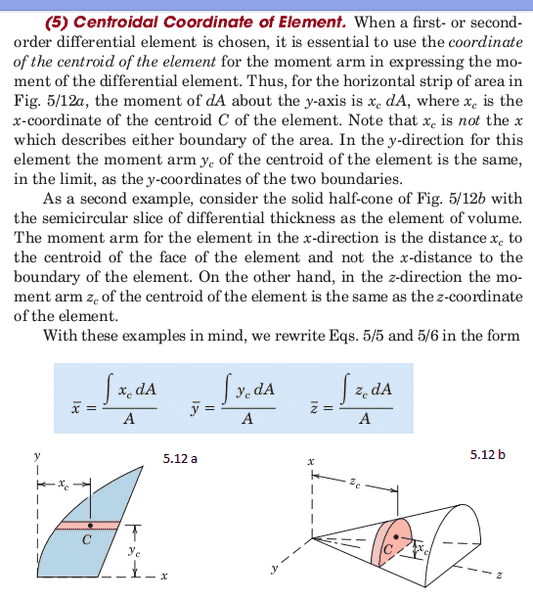
I see the logic, you need to use the coordinate of the centroid of the differential element when you are integrating, but I cannot understand examples 5.12 a, and 5.12 b.
In the first example the only option to see any logic for those moment arms is assuming that the gravity is acting on the z axis at point C. Until here it could be right.
But now I cannot understand in any way example 5.12 b, it says that the moment arm of the differential element has a moment arm of xc around axis x, if that is true WHat is the axis in which the gravity is acting??
There are three options:
1.- If gravity acts on the x-axis to point C, we have a force parallel to the x-axis so the moment is zero, this cannot be the case.
2.- If gravity acts on the y-axis to point C, the moment arm is zc but the book says clearly that zc is not the moment arm, that it is xc, so this cannot be the case.
3.- So the only option should be gravity acting on the z axis to point C, but that would cross the x-axis since due to symmetry around z axis.
So I understand you need to use the centroids of the differential elements, not the boundaries, but in this case I cannot see in any way that zc is the moment arm around x-axis for that element.
Does anybody know the line of action of the gravity in that example? And what about the moment arms of the element of 5.12 b?
Maybe I´m confused and it has some logic, but now I cannot understand this.
I´m reading a book about statics and I cannot understand this chapter. I have been calculating moments of forces in hundreds of problems, when I found a force acting on a body I needed to fix a coordinate system, then calculating the moment arms of that force around a point and then using the equation M= r x f, or M=fd if it was a simple case on a plane.
Now they start talking about calculating the center of gravity and using the moments principle (the sum of the moments has a resultant that passes through the center of gravity) they give this equation:
x = ∫xdw/ W
The point is that x is the moment arm of the force dw (differential weight) around the x-axis if I am right.
Well if that is true, What is the meaning of this advice some pages later in the book?
I see the logic, you need to use the coordinate of the centroid of the differential element when you are integrating, but I cannot understand examples 5.12 a, and 5.12 b.
In the first example the only option to see any logic for those moment arms is assuming that the gravity is acting on the z axis at point C. Until here it could be right.
But now I cannot understand in any way example 5.12 b, it says that the moment arm of the differential element has a moment arm of xc around axis x, if that is true WHat is the axis in which the gravity is acting??
There are three options:
1.- If gravity acts on the x-axis to point C, we have a force parallel to the x-axis so the moment is zero, this cannot be the case.
2.- If gravity acts on the y-axis to point C, the moment arm is zc but the book says clearly that zc is not the moment arm, that it is xc, so this cannot be the case.
3.- So the only option should be gravity acting on the z axis to point C, but that would cross the x-axis since due to symmetry around z axis.
So I understand you need to use the centroids of the differential elements, not the boundaries, but in this case I cannot see in any way that zc is the moment arm around x-axis for that element.
Does anybody know the line of action of the gravity in that example? And what about the moment arms of the element of 5.12 b?
Maybe I´m confused and it has some logic, but now I cannot understand this.