Stoke's Theorem: Can't Solve (b)? Get Answers Now!

  • Thread starter Thread starter chickens
  • Start date Start date
  • Tags Tags
    Theorem
Click For Summary

Homework Help Overview

The discussion revolves around the application of Stoke's Theorem, specifically focusing on a practice problem involving integration over a triangular region in the xy-plane. Participants are attempting to resolve discrepancies in their calculations for part (b) of the problem, while part (a) has been successfully addressed by some.

Discussion Character

  • Exploratory, Assumption checking, Problem interpretation

Approaches and Questions Raised

  • Participants are questioning the definition and application of the differential area element ds, with some suggesting that it should include a vector component. Others are exploring the implications of integrating over different geometric shapes, such as circles versus triangles.

Discussion Status

There is an ongoing examination of the correct setup for the integration, with some participants providing guidance on how to approach the problem by breaking the triangle into sides and considering parametric equations. Multiple interpretations of the contour direction and area element are being discussed, indicating a productive exploration of the topic.

Contextual Notes

Participants note confusion stemming from the geometric setup and the specific limits of integration required for the triangular region, as well as references to tutorial examples that differ from the current problem.

chickens
Messages
29
Reaction score
0
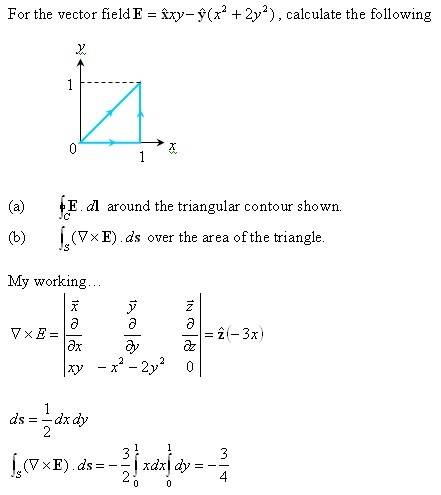
Hi guys... I'm stuck in this question. Its not a homework nor coursework, just practice. The answer for both is the same, that is -1 ...I'm able to get (a) but (b) ... still wondering what went wrong. Please enlighten me. Thanks in advance.
vectorhelp.jpg
 
Last edited:
Physics news on Phys.org
That ds=dxdy/2 part.. it's not how it works. what if I wanted to integrate over a circle? would you take ds=pi (dx²+dy²)?
 
chickens said:
Hi guys... I'm stuck in this question. Its not a homework nor coursework, just practice. The answer for both is the same, that is -1 ...I'm able to get (a) but (b) ... still wondering what went wrong. Please enlighten me. Thanks in advance.
View attachment 8120

Also, how can you say this:
ds = 1/2dxdy

You are saying that ds is a vector. Yet, 1/2dxdy is not.
 
sorry... that ds suppose to have z_hat with it
 
quasar987 said:
That ds=dxdy/2 part.. it's not how it works. what if I wanted to integrate over a circle? would you take ds=pi (dx²+dy²)?

i'm not sure about the ds part as usually there is this table i would refer to, and it says ds = dxdy z_hat but ... I've also tried doing using it, i won't get the same answer.


If need to integrate over a circle, transform the vector to cylindrical type and use cylindrical variables r phi z to get it?
 
In tutorial classes, they gave a semicircle and that was quite easy to get it... but this geometrical shape triangle... is my first time trying it, and i got so say... its cracking my head (i know its simple stuff...but i really don't get where went wrong)
 
First, at least one of the arrows in your picture is going the wrong way. I suspect that your contour is supposed to go FROM (1, 1) T0 (0, 0), not the otherway round as you have it.

[itex]d\vec{S}[/itex] is NOT "[itex]\frac{1}{2} dxdy \vec{z}[/itex]". The fact that you are integrating over a triangle has nothing to do with the differential of area (everything to do with limits of integration!). Since this is in the xy-plane, [itex]d\vec{S}= dxdy \vec{z}[/itex]. The integral is NOT for [itex]0\le x\le 1[/itex], [itex]0\le y\le 1[/itex]; that would be over the unit square. You want to integrate over the triangle with boundaries y= 0, x= 1, y= x.

For part (b) break the triangle into the three sides. Write parametric equations for each.
 
HallsofIvy said:
First, at least one of the arrows in your picture is going the wrong way. I suspect that your contour is supposed to go FROM (1, 1) T0 (0, 0), not the otherway round as you have it.

[tex]d\vec{S}[/tex] is NOT "[tex]\frac{1}{2} dxdy \vec{z}[/tex]". The fact that you are integrating over a triangle has nothing to do with the differential of area (everything to do with limits of integration!). Since this is in the xy-plane, [tex]d\vec{S}= dxdy \vec{z}[/tex]. The integral is NOT for [tex]0\le x\le 1[/tex], [tex]0\le y\le 1[/tex]; that would be over the unit square. You want to integrate over the triangle with boundaries y= 0, x= 1, y= x.

For part (b) break the triangle into the three sides. Write parametric equations for each.

yup...sorry... the contour suppose to go from (1,1) to (0,0) thanks for the mistake pointed out :)
 
anyway...mind reedit the latex thing... can't seem to get them =_=
 

Similar threads

  • · Replies 4 ·
Replies
4
Views
2K
  • · Replies 1 ·
Replies
1
Views
1K
  • · Replies 6 ·
Replies
6
Views
3K
  • · Replies 3 ·
Replies
3
Views
2K
  • · Replies 21 ·
Replies
21
Views
4K
  • · Replies 6 ·
Replies
6
Views
3K
  • · Replies 5 ·
Replies
5
Views
2K
Replies
6
Views
2K
Replies
7
Views
2K
  • · Replies 1 ·
Replies
1
Views
3K