The Minimum voltage requirement for an RC Oscillator

Click For Summary
SUMMARY

The minimum voltage requirement for an RC oscillator using a 2N3904 transistor is at least 5V to ensure proper operation. The circuit's design must account for DC biasing, with a voltage divider setting the base bias voltage. A rough calculation indicates that the base voltage is insufficient at lower voltages, and simulations suggest that the circuit does not oscillate until the supply voltage reaches approximately 8V. Adjustments to component values, such as the emitter capacitor and resistor, are necessary to achieve stable oscillation at lower frequencies.

PREREQUISITES
  • Understanding of transistor operation and biasing, specifically for 2N3904.
  • Knowledge of RC oscillator design principles and phase shift networks.
  • Familiarity with circuit simulation tools, such as SPICE.
  • Ability to perform voltage measurements across circuit components.
NEXT STEPS
  • Learn about DC biasing techniques for transistor circuits.
  • Study the effects of component values on oscillator performance.
  • Explore circuit simulation software to analyze oscillator behavior.
  • Investigate methods for increasing gain in RC oscillators.
USEFUL FOR

Electronics enthusiasts, circuit designers, and engineers working on oscillator circuits or troubleshooting transistor-based designs.

leehyong
Messages
1
Reaction score
1
Hi
I am trying to run an RC oscillator using a 2N3904
(Datasheet for reference: http://www.kynix.com/uploadfiles/pdf8798/2N3904.pdf)
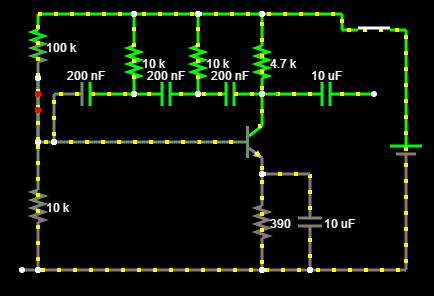
The circuit looks like the following.
kdsq5.png


I want to run it at 0-5v but I failed, I assume it is because the voltage is not high enough?

What would you expect the minimum voltage requirement to be for this type of circuit.

 
  • Like
Likes Delta2
Engineering news on Phys.org
Did you DESIGN the circuit based on some assumptions/requirements for th DC operational point?
Did you recalculate this operational point? Do you know (from oscillator theory) how much gain is necessary?
 
leehyong said:
I assume it is because the voltage is not high enough?
Hi leehyong. :welcome:

Possibly it could be insufficient supply voltage.

Two independent set of conditions must be met. The first involves DC biasing: if you remove all of the capacitors from the circuit then what you are left with must set the transistor's operation comfortably within its active region (linear amplifying).

⏩ Are you able to analyse the circuit with all capacitors missing to determine the expected DC voltage at its 3 nodes?

What do you plan to use the oscillator for?
 
NascentOxygen said:
Possibly it could be insufficient supply voltage.
That`s for sure.
A rough calculation of the base voltage (forgetting the base current) gives only app. VB=5*10/110<0.5 volts.
 
The 100k : 10k voltage divider sets the transistor base bias voltage.
It will need at least a 5V supply before the transistor begins to turn on.
I would remove the 10k between the base and ground then find a minimum voltage.
 
With a little tweaking of component values this should easily run on 5 volts.
 
Averagesupernova said:
With a little tweaking of component values this should easily run on 5 volts.
Yes - of course. Therefore my question in post#2 if the OP has designed the circuit.
 
There are a number of problems with this circuit, all of which conspire to prevent oscillation. One is the time it takes to start, if it ever does. Spice simulation shows it does not start until the supply voltage reaches about 8V.

Another problem is the gain of the transistor amplifier needed to overcome the losses in the phase shift network at the frequency of operation. The emitter capacitor needs to be increased to raise the gain at lower frequencies. Scaling the frequency down by increasing the capacitors in the feedback circuit necessitates increasing the emitter capacitor to restore that gain. That was not done with the OP circuit.

The emitter resistor needs to be reduced to enable the transistor amplifier to drive greater loads on the output without killing the oscillation.
 
  • #10
I am always surprised when - as in the present case - somebody seems to have a problem and is asking for help, but is not willing to give requested additional information. Even worse - sometimes it seems that he is not interested anymore. Really a bad behaviour.
 
  • Like
Likes sophiecentaur
  • #11
Measure the volts across the 390R in the Emitter. It should be more than Zero, which it will be if the transistor does not turn on. (due to wrong base bias volts)
If you disconnect the 10k resistor in the base, the Emitter Volts should go to a non zero value. From the diagram, it looks like a simulation.
Please take note of the above post (from LvW), if you want any more help . . . . . ever.
 

Similar threads

  • · Replies 41 ·
2
Replies
41
Views
7K
  • · Replies 5 ·
Replies
5
Views
4K
  • · Replies 27 ·
Replies
27
Views
3K
  • · Replies 5 ·
Replies
5
Views
3K
Replies
3
Views
2K
  • · Replies 2 ·
Replies
2
Views
2K
  • · Replies 6 ·
Replies
6
Views
2K
  • · Replies 38 ·
2
Replies
38
Views
23K
  • · Replies 8 ·
Replies
8
Views
2K
  • · Replies 25 ·
Replies
25
Views
4K