Thevenin equivalent diamonda shaped

Click For Summary

Discussion Overview

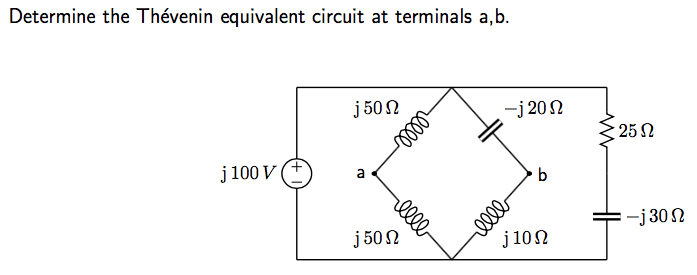
The discussion revolves around finding the equivalent resistance (Req) and Thévenin equivalent of a diamond-shaped circuit configuration. Participants express challenges in identifying parallel and series components within the circuit, particularly when visualizing the connections and nodes.

Discussion Character

  • Technical explanation
  • Debate/contested
  • Mathematical reasoning

Main Points Raised

  • One participant expresses difficulty in determining which components are in parallel and which are not, particularly in the diamond shape configuration.
  • Another participant suggests that the impedance of 25 - j30Ω is in parallel with a wire, indicating a potential simplification.
  • A different viewpoint emphasizes that the shape of the circuit is irrelevant; instead, one should focus on identifying nodes to determine parallel connections.
  • There is a suggestion to avoid short-circuiting the voltage source and to label points in the circuit for clarity.
  • One participant proposes a method for calculating the equivalent impedance by converting impedances to admittances and summing them, then converting back to impedance.
  • Another participant notes that determining the Thévenin voltage is also necessary in addition to finding the equivalent impedance.

Areas of Agreement / Disagreement

Participants express differing opinions on whether to short-circuit the voltage source, with some agreeing that it should not be done while others suggest it may lead to simplifications. The discussion includes multiple competing views on how to approach the problem, and no consensus is reached on a single method or solution.

Contextual Notes

Some participants express confusion regarding the identification of nodes and the relationships between components, indicating a potential limitation in understanding the circuit's configuration. There are unresolved mathematical steps in the proposed methods for calculating equivalent impedance.

DottZakapa
Messages
239
Reaction score
17
Mod Note: thread moved from technical forum, so homework template is missing
Screen Shot 2017-02-11 at 20.42.07.png


Hi every one! I am encountering difficulties on finding the Req. in the sense that i can't really see which is in parallel end which is not, especially on the diamond shape. I haven't really understood how to treat such cases.
I short circuit the voltage source,
the Z=(25-j30)Ω is in parallel with?
Could please anyone help me figure out how to approach such configurations once and for all?
Thank you
See attachment
 
Physics news on Phys.org
25 - j30 would be in parallel with a wire. Wouldn't you agree? :oldwink:
 
DottZakapa said:
Could please anyone help me figure out how to approach such configurations once and for all?
FORGET about the shape of the circuit as drawn. It's totally irrelevant. Just look at every node. Find elements that both end in the same 2 nodes. They are parallel.
 
Averagesupernova said:
25 - j30 would be in parallel with a wire. Wouldn't you agree? :oldwink:
I agree, the parallel would give zero, then i'll have ( -j20 || j10 ) + ( j50 || j50 ) am I right?
 
phinds said:
FORGET about the shape of the circuit as drawn. It's totally irrelevant. Just look at every node. Find elements that both end in the same 2 nodes. They are parallel.
When I see nodes in between like A B i get lost
 
DottZakapa said:
I agree, the parallel would give zero, then i'll have ( -j20 || j10 ) + ( j50 || j50 ) am I right?
That is the way I see it.
 
DottZakapa said:
I short circuit the voltage source,
DO NOT short circuit the voltage source.
Label the point on the RHS between 25 and -j30 with a “c”.

The j100 V source is then connected to three separate current paths, that are in parallel with each other. Each of those parallel paths has a mid-point, now labelled a, b or c.
Each path has two components in series. Like resistors, series impedances add, so the three impedances, (named after their midponts), become;
Za = 0 +j (50+50)
Zb = 0 +j (10–20)
Zc = 25 +j (–30)
Note: The current that flows in each of those parallel paths will be ( 0 –j 100 ) / Z.

To solve parallel impedances, convert them to admittances by taking their complex reciprocals, then add those admittances to get the total admittance. Convert that admittance with another reciprocal back to impedance, giving you the Zeq of all three parallel paths.
1/Zeq = 1/Za +1/Zb +1/Zc
 
Last edited:
Baluncore said:
DO NOT short circuit the voltage source.
Label the point on the RHS between 25 and -j30 with a “c”.
The task is to determine the Thévenin equivalent between points a and b.
 
  • Like
Likes   Reactions: Averagesupernova
DottZakapa said:
I agree, the parallel would give zero, then i'll have ( -j20 || j10 ) + ( j50 || j50 ) am I right?
That's half the task solved. Besides impedance you also need to determine the Thévenin voltage.
 
  • Like
Likes   Reactions: Averagesupernova

Similar threads

  • · Replies 5 ·
Replies
5
Views
3K
  • · Replies 1 ·
Replies
1
Views
2K
  • · Replies 12 ·
Replies
12
Views
3K
  • · Replies 6 ·
Replies
6
Views
2K
  • · Replies 7 ·
Replies
7
Views
3K
  • · Replies 35 ·
2
Replies
35
Views
6K
  • · Replies 9 ·
Replies
9
Views
5K
  • · Replies 10 ·
Replies
10
Views
3K
Replies
9
Views
2K
  • · Replies 9 ·
Replies
9
Views
6K