Thevenin Voltage Value Homework

Click For Summary
The discussion revolves around calculating Thevenin voltage and resistance in a circuit involving a zener diode. Theoretical resistance values were derived based on the arrangement of resistors, with some confusion about the actual measured voltage of 3.75 V compared to expected values. Participants debated the correct configuration of resistors and the implications of the zener diode's breakdown voltage of 6.2 V. A key point raised was the need to clarify resistor values, particularly R4, which might have been misidentified, affecting voltage calculations. Ultimately, the conversation highlights the importance of accurate component values and understanding circuit configurations for effective analysis.
  • #31
Here's another rendering of your circuit with the components rearranged into a more common pattern:
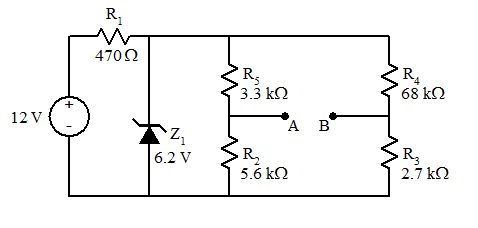
Fig1.png


If the zener is replaced by a short (not a bad approximation since it should have a zener resistance of just a few Ohms when in "zener mode") can you reevaluate your method for determining the Thevenin resistance?
 
  • Like
Likes mrowa196
Physics news on Phys.org
  • #32
Great, that diagram of yours explains everything about the voltage.

The method for determining the Thevening resistance from my lecture notes is here:
Zrzut ekranu 2016-01-05 o 00.59.17.png

In the original circuit there is voltage source on the left, so you ignore it, look at the circuit from the right and then 6 Ohm is in series with 2 Ohm and 3 Ohm in parallel.
 
  • #33
Yes, that's a good example. Now, what do you make of the circuit in question? When the zener is replaced by a short, what opportunities for combining resistors do you find?
 
  • #34
I still see it as in the beginning: R4 and R5 are in series and parallel to R2 and R3 which are in series :/
 
  • #35
mrowa196 said:
I still see it as in the beginning: R4 and R5 are in series and parallel to R2 and R3 which are in series :/
Nope. R3 and R4 can't be in series because the zener also connects to their junction. Same goes for R4 and R5.

Look for resistor pairs whose terminals share the same connections (pay attention to the "short" that the zener now represents!).

When in doubt take some highlighter pens and color code the separate nodes. Look for resistors with the same two node connections (color pairs).
 
  • #36
How did you get 470Ω here?

fig1-png.94003.png

According to the simulation I ran, I got 400Ω there.
Screenshot_2016-01-05-06-35-42.png
 
  • #37
cnh1995 said:
How did you get 470Ω here?
I read the color code on the resistor in the provided image :smile:
 
  • #38
gneill said:
I read the color code on the resistor in the provided image :smile:
Oh..!:smile:Beause I could not theoretically determine R1. But once the zener is shorted, R1 won't be a part of the circuit, right?
 
  • #39
cnh1995 said:
Oh..!:smile:Beause I could not theoretically determine R1. But once the zener is shorted, R1 won't be a part of the circuit, right?
Right. That's a valid approximation since the zener resistance is small compared to the other resistances in the circuit. So R1 will effectively be shorted, too.

In a more stringent analysis, one might find the resistance of the zener under operating conditions to be, say ten Ohms or so. Maybe less. Maybe a tad more. If it came down to such details then you'd look for a datasheet for the particular zener and pull up a value from there.
 
  • Like
Likes cnh1995
  • #40
gneill said:
Right. That's a valid approximation since the zener resistance is small compared to the other resistances in the circuit. So R1 will effectively be shorted, too.

In a more stringent analysis, one might find the resistance of the zener under operating conditions to be, say ten Ohms or so. Maybe less. Maybe a tad more. If it came down to such details then you'd look for a datasheet for the particular zener and pull up a value from there.
Right!
 
  • #41
How about R3 being in parralel with R4, but in series with R2 and R5 in parralel? That gives me something about 4.5 after quick calculation.
 
  • Like
Likes NascentOxygen
  • #42
mrowa196 said:
How about R3 being in parralel with R4, but in series with R2 and R5 in parralel? That gives me something about 4.5 after quick calculation.
You mean (R3 ll R4) in series with (R2 ll R5)? Looks correct to me!
 
  • #43
Thank you all very much! I understand it completely now ;)
 
  • #44
You calculated the theoretical value for VAB somewhere?
 
  • #45
I used this diagram and potential divider calculations to get the voltage at A and B and that gave me a good result
gneill said:
Here's another rendering of your circuit with the components rearranged into a more common pattern:
View attachment 94003

If the zener is replaced by a short (not a bad approximation since it should have a zener resistance of just a few Ohms when in "zener mode") can you reevaluate your method for determining the Thevenin resistance?
At point A: 5.6/(5.6+3.3)*6.2 = 3.90
At point B: 2.7/(68+2.7)*6.2 = 0.24

The difference would be 3.66. Correct?
 
Last edited:
  • #46
Looks good.

If you want to obtain a more accurate theoretical value for VAB, replace the zener with a suitable equivalent model and analyze the full circuit. For example, a 6.2 V source in series with a 10 Ω resistor would probably be a pretty good starting point for a model for the zener.

You could then combine the 12 V source and its 470 Ω resistor with the zener model to form a Thevenin equivalent source that drives the bridge. Then tackle the resulting circuit.

Fig3.PNG
 
  • Like
Likes mrowa196
  • #47
gneill said:
Here's another rendering of your circuit with the components rearranged into a more common pattern:
View attachment 94003

If the zener is replaced by a short (not a bad approximation since it should have a zener resistance of just a few Ohms when in "zener mode") can you reevaluate your method for determining the Thevenin resistance?

Hi, I understand how R2 ll R5 and R3 ll R4 but what is the reasoning for R2 and R3 being in series and same for R4 and R5? Thanks
 
  • #48
nathsen said:
Hi, I understand how R2 ll R5 and R3 ll R4 but what is the reasoning for R2 and R3 being in series and same for R4 and R5? Thanks
Redraw the circuit in post #46, suppressing the voltage source (ignoring its small resistance) and placing identified parallel resistances next to each other:

upload_2016-4-27_21-32-35.png


Does that help?
 
  • Like
Likes cnh1995
  • #49
gneill said:
Redraw the circuit in post #46, suppressing the voltage source (ignoring its small resistance) and placing identified parallel resistances next to each other:

View attachment 99869

Does that help?
gneill said:
Redraw the circuit in post #46, suppressing the voltage source (ignoring its small resistance) and placing identified parallel resistances next to each other:

View attachment 99869

Does that help?
Thanks again for your reply. So, to identify two components are in parallel I can identify that two components share the same pair of nodes. What's the definitive method to determine a component is in series with another? How do I come to the conclusion that they are in series from your diagram? Or are they only considered to be in series once both pair of parallel resistors are added?
 
  • #50
nathsen said:
Thanks again for your reply. So, to identify two components are in parallel I can identify that two components share the same pair of nodes. What's the definitive method to determine a component is in series with another? How do I come to the conclusion that they are in series from your diagram? Or are they only considered to be in series once both pair of parallel resistors are added?
It's the pairs of parallel resistors that are in series, not the resistors individually. The parallel pairs can both be simplified to single resistance values, and those resistors will be in series (share one node exclusively).
 
  • Like
Likes nathsen

Similar threads

Replies
2
Views
1K
  • · Replies 3 ·
Replies
3
Views
2K
  • · Replies 5 ·
Replies
5
Views
2K
  • · Replies 9 ·
Replies
9
Views
2K
  • · Replies 4 ·
Replies
4
Views
2K
  • · Replies 17 ·
Replies
17
Views
3K
Replies
2
Views
1K
  • · Replies 42 ·
2
Replies
42
Views
6K
  • · Replies 8 ·
Replies
8
Views
2K
  • · Replies 5 ·
Replies
5
Views
2K