Tuning for force tracking in MR (Magneto-Rheological) dampers

Click For Summary
SUMMARY

The discussion focuses on tuning parameters for force tracking in Magneto-Rheological (MR) dampers using a non-parametric linearised data-driven (NPLDD) double input model. The closed-loop model employs continuous state control and IF-THEN rules to achieve desired force tracking. Despite setting values for G and B at 0.05 and 2, respectively, the output does not accurately follow the desired input force, indicating a need for further tuning or possibly a transition to a PID controller for improved performance.

PREREQUISITES
  • Understanding of Magneto-Rheological (MR) damper modeling
  • Familiarity with non-parametric linearised data-driven (NPLDD) techniques
  • Knowledge of closed-loop control systems and IF-THEN rules
  • Basic principles of PID controller design
NEXT STEPS
  • Research tuning techniques for G and B parameters in MR dampers
  • Explore the implementation of PID controllers for force tracking in control systems
  • Study the effects of input waveform types (sine, square, sawtooth) on system response
  • Investigate methods to minimize spikes in output response during control tuning
USEFUL FOR

Engineers and researchers involved in the design and optimization of control systems for Magneto-Rheological dampers, particularly those focused on improving force tracking accuracy.

Shuhaibul
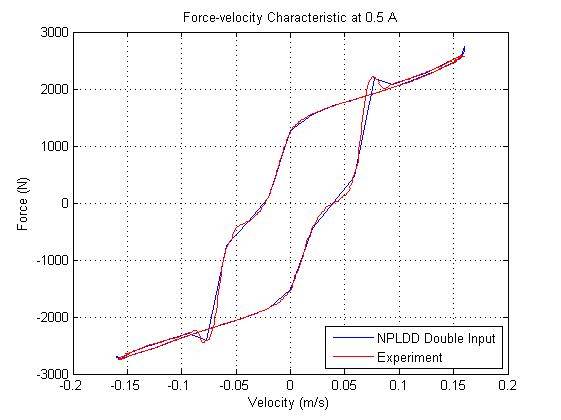
I already create MR damper modelling by using non-parametric linearised data driven (NPLDD) double input model. The hysteresis curve behavior is 99.9% followed as per experimental data, Figure below:
Figure%201_Hysteresis%20Curve.jpg

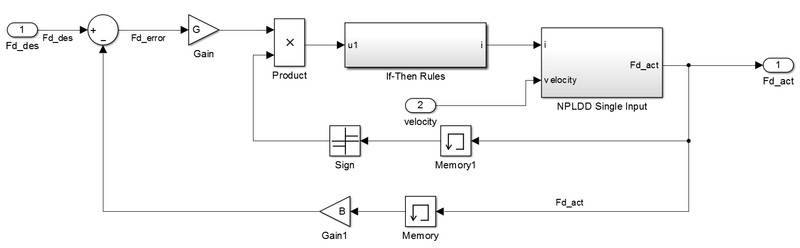
Then, by using this model, I had created closed loop model for force tracking control. The closed loop is developed by using continuous state control and If-Then Rules block as below:
Figure%202_Closed%20Loop%20Diagram.jpg

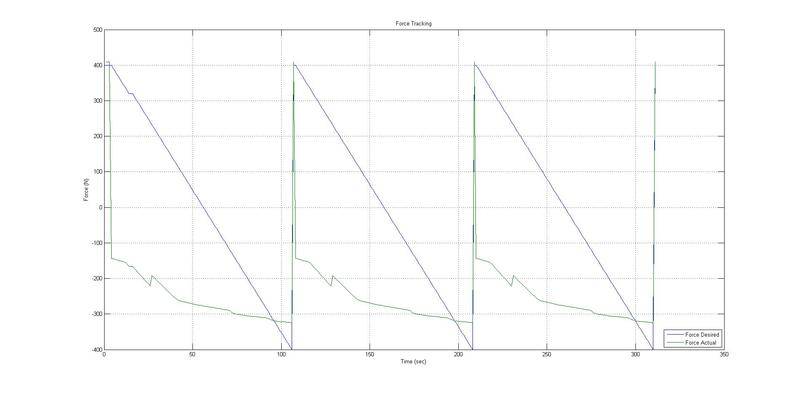
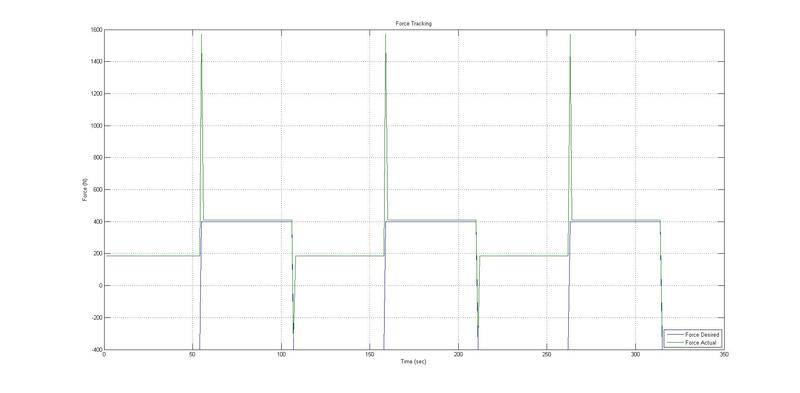
The input Fd_des and velocity is set to be sine, square, and sawtooth waveform, so that the output (Fd_act) will exhibit the same as input (Fd_des). However, after several time tuning the value of G and B, the result for force tracking (F_act vs F_des) is not the same as below:
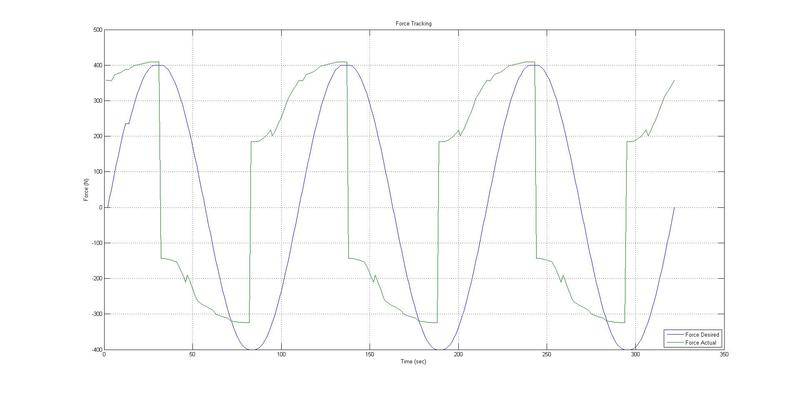
Figure%203_Sine%20wave_force%20tracking.jpg
Figure%204_Square%20wave_force%20tracking.jpg
Figure%205_Sawtooth%20wave_force%20tracking.jpg

All the result is not followed/tracked the input. The value of G and B are 0.05 and 2 respectively.
 
Engineering news on Phys.org
Are you trying to get the graphs to match as close as possible? It was not clear to me in your problem statement. Are those spikes due to something in the IF-THEN part of your control system, causing an abrupt change?
 
Thanks for your response. My aim is to get the graph to be match as close as possible. If the output graph follow exactly the input graph, the the force tracking tuning will be true. The spikes may due the tuning of G and B values. IF-THEN rules is used to ensure the input current will be in between 0 to 0.9A. Do you have any idea how to tune the G and B value? Or need to change to PID controller?
 

Similar threads

  • · Replies 0 ·
Replies
0
Views
4K
  • · Replies 0 ·
Replies
0
Views
3K
Replies
16
Views
4K
  • · Replies 45 ·
2
Replies
45
Views
7K
  • · Replies 4 ·
Replies
4
Views
3K
Replies
24
Views
19K
Replies
1
Views
9K
  • · Replies 7 ·
Replies
7
Views
3K
  • · Replies 18 ·
Replies
18
Views
4K
  • · Replies 10 ·
Replies
10
Views
4K