Up 244.14.4.26: Plotting $r^7$ Integrals

  • Context: MHB 
  • Thread starter Thread starter karush
  • Start date Start date
Click For Summary

Discussion Overview

The discussion revolves around plotting integrals of the form $r^7$ in polar coordinates and converting them to Cartesian coordinates. Participants explore the region of integration, the appropriate transformations, and the challenges of visualizing these functions using graphing tools like Desmos.

Discussion Character

  • Exploratory
  • Technical explanation
  • Debate/contested
  • Mathematical reasoning

Main Points Raised

  • Some participants express uncertainty about how to plot $r^7$ on Desmos and suggest that $r^6$ might be more appropriate.
  • There are discussions about the correct representation of the boundaries defined by $\theta = \tan^{-1}(4/3)$, $r = 3\sec(\theta)$, $\theta = \pi/2$, and $r = 4\csc(\theta)$.
  • One participant questions the necessity of evaluating the integrals, suggesting the focus should be on drawing the region and transforming to Cartesian coordinates instead.
  • Concerns are raised about the accuracy of the drawings made by participants, particularly regarding the placement of $\theta = \pi/2$.
  • There is a disagreement about whether the expression for $\theta = \pi/2$ can be represented as $x = \frac{\pi}{2}$, with one participant asserting that it cannot.

Areas of Agreement / Disagreement

Participants do not reach a consensus on the correct approach to plotting the integrals or the accuracy of their drawings. Multiple viewpoints exist regarding the necessity of evaluating the integrals and the proper representation of the boundaries in Cartesian coordinates.

Contextual Notes

Participants express uncertainty about the correctness of their drawings and the interpretation of the problem statement. There are unresolved questions about the transformations and the implications of using different forms of the integrals.

karush
Gold Member
MHB
Messages
3,240
Reaction score
5
$\tiny{up 244.14.4.26}$
$\textit{a. Sketch the region of Intregration}$
$\textit{b. convert the sum of integrals to a Cartesian sum of Integrals:}$
\begin{align*}\displaystyle
I_{26}&=\int_{0}^{\tan^{-1}(4/3)}
\int_{0}^{3\sec{\theta}}
r^7 \, dr \, d\theta
+\int_{\tan^{-1}(4/3)}^{\pi/2}
\int_{0}^{4\csc\theta}
r^7 \, dr \, d\theta\\
&=\int_{0}^{\tan^{-1}(4/3)}\Biggr|\frac{r^8}{8}\Biggr|_0^{3\sec{\theta}} \, d\theta
+\int_{\tan^{-1}(4/3)}^{\pi/2}\Biggr|\frac{r^8}{8}\Biggr|_{0}^{4\csc\theta} \, d\theta
\end{align*}
next ?

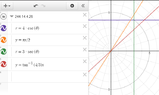
OK first I don't how you plot $r^7$ on Desmos
 
Last edited:
Physics news on Phys.org
karush said:
$\tiny{up 244.14.4.26}$
$\textit{a. Sketch the region of Intregration and convert the sum of integrals to a Cartesian sum of Integrals:}$
\begin{align*}\displaystyle
I_{26}&=\int_{0}^{\tan^{-1}(4/3)}
\int_{0}^{3\sec{\theta}}
r^7 \, dr \, d\theta
+\int_{\tan^{-1}(4/3)}^{\pi/2}
\int_{0}^{4\csc\theta}
r^7 \, dr \, d\theta\\
&=\int_{0}^{\tan^{-1}(4/3)}\Biggr|\frac{r^8}{8}\Biggr|_0^{3\sec{\theta}} \, d\theta
+\int_{\tan^{-1}(4/3)}^{\pi/2}\Biggr|\frac{r^8}{8}\Biggr|_{0}^{4\csc\theta} \, d\theta
\end{align*}
next ?

OK first I don't how you plot $r^7$ on Desmos

Can you plot:

1) \theta = \tan^{-1}(4/3)

2) r = 3\cdot\sec(\theta)

3) \theta = \pi/2

4) r = 4\cdot\csc(\theta)

Why are you trying to plot $r^7$? $r^6$ may be more appropriate. Why?
 

Attachments

  • 244.14.4.26.PNG
    244.14.4.26.PNG
    24.6 KB · Views: 152
Interesting. Why did you choose to abandon $\theta$ and insert y and x on $\theta = \pi/2$ and the inverse tangent?

$\theta = \pi/2$ is the y-axis.

Give some thought to the inverse tangent, too.

You could just substitute some version of the basic identities and rearrange a little.

$y = r\cdot\sin(\theta)$

$x = r\cdot\cos(\theta)$

$r^{2} = x^{2}+y^{2}$

$\theta = $ ?? I'll let you track down this one. :-)
 
$\theta = \tan^{-1}(4/3)$ doesn't plot
I assume we are finding the area of a wedge?
\begin{align*}
&=\int_{0}^{\tan^{-1}(4/3)}\Biggr|\frac{r^8}{8}\Biggr|_0^{3\sec{\theta}} \, d\theta
+\int_{\tan^{-1}(4/3)}^{\pi/2}\Biggr|\frac{r^8}{8}\Biggr|_{0}^{4\csc\theta} \, d\theta \\
&=3\int_{0}^{\tan^{-1}(4/3)} r^7 \sec{\theta}\, dr
\, +
4\int_{\tan^{-1}(4/3)}^{\pi/2} r^7 \csc(\theta) dr
\end{align*}
so far :mad::mad:

 
Are you sure you're understanding the problem statement? I don't see any instruction to EVALUATE the integrals. Just draw the pictures and transform to Cartesian Coordinates.
 
I don't don't think my drawing is correct?
or is it?
 
karush said:
I don't don't think my drawing is correct?
or is it?
You haven't fixed $\theta = \pi/2$
 
tkhunny said:
You haven't fixed $\theta = \pi/2$

that expression won't plot in desmos

is the same as $x=\frac{\pi}{2}$?
 
  • #10
karush said:
that expression won't plot in desmos

is the same as $x=\frac{\pi}{2}$?

Absolutely not.
 

Similar threads

  • · Replies 5 ·
Replies
5
Views
2K
Replies
14
Views
3K
  • · Replies 4 ·
Replies
4
Views
4K
  • · Replies 29 ·
Replies
29
Views
5K
  • · Replies 4 ·
Replies
4
Views
2K
  • · Replies 2 ·
Replies
2
Views
3K
  • · Replies 14 ·
Replies
14
Views
3K
  • · Replies 5 ·
Replies
5
Views
3K
  • · Replies 12 ·
Replies
12
Views
3K
  • · Replies 7 ·
Replies
7
Views
2K