Vector calculus for ellipse in polar coordinates

Click For Summary

Homework Help Overview

The discussion revolves around a problem involving vector calculus, specifically focusing on the representation of an ellipse in polar coordinates and its relationship with a circle. Participants are exploring the parametric equations of an ellipse and the implications of its center not being at the origin.

Discussion Character

  • Exploratory, Conceptual clarification, Problem interpretation, Assumption checking

Approaches and Questions Raised

  • Participants discuss the parametric equations for an ellipse and question the validity of their application given the ellipse's center. There are attempts to graph the ellipse and circle, with some uncertainty about the intersections and the region they enclose. Questions arise regarding the correct solutions to equations derived from the ellipse's definition.

Discussion Status

The conversation is ongoing, with various interpretations being explored. Some participants have offered guidance on how to approach the problem, particularly in terms of substituting polar coordinates into the ellipse equation. There is a mix of agreement and differing opinions on the graphical representation and the mathematical setup.

Contextual Notes

Participants are working under the constraints of a homework assignment, which may limit the information they can share. There is also a focus on ensuring that the equations are correctly interpreted and solved, with some participants expressing confusion about the implications of their findings.

dragonxhell
Messages
21
Reaction score
0
Hello =]
I'm having trouble with this question, can somebody please help me with it! I'll thanks/like your comment if help me =)

![Question][1]
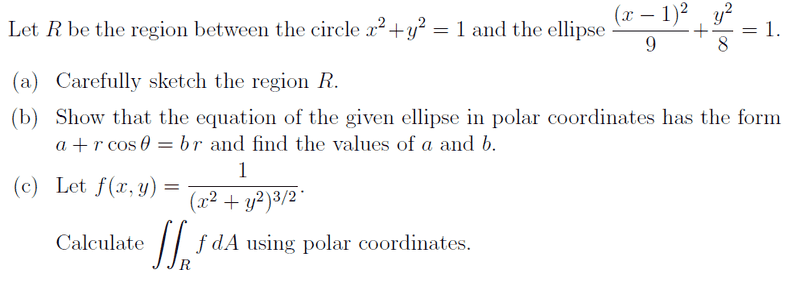

YGKhm.png


I know that for a ellipse the parametric is x=a sin t , b= b cos t t:0 to 2pi (?)

for part a) I drew up the graph but not sure if it's right. the circle have 1 radius and for the ellipse I able to find the x= 2
(x-1)^2 =9
sqrt(x-1)^2=sqrt9
x-1=3
x=4

for y=2sqrt2
y^2=8
sqrty=sqrt8
y=sqrt4 sqrt 2
y= 2sqrt2 or 2.8

So the region should be the circle? since the ellipse like cover the whole circle?
Thank you very much for helping!
Cheers.
 
Physics news on Phys.org
dragonxhell said:
I know that for a ellipse the parametric is x=a sin t , b= b cos t t:0 to 2pi (?)

That would be valid if the ellipse was centered at the origin, which is not the case here. (but only a slight adjustment needs to be made).

for part a) I drew up the graph but not sure if it's right. the circle have 1 radius and for the ellipse I able to find the x= 2
(x-1)^2 =9
sqrt(x-1)^2=sqrt9
x-1=3
x=4

for y=2sqrt2
y^2=8
sqrty=sqrt8
y=sqrt4 sqrt 2
y= 2sqrt2 or 2.8

There exists two solutions to each of these equations.

So the region should be the circle? since the ellipse like cover the whole circle?
Thank you very much for helping!
Cheers.
The region is not exactly a circle, but the unit circle is completely contained within the ellipse.
 
CAF123 said:
That would be valid if the ellipse was centered at the origin, which is not the case here. (but only a slight adjustment needs to be made).
There exists two solutions to each of these equations.


The region is not exactly a circle, but the unit circle is completely contained within the ellipse.
the region happen is when 2 of graph meet each other?
so for x it's 4 and -4 and for y its 2sqrt2 and -2sqrt 2 right?
i did a sketch of it, by any chance you know how to do this question? =(


Mod note: The image was way too large. Please scale the image down to about 900 x 600 pixels and edit this post to include it again, or add it in a new post in this thread.[/color]
 
Last edited by a moderator:
dragonxhell said:
so for x it's 4 and -4 and for y its 2sqrt2 and -2sqrt 2 right?

No, for the first equation, you solve ##(x-1)^2 = 9## so ## x-1 = \pm 3## What are the two solutions?
Similarly for the other equation.

Your sketch shows the ellipse concentric with the unit circle, but this is incorrect since the ellipse has a centre (1,0). When you find the correct solutions to the above, it should fix things.
 
@dragonxhell: To get started on this problem you need to substitute the polar coordinate values for ##x## and ##y## into the equation of the ellipse and solve it for ##r##. That should lead you to the answer for part b. Then you will use the form$$
\int_0^{2\pi} \int_{r_{inner}}^{r_{outer}} \frac 1 {r^3}r\,drd\theta$$
 
CAF123 said:
No, for the first equation, you solve ##(x-1)^2 = 9## so ## x-1 = \pm 3## What are the two solutions?
Similarly for the other equation.

Your sketch shows the ellipse concentric with the unit circle, but this is incorrect since the ellipse has a centre (1,0). When you find the correct solutions to the above, it should fix things.
o so the centre is (1,0) and the equation you show me I have already obtained
But don't you move the 1 over? To just simply get x by it self? So it should be 4 and -3 (-4+1?)
 
LCKurtz said:
@dragonxhell: To get started on this problem you need to substitute the polar coordinate values for ##x## and ##y## into the equation of the ellipse and solve it for ##r##. That should lead you to the answer for part b. Then you will use the form$$
\int_0^{2\pi} \int_{r_{inner}}^{r_{outer}} \frac 1 {r^3}r\,drd\theta$$

Is this right? Can somebody double check this for me? It seem right to me...


(x−1)²/9 + y²/8 = 1
8(x−1)² + 9y² = 72
8x² − 16x + 8 + 9y² = 72
9(x²+y²) − x² − 16x + 8 = 72
9(x²+y²) = x² + 16x + 64
9(x²+y²) = (x + 8)²
9r² = (r cosθ + 8)²3r = r cosθ + 88 + r cosθ = 3r
a = 8, b = 3
c)R is region outside circle: r = 1*and inside ellipse: r = 8/(3−cosθ)
Limits:*1 ≤ r ≤ 8/(3−cosθ)
0 ≤ θ ≤ 2πƒ
= 1/(x²+y²)^(3/2)
= 1/(r²)^(3/2)
= 1/r³∫∫ ƒ dA = ∫ [0 to 2π] ∫ [1 to 8/(3−cosθ)] 1/r³ * r dr dθR. . . . .
= ∫ [0 to 2π] ∫ [1 to 8/(3−cosθ)] 1/r² dr dθ. . . . .
= ∫ [0 to 2π] (−1/r) | [1 to 8/(3−cosθ)] dθ. . . . .
= ∫ [0 to 2π] (−(3−cosθ)/8 − (−1)) dθ. . . . . = ∫ [0 to 2π] 1/8 (cosθ + 5) dθ. . . . .
= 1/8 (sinθ + 5θ) | [0 to 2π]*. . . . .
= 1/8 [(0 + 10π) − (0 + 0)]. . . . .
= 5π/4

Also for part a) the R region it is the region between the ellipse to the circle right?
 
dragonxhell said:
Is this right? Can somebody double check this for me? It seem right to me...


(x−1)²/9 + y²/8 = 1
8(x−1)² + 9y² = 72
8x² − 16x + 8 + 9y² = 72
9(x²+y²) − x² − 16x + 8 = 72
9(x²+y²) = x² + 16x + 64
9(x²+y²) = (x + 8)²
9r² = (r cosθ + 8)²3r = r cosθ + 88 + r cosθ = 3r
a = 8, b = 3
c)R is region outside circle: r = 1*and inside ellipse: r = 8/(3−cosθ)
Limits:*1 ≤ r ≤ 8/(3−cosθ)
0 ≤ θ ≤ 2πƒ
= 1/(x²+y²)^(3/2)
= 1/(r²)^(3/2)
= 1/r³∫∫ ƒ dA = ∫ [0 to 2π] ∫ [1 to 8/(3−cosθ)] 1/r³ * r dr dθR. . . . .
= ∫ [0 to 2π] ∫ [1 to 8/(3−cosθ)] 1/r² dr dθ. . . . .
= ∫ [0 to 2π] (−1/r) | [1 to 8/(3−cosθ)] dθ. . . . .
= ∫ [0 to 2π] (−(3−cosθ)/8 − (−1)) dθ. . . . . = ∫ [0 to 2π] 1/8 (cosθ + 5) dθ. . . . .
= 1/8 (sinθ + 5θ) | [0 to 2π]*. . . . .
= 1/8 [(0 + 10π) − (0 + 0)]. . . . .
= 5π/4

Also for part a) the R region it is the region between the ellipse to the circle right?

Yes. Very nice.
 
LCKurtz said:
Yes. Very nice.
Can you please check this question for me because my answer is different to my friends and they say its wrong...
Given the equation: G= (x^3 -3xy^2)I +(y^3-3x^2y)j +2k is conservative find the potential function for the fields that are conservative
My answer
f:grad f=F
fx=x^3-3xy^2
fy=y^3-3x^2y
fz=z

integral (x^3-3xy^2)dx
=x^4/4-3x^2y^2/2 +h(y, z)
fy or f'y= -3x^2 y +hy(y, z)
fy=y^3-3x^2y= -3x^2y+hy(y, z)
hy(y,z)=y^3

Integral y^3 dy = y^4/4 +gz
fz=0 because no z term ^
Integral 0dz =c
F= x^4/4-3x^2y^2/2 +y^4/4+c <-potential function
 
  • #10
dragonxhell said:
Can you please check this question for me because my answer is different to my friends and they say its wrong...
Given the equation: G= (x^3 -3xy^2)I +(y^3-3x^2y)j +2k is conservative find the potential function for the fields that are conservative
My answer
f:grad f=F

There is no F anywhere. Don't you mean grad f = G?

fx=x^3-3xy^2
fy=y^3-3x^2y
fz=z

Is ##f_z = z## or ##f_z = 2##? Look at G.
integral (x^3-3xy^2)dx
=x^4/4-3x^2y^2/2 +h(y, z)
fy or f'y= -3x^2 y +hy(y, z)
fy=y^3-3x^2y= -3x^2y+hy(y, z)
hy(y,z)=y^3

Integral y^3 dy = y^4/4 +gz
fz=0 because no z term ^
Integral 0dz =c
Poorly written. At this point you have$$
f = \frac {x^4} 4 - \frac {3x^2y^2} 2 +\frac{y^4} 4 + h(z)$$
Now you need to take ##f_z## and set it equal to the third term, whether it is a ##2## or a ##z##. You don't get ##f_z=0## either way.
 
  • #11
LCKurtz said:
There is no F anywhere. Don't you mean grad f = G?


Is ##f_z = z## or ##f_z = 2##? Look at G.

Poorly written. At this point you have$$
f = \frac {x^4} 4 - \frac {3x^2y^2} 2 +\frac{y^4} 4 + h(z)$$
Now you need to take ##f_z## and set it equal to the third term, whether it is a ##2## or a ##z##. You don't get ##f_z=0## either way.
sorry I type it all up on my phone and when I submit it it's so messy...
so you are saying
my integral y^4/4 must equal to fz which is z
So the final answer is
F=x^4/4 -3x^2y^2/2 +y^4/4 +z^2/2
 

Similar threads

  • · Replies 4 ·
Replies
4
Views
3K
  • · Replies 8 ·
Replies
8
Views
3K
  • · Replies 5 ·
Replies
5
Views
3K
  • · Replies 1 ·
Replies
1
Views
2K
  • · Replies 7 ·
Replies
7
Views
3K
Replies
6
Views
2K
Replies
7
Views
2K
Replies
9
Views
7K
Replies
12
Views
5K
Replies
4
Views
4K