What is the closed volume integral symbol in Microsoft Word?

Click For Summary
SUMMARY

The closed volume integral symbol in Microsoft Word represents the integration over a closed volume, typically denoted with a differential element ##dV##. This symbol is used in the context of applying the Divergence theorem and Stoke's theorem to closed volumes, such as spheres defined by equations like ##x^2 + y^2 + z^2 \leq 1##. The discussion clarifies that the loop around the triple integral signifies that the volume is closed, distinguishing it from open volumes, which do not have a defined boundary. The closed volume integral is essential for calculations involving flux and surface area in higher-dimensional spaces.

PREREQUISITES
  • Understanding of closed surface integrals and differential elements (##d \vec S##, ##dS##).
  • Familiarity with the Divergence theorem and Stoke's theorem.
  • Basic knowledge of volume integrals and their applications in calculus.
  • Awareness of mathematical symbols and their meanings in integration.
NEXT STEPS
  • Research the application of the Divergence theorem in closed volumes.
  • Explore the mathematical definition and applications of the closed volume integral symbol.
  • Learn about the differences between closed and open volumes in higher-dimensional calculus.
  • Investigate the del operator and its 4D counterpart, the D'Alembertian, in the context of relativity.
USEFUL FOR

Mathematicians, physicists, and engineering students who are studying advanced calculus and vector calculus, particularly those interested in the applications of integration in higher dimensions.

STEMucator
Homework Helper
Messages
2,076
Reaction score
140
Hi everyone.

I've been curious about a particular symbol, but I've never seen it used or mentioned in any context. I don't really have much information about its usage, so I thought I would ask around and see if anyone knew about its application.
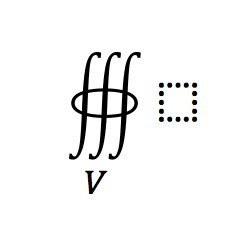
Screen Shot 2015-09-19 at 3.10.24 PM.png


I saw this symbol in Microsoft word.

How do we interpret it, and how do we use it?

I'm familiar with closed surface integrals with differential elements ##d \vec S##. We use those when we want to calculate the flux of a field ##\vec F##. I'm also familiar with closed surface integrals with differential elements ##dS##. We use those when we want to calculate surface area.

What about the closed volume integral above though?

I know we should probably use a differential element ##dV## for a closed volume, and the answer would represent the volume of the object. Is there such thing as a differential volume element ##d \vec V## such that we can extend theorems to the fourth dimension (theorem's like Stoke's theorem and the Divergence theorem)?

Thank you in advance.
 
Physics news on Phys.org
I think the dash box is simply for inserting your integrand.

Its up to you to remember the dV part.

There is a seldom used math symbol called the delambertian that's used in relativity that is the 4D version of the del operator but this isn't it.
 
Zondrina, I think you're asking about the integration symbol, not the box to the right. According to this page, https://en.wikipedia.org/wiki/Integral_symbol, that's a closed volume integral. I don't know much more about it, and a quick web search didn't turn up much.
 
So the only reason the loop is around the triple integral is to signify the volume is closed.

Does that mean something like the divergence theorem can be written like so:

Screen Shot 2015-09-19 at 6.09.47 PM.png


For a closed volume ##V## such as ##x^2 + y^2 + z^2 \leq 1##.

For a volume ##V## that isn't closed such as ##x^2 + y^2 + z^2 < 1##, would the theorem would take the form:

Screen Shot 2015-09-19 at 6.12.46 PM.png


Otherwise I don't see any reason to ever have to use the symbol mentioned in the OP.
 
Last edited:
I don't know what is meant by "closed volume". What is the difference between a closed volume and an open volume?
 
In three dimensions there is no such thing as a "closed volume". There can be in higher dimensions, of course.
 

Similar threads

  • · Replies 3 ·
Replies
3
Views
2K
  • · Replies 5 ·
Replies
5
Views
3K
  • · Replies 3 ·
Replies
3
Views
2K
  • · Replies 10 ·
Replies
10
Views
4K
  • · Replies 3 ·
Replies
3
Views
2K
  • · Replies 1 ·
Replies
1
Views
4K
  • · Replies 2 ·
Replies
2
Views
2K
  • · Replies 2 ·
Replies
2
Views
3K
  • · Replies 3 ·
Replies
3
Views
2K
  • · Replies 2 ·
Replies
2
Views
3K