What Gear Ratio Is Needed for a 30-40 km/h Electric Longboard?

Join the discussion
Registration is free. Start your own thread to ask a follow-up.
10 replies · 5K views
Gurfin321
Messages
5
Reaction score
0
I would like to know what gear ratio i would need for my electric longboard. The goal is to run the longboard at 30 - 40 km/h at max power. Me and the longboards weight is approximately 65 kg. The brushless motor i am running has an rpm of approximately 18000 rpm (as it is an airplane engine) and a torque of 1,24 Nm. I would like to be able to go up a 10 degrees incline at 10 - 20 km/h. The longboard wheel is 75 mm in diameter. My question to you is: "How big a gear ratio should i use, and achieve said goals?". I would like to know all formels and equations, and also all the variables.
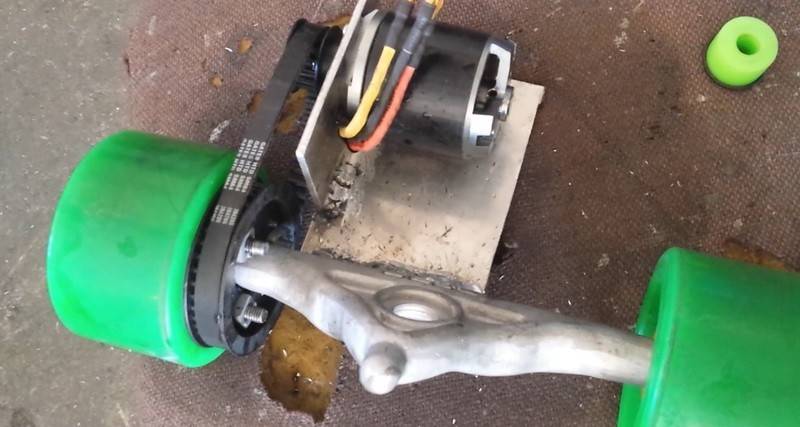
8130428_orig.jpg
Thanks in advance!
//Josef
 
Physics news on Phys.org
Gurfin321 said:
I would like to know what gear ratio i would need for my electric longboard. The goal is to run the longboard at 30 - 40 km/h at max power. Me and the longboards weight is approximately 65 kg. The brushless motor i am running has an rpm of approximately 18000 rpm (as it is an airplane engine) and a torque of 1,24 Nm. I would like to be able to go up a 10 degrees incline at 10 - 20 km/h. The longboard wheel is 75 mm in diameter. My question to you is: "How big a gear ratio should i use, and achieve said goals?". I would like to know all formels and equations, and also all the variables.

8130428_orig.jpg
Thanks in advance!
//Josef
Welcome to the PF.

Is that the kind of electric motor that is routinely used in commercial battery-powered longboards? Such a high RPM motor (which is useful for RC aircraft would seem to be not well suited to a lower-RPM higher-torque application like a longboard.
 
berkeman said:
Welcome to the PF.

Is that the kind of electric motor that is routinely used in commercial battery-powered longboards? Such a high RPM motor (which is useful for RC aircraft would seem to be not well suited to a lower-RPM higher-torque application like a longboard.
No it is not, however i can if needed switch motor, as long as it will suit my needs, budget is not a grate problem. I would like to get it as cheap as possible, while stil remaining top quality.
 
Gurfin321 said:
No it is not, however i can if needed switch motor, as long as it will suit my needs, budget is not a grate problem. I would like to get it as cheap as possible, while stil remaining top quality.
From an engineering perspective, the losses in such a high gear ratio will cost you power and battery life. It would be much better to find out what type of motor is used on commercial longboards, and see how inexpensively you can buy one (like on eBay or similar). Do you have access to a commercial battery-powered longboard that you can check the motor type/brand/size? If not, I have a good friend who commutes to Stanford on his battery-powered longboard. I could ask him...
 
berkeman said:
From an engineering perspective, the losses in such a high gear ratio will cost you power and battery life. It would be much better to find out what type of motor is used on commercial longboards, and see how inexpensively you can find one (like on eBay or similar). Do you have access to a commercial battery-powered longboard that you can check the motor type/brand/size? If not, I have a good friend who commutes to Stanford on his battery-powered longboard. I could ask him...
I do not have access to an electric longboard, so it would be greatly appreciated if you could ask him for advise. Thanks!
 
Here is his reply. Can you follow up on the Internet info about the board and motor? :smile:

I'm in the Idaho backcountry biking between hot springs . My board is a Boosted Dual Plus. Not sure whose motor they are using, but there is a teardown on the net so you can find it. Battery is 99 Watt-Hours.

Cheers
 
berkeman said:
Here is his reply. Can you follow up on the Internet info about the board and motor? :smile:
I was not able to find boosted motor however, on some other longboard diys they used motor like these http://www.hobbyking.com/hobbyking/...sk3_5055_280kv_brushless_outrunner_motor.html
While my motor should be even more powerful! (Sorry swedish site) http://www.hobbex.se/sv/artiklar/rimfire-80-50-55-500-borstlos-elmotor.htmlWill it work?
 
Quick analysis:

Possible top speed ##v_{max}## in (m/s):
[tex]v_{max} = \sqrt[3]{\frac{P_{max}}{0.5\rho C_DA}}[/tex]
Where:
  • ##P_{max}## = maximum motor power (2200 W, from your source);
  • ##\rho## = air density (1.225 kg/m³);
  • ##C_D## = drag coefficient (http://www.taylors.edu.my/EURECA/2014/downloads/02.pdf ##\approx## 1.00);
  • ##A## = frontal area (standing human ##\approx## 0.9 m²).
This gives 15.86 m/s or about 57 km/h.

Power required to go 15 km/h (= 4.17 m/s) on a 10° incline:
[tex]\begin{split}<br /> P &= 0.5\rho C_D A v^3 + (mg\sin\theta) v \\<br /> P &= 0.5 (1.225) (1.00) (0.9) (4.17)^3 + ((65)(9.81)\sin(10)) (4.17) \\<br /> P &= 502\ W<br /> \end{split}[/tex]
The gear ratio needed (assuming there is sufficient power at the motor rpm):
[tex]GR = \frac{rpm_m}{rpm_w} = \frac{\pi}{30}\frac{rpm_m r}{v}[/tex]
Where:
  • ##rpm_m## is the motor rpm (rpm);
  • ##rpm_w## is the wheel rpm (rpm);
  • ##v## is the speed (m/s);
  • ##r## is the wheel radius (m).
Say you have a 70 mm wheel (= 0.035 m radius), then if you want to reach 40 km/h (= 11.1 m/s) when the motor is at 18 000 rpm, then you need a gear ratio of 5.94:1. But you may not need to reach that rpm since you have enough power to reach 57 km/h.

Of course, you need to make sure the motor can produce the required power at every speed (i.e. considering actual rpm motor at that speed), in every condition you expect (i.e. incline), with the gear ratio selected.
 
Last edited by a moderator:
  • Like
Likes   Reactions: berkeman and Gurfin321
jack action said:
Quick analysis:

Possible top speed ##v_{max}## in (m/s):
[tex]v_{max} = \sqrt[3]{\frac{P_{max}}{0.5\rho C_DA}}[/tex]
Where:
  • ##P_{max}## = maximum motor power (2200 W, from your source);
  • ##\rho## = air density (1.225 kg/m³);
  • ##C_D## = drag coefficient (http://www.taylors.edu.my/EURECA/2014/downloads/02.pdf ##\approx## 1.00);
  • ##A## = frontal area (standing human ##\approx## 0.9 m²).
This gives 15.86 m/s or about 57 km/h.

Power required to go 15 km/h (= 4.17 m/s) on a 10° incline:
[tex]\begin{split}<br /> P &= 0.5\rho C_D A v^3 + (mg\sin\theta) v \\<br /> P &= 0.5 (1.225) (1.00) (0.9) (4.17)^3 + ((65)(9.81)\sin(10)) (4.17) \\<br /> P &= 502\ W<br /> \end{split}[/tex]
The gear ratio needed (assuming there is sufficient power at the motor rpm):
[tex]GR = \frac{rpm_m}{rpm_w} = \frac{\pi}{30}\frac{rpm_m r}{v}[/tex]
Where:
  • ##rpm_m## is the motor rpm (rpm);
  • ##rpm_w## is the wheel rpm (rpm);
  • ##v## is the speed (m/s);
  • ##r## is the wheel radius (m).
Say you have a 70 mm wheel (= 0.035 m radius), then if you want to reach 40 km/h (= 11.1 m/s) when the motor is at 18 000 rpm, then you need a gear ratio of 5.94:1. But you may not need to reach that rpm since you have enough power to reach 57 km/h.

Of course, you need to make sure the motor can produce the required power at every speed (i.e. considering actual rpm motor at that speed), in every condition you expect (i.e. incline), with the gear ratio selected.
THANK you! Great help, really got stuck with this one.

Where did you learn all this, i would like to know the source as it might come in handy to solve other practical problems.
Now me and my buddy are going to build an awesome longboard.
Again Thanks!

//Josef
 
  • Like
Likes   Reactions: bellesbarbara, bsheikho and Gurfin321