Engineering What is the torque output by this gearbox?

  • Thread starter Thread starter Master1022
  • Start date Start date
  • Tags Tags
    Output Torque
Click For Summary
The discussion centers on the torque output of a gearbox, where the user is comparing their calculations with an answer key. The user calculates the torque for the reverse gear operation, arriving at 800 Nm for the input torque and 400 Nm for the output torque at the wheels, while the answer key states 200 Nm for the wheels. There is a suggestion that the diagram may be incorrect, as typical gear transmissions increase torque and reduce angular velocity. The conversation also touches on the implications of gear ratios and the calculation of brake torque, concluding that the average torque supported by the stationary cage shaft could be 600 Nm if the diagram is correct. The calculations presented are affirmed as correct, emphasizing the importance of accurate diagrams in understanding gearbox mechanics.
Master1022
Messages
590
Reaction score
116
Homework Statement
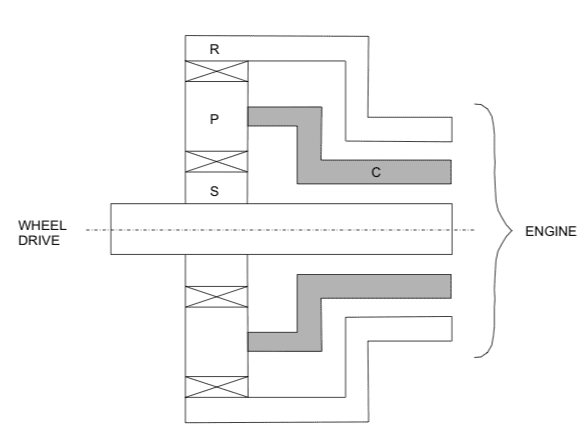
We are using the following gear in the reverse gear mode (brake applied to the cage shaft and engine is driving the ring gear) and are traveling at 1 m/s. The wheel radius is 0.2 m. What is the torque that the engine needs to provide 2kW of power? Also, what is the torque in the wheels?
Relevant Equations
## v = \omega r ##
Hi,

I was just working through this gearbox problem and the answer key has different results to mine. I thought that I should show my working to see where the error is on their part or mine?

This is the gear box (for reference, ## N_s = 32 ##, ## N_p = 16 ##, and ## N_r = 64 ##)
Screen Shot 2020-09-04 at 8.32.09 PM.png


My attempt:
For the reverse gear operation (brake applied to the cage shaft and engine is driving the ring gear), I found that the ratio of:
$$ \frac{\omega_{out}}{\omega_{in}} = \frac{\omega_s}{\omega_r} = -2 $$

Therefore, ## v = \omega_{s} r =1 ## which yields ## \omega_s = 5 ## rad/s. Therefore, we get ## \omega_r = -2.5 ## rad/s. We also assume that the gear train is 100% efficient and therefore:
$$ P_{s} = 2000 = T_s \omega_s \Rightarrow T_s = 400 Nm $$

Once again, by using power conservation:
$$ T_r \omega_r = T_s \omega_s \Rightarrow T_r = T_s \frac{\omega_s}{\omega_r} = -2T_s = (-) 800 Nm $$

The answer has the same answer for the torque of the wheels, but then has ## |T_r| = 200 Nm ##. Have they just flipped the fraction the wrong way round or have I made the error. I keep trying to rework through the problem and I am getting the same answer (800)...

Also, just one more follow up question. Given that the gearbox is in equilibrium (I think this is an assumption we make), would I do the following if we were asked to find the torque provided by the brake?
$$ T_{brake} + T_r + T_s = 0 \Rightarrow T_{brake} = 800 - 200 = 600 Nm $$

Thank you. Any help is greatly appreciated
 
Physics news on Phys.org
Your calculations are correct.
The total torque (Sun shaft) imposed by the load of 2 KW (100% efficiency) on the wheels going in reverse should be 400 N-m.
Considering two driving wheels, that would be 200 N-m each.

Based on the above, the input torque (Ring shaft) imposed by the engine generating 2 KW, while turning at 2.5 rad/s, should be 800 N-m.

I believe that the diagram is incorrect, because generally the transmissions of vehicles increase torque and reduce angular velocity from the engine to the wheels.
For example, the reverse gear of a Chevrolet Corvette has a ratio of -3.38:1, which means that the engine makes 3.38 revolutions for every revolution of the transmission's output.

Another hint is the angular velocity of the engine: 2.5 rad/s equals 24 rpm, which is way too low for an engine to properly idle.
If, in effect, the locations of words "Engine" and "Wheel drive" are reversed in the diagram, the engine could be rotating at a more practical 96 rpm while delivering a torque of 200 N-m via the Sun drive instead.

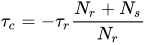
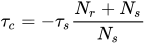
The brake torque supported by the stationary cage shaft or carrier of the Planet gears should be the average of Sun's and Ring's torques: 600 N-m if the diagram is correct, 300 N-m if incorrect.
 
Last edited:
@Lnewqban - thank you very much for your reply!

Lnewqban said:
Your calculations are correct.
The total torque (Sun shaft) imposed by the load of 2 KW (100% efficiency) on the wheels going in reverse should be 400 N-m.
Considering two driving wheels, that would be 200 N-m each.

Based on the above, the input torque (Ring shaft) imposed by the engine generating 2 KW, while turning at 2.5 rad/s, should be 800 N-m.

Okay that is good to hear.

Lnewqban said:
I believe that the diagram is incorrect, because generally the transmissions of vehicles increase torque and reduce angular velocity from the engine to the wheels.
For example, the reverse gear of a Chevrolet Corvette has a ratio of -3.38:1, which means that the engine makes 3.38 revolutions for every revolution of the transmission's output.
Yes, I'm not sure whether the physical implications or the numbers were thought about when writing this problem...

Just to confirm so I understand the ratio the "speed/velocity ratio": a ratio of ## \omega_{engine} : \omega_{output} ##? That would line up with your qualitative analysis of the reverse gear operation. I only ask as these questions tend to quote lots of ratios and I sometimes get confused what is being compared

Lnewqban said:
The brake torque supported by the stationary cage shaft or carrier of the Planet gears should be the average of Sun's and Ring's torques: 600 N-m if the diagram is correct, 300 N-m if incorrect.
Thank you for confirming this.
 
You are welcome. :smile:

These are the equations to calculate the torque of the stationary cage shaft or carrier of the Planet gears:

fb3b8c919d6edd1495552ce26c9ca97842709acd

5ce35e1362515ec9b58e29226c48095820344a97


This article, from which I have copied the above equations, could help you with future epicyclic gears problems:

https://en.m.wikipedia.org/wiki/Epicyclic_gearing#Gear_ratio_of_standard_epicyclic_gearing

The 3.38:1 notation that I showed is a typical way to express the driven/drive gear ratio, which is a geometrical magnitude, as only considers the number of teeth of each gear combination in a transmission or gearbox.
 
  • Like
Likes Master1022

Similar threads

  • · Replies 6 ·
Replies
6
Views
4K
  • · Replies 2 ·
Replies
2
Views
9K
  • · Replies 6 ·
Replies
6
Views
4K
  • · Replies 26 ·
Replies
26
Views
22K
  • · Replies 3 ·
Replies
3
Views
3K
  • · Replies 4 ·
Replies
4
Views
7K
  • · Replies 11 ·
Replies
11
Views
5K
  • · Replies 7 ·
Replies
7
Views
2K
  • · Replies 1 ·
Replies
1
Views
4K
Replies
2
Views
10K