What should I consider when sketching a vector field?

Join the discussion
Ask a follow-up here, or get your own question answered by working scientists, mathematicians and engineers — people, not an autocomplete.
Real named experts · corrections over time · the nuance an AI answer skips
17 replies · 2K views
arhzz
Messages
284
Reaction score
58
Homework Statement
Draw the vector field
Relevant Equations
-
Hello! I am suspossed to write (sketch) this particular vector field.

$$V2(r) = \frac{C}{\sqrt{x^2+y^2+z^2})^3} * (x,y,z) $$ Note that the x y z is suspossed to be a vector so they would be written vertically (one over the other) but I don't know how to write vectors and matrices in LaTeX,so if anyone has a good tutorial or a site where I could learn that please let me know. Now for this vector field I first need to determine if it diverges and I got 0,since we don't have r anywhere so doing the partial differentiation will give us all 0.Now I am not really sure how to draw it since if the divergence of a vector field says to which extent the vector field flux behaves like a source at a given point.Our professor said we can imagine it like "outgoingness".If I had to simply draw it of this what I know I'd say there is nothing to be drawn,simply leave it blank if you will. We are also given a tip; "Consider z to be a constant".Now this tip confused me since I'd go with the answer nothing to be drawn but I pressume I'm wrong. What should I consider here,I must be missing something.

Thank you!
 
Physics news on Phys.org
Let's simplify a bit. Can you draw some vectors in a plane (z=0)?
 
arhzz said:
Homework Statement:: Draw the vector field
Relevant Equations:: -

since we don't have r anywhere
The divergence of this vector field might be zero but the proof might not be so easy. r exists in the denominator it is $$r=\sqrt{x^2+y^2+z^2}$$
 
Oh worth pointing out,no proof is needed (in the form of mathematicly proving that it diverges). I think I can draw vectors in a plane.When you say z = 0 do you mean that it does not have a length in the z direction? so only x and y are the ones that remain?
 
arhzz said:
Oh worth pointing out,no proof is needed (in the form of mathematicly proving that it diverges). I think I can draw vectors in a plane.When you say z = 0 do you mean that it does not have a length in the z direction? so only x and y are the ones that remain?
Drawing a 3D field on paper is quite difficult. That's why I suggested a simplified version drawn at z=0.
 
I am not sure I understand what exactly is the vector field btw. Is it the one where each cartesian component of it is equal to$$V_x=V_y=V_z=\frac{C}{\sqrt{x^2+y^2+z^2}^3}$$

If yes then its divergence is not zero, it is $$\nabla\cdot\vec{V}=\frac{-3C(x+y+z)}{(x^2+y^2+z^2)^{\frac{5}{2}}}$$
 
Delta2 said:
I am not sure I understand what exactly is the vector field btw. Is it the one where each cartesian component of it is equal to$$V_x=V_y=V_z=\frac{C}{\sqrt{x^2+y^2+z^2}^3}$$

If yes then its divergence is not zero, it is $$\nabla\cdot\vec{V}=\frac{-3C(x+y+z)}{(x^2+y^2+z^2)^{\frac{5}{2}}}$$
I see a mistake. The field is:
$$V_{x}=\frac{Cx}{(x^2+y^2+z^2)^{3/2}}, V_{y}=\frac{Cy}{(x^2+y^2+z^2)^{3/2}}, V_{z}=\frac{Cz}{(x^2+y^2+z^2)^{3/2}}$$
 
  • Like
Likes   Reactions: Klystron and Delta2
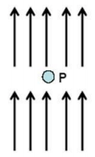
Well I don't really want to try to demand anything blantaly because I do not have the necesarriy knowledge to back it up,but in the solutions the divergence of the field is 0.Also I have googled a bit about what the field looks like when the divergence is equal to 0 and it is simply that the lines of the field go like this
 

Attachments

  • divergence.png
    divergence.png
    2.5 KB · Views: 201
Yes I am sorry I took the wrong field formula (thx @Gordianus for the correction), the field indeed has divergence zero. However the field that you depict is one possible field that has divergence zero, there are other fields that don't look like it but still have divergence zero.
Moreover I believe in spherical coordinates the field's formula is that in post #9. What do you think that are the field lines then?
 
I bring bad news. This field doesn't have divergence equal to zero everywhere. What happens at x=y=z=0?
 
  • Like
Likes   Reactions: Delta2
Delta2 said:
Strictly speaking the field isn't defined for (0,0,0) so we don't care about this point.
The field isn't defined at (0,0,0) but we still face the curious fact the flow through any closed surface that surrounds the origin is a certain number. Of course, we're approaching the niceties of Dirac's delta function.
 
Gordianus said:
The field isn't defined at (0,0,0) but we still face the curious fact the flow through any closed surface that surrounds the origin is a certain number. Of course, we're approaching the niceties of Dirac's delta function.
You mean we are facing some sort of mini paradox, because the flux of any surface that surrounds the origin would be zero (if divergence was everywhere zero) yet the field seems to go to infinity at the origin. Either divergence theorem doesn't apply here or we have to say that ##\nabla\cdot\vec{V}=C\delta(\vec{r})## that is the divergence is zero everywhere except at the origin where it jumps to infinity.
 
Shhh...Don't say ##\delta(r)## jumps to infinity when ##r=0##. Mathematicians may be hearing us!
 
  • Haha
Likes   Reactions: Delta2
I am a mathematician, I know that the dirac delta function is in fact a sequence of functions.. We don't care if the limit of this sequence exist, we care if the limit in the sequence of the corresponding integrals exist.