Where can I find cuvettes with transparent caps?

  • Context: High School 
  • Thread starter Thread starter KShah423
  • Start date Start date
  • Tags Tags
    Transparent
Click For Summary
SUMMARY

The discussion centers on the challenge of using cuvettes with transparent caps for experiments involving the Faraday Effect. The participant, a high school student, seeks affordable UV plastic cuvettes that can be positioned horizontally within a solenoid. Solutions provided include supporting the solenoid vertically, using a microscope slide for cuvette placement, and adjusting the light source and sensor positions to facilitate proper light passage without caps.

PREREQUISITES
  • Understanding of the Faraday Effect
  • Familiarity with optical components such as lasers and mirrors
  • Knowledge of cuvettes and their applications in experiments
  • Basic principles of light polarization
NEXT STEPS
  • Research affordable UV plastic cuvettes suitable for horizontal placement
  • Explore methods for supporting solenoids in experimental setups
  • Learn about the use of mirrors and prisms in optical experiments
  • Investigate alternative light sources for polarization experiments
USEFUL FOR

This discussion is beneficial for high school students conducting physics experiments, educators teaching optics, and hobbyists interested in optical phenomena and experimental setups.

KShah423
Messages
11
Reaction score
1
I am a high school student replicating the Faraday Effect. I'm using cuvettes to fill with liquids and air to test the polarization of light. I found cuvettes such as these:
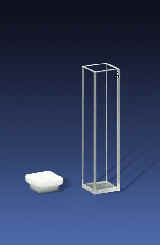
Fluorc1.jpg

The problem is the cap. The cuvettes are to be inserted inside of a solenoid, so the only possible way for them to be properly situated is horizontally. However, light from a laser cannot pass through the cap. Is there an affordable solution to finding UV plastic cuvettes that can be placed horizontally? Thank You.
 
Science news on Phys.org
How about an alternate approach?

Support the solenoid vertically, even put it on two stacks of books if nothing else is available.
Put a microscope slide under the solenoid so you have a support for the cuvettes and place the cuvette in the solenoid. Then you can leave the cap off.
The light source can be either under the solenoid pointing upward, or aimed at a mirror or prism under the solenoid to aim the light upward.
The sensor could rest on top of the solenoid or you could place another mirror up there to redirect the output light to the sensor.

Or if it is easier, put the light source above the solenoid and the sensor below it.
 

Similar threads

  • · Replies 3 ·
Replies
3
Views
7K
  • · Replies 3 ·
Replies
3
Views
2K
  • · Replies 4 ·
Replies
4
Views
2K
  • · Replies 5 ·
Replies
5
Views
2K
  • · Replies 18 ·
Replies
18
Views
4K
  • · Replies 2 ·
Replies
2
Views
1K
  • · Replies 152 ·
6
Replies
152
Views
11K
  • · Replies 8 ·
Replies
8
Views
3K
Replies
4
Views
3K
  • · Replies 1 ·
Replies
1
Views
8K