Why does my Patton-Reeder indicator immediately turn blue? (Ca2 conc.)

  • Thread starter Thread starter rwooduk
  • Start date Start date
Click For Summary

Discussion Overview

The discussion revolves around the use of the Patton-Reeder (PR) indicator in measuring calcium ion concentration using the EDTA method. Participants explore the effects of pH, the presence of other ions, and the preparation of the calcium solution, with a focus on troubleshooting unexpected color changes in the indicator.

Discussion Character

  • Exploratory
  • Technical explanation
  • Debate/contested
  • Experimental/applied

Main Points Raised

  • One participant notes that the PR indicator turns dark blue immediately upon addition to the calcium solution, questioning the role of magnesium and potassium in the reaction.
  • Another participant suggests that potassium and sodium do not significantly affect the EDTA or PR indicator reactions, emphasizing the importance of maintaining a high pH to facilitate the EDTA/Ca reaction.
  • Concerns are raised about the use of a carbonate buffer in preparing the calcium solution, as it may precipitate calcium and affect the titration results.
  • A participant shares their experience of adjusting the pH of the calcium solution and achieving the expected color change in the PR indicator, indicating that the initial high pH may have influenced the results.
  • It is mentioned that indicators used in complexometric titrations can also respond to pH changes, which may be relevant to the observed color changes.

Areas of Agreement / Disagreement

Participants express differing views on the role of magnesium and the effects of pH on the indicator's behavior. The discussion remains unresolved regarding the optimal preparation of the calcium solution and the specific conditions affecting the indicator's response.

Contextual Notes

Participants highlight potential limitations in the preparation of the calcium solution, including the influence of pH and the presence of buffering agents, which may not have been adequately addressed in the initial guide.

rwooduk
Messages
757
Reaction score
59
I was trying to use the ethylenediaminetetraacetic acid (EDTA) method using this simple guide to measure the calcium ions in my CaCl2 (2.4 mM) + NaHCO3 (6.4 mM) solution. But the solution immediately turns dark blue (like really dark) when I add the indicator to the calcium solution.
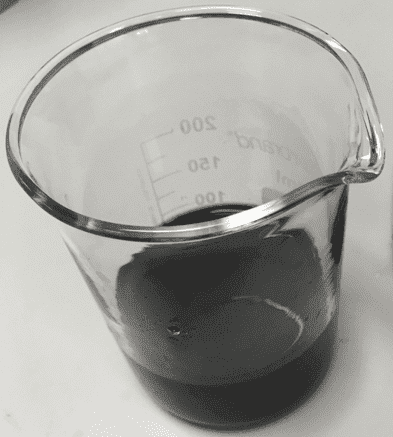
2LTZjhY.png


From the guide; excess calcium ions form a complex with the PR indicator (pink), but then as the EDTA is added they start to form a complex with EDTA and it turns blue.
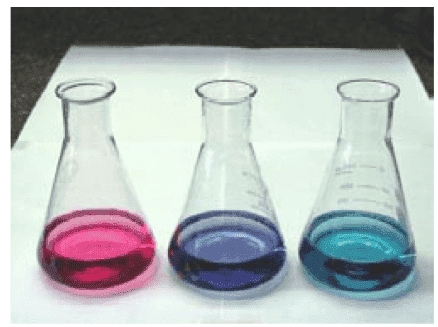
RJnv7eL.png

## [Ca-PR] + EDTA^{4-}\rightarrow PR + [Ca-EDTA]^{2-}##​

The background to this comes from some papers that say the EDTA method is via magnesium precipitatation as magnesium hydroxide by addition of potassium hydroxide. Then, calcium forms a stronger complex with EDTA than magnesium. Where does the magnesium fit into the above reaction? Where's the potassium?

Now, there is no magnesium or potassium in my calcium solution, so I believe this may be the problem.

My PR indicator immediately turns dark blue when added to my calcium solution. Do I need to add magnesium to my solution and use potassium hydroxide? However, nowhere in the "Solutions Needed" part do they mention magnesium. The guide is quite confusing.

Also, in order to make the calcium solution, NaOH (0.1 N) is added to the ##NaHCO_{3}##, to get the pH to 9.1. Then it is mixed with the ##CaCl_{2}## resulting in a final pH of 8.8. In my experiment the pH was measured at 12.78 and it stayed at that value when the ##CaCl_{2}## was added (no idea why, will try using less NaOH). Could the pH have been to high?

Please could someone give me a point in the right direction? What do I need to do to my calcium solution in order to use the EDTA method?
 
Chemistry news on Phys.org
Potassium and sodium don't matter here, they don't react with neither EDTA nor the PR indicator (or, to be more precise, stability constants of these complexes make them negligible). NaOH or KOH is added to keep pH as high as possible. That serves two purposes - it makes the EDTA/Ca reaction easier (EDTA is a weak acid, ionizing it in a high pH is beneficial), but more importantly it masks the Mg precipitating it as Mg(OH)2. If there is no Mg present, added base just keeps the pH high.

Calcium solution made by using carbonate buffer sounds off, as it will precipitate calcium, removing it from the solution. Try if preparing calcium solution without a buffer won't make the titration work.
 
  • Like
Likes   Reactions: rwooduk
Borek said:
Potassium and sodium don't matter here, they don't react with neither EDTA nor the PR indicator (or, to be more precise, stability constants of these complexes make them negligible). NaOH or KOH is added to keep pH as high as possible. That serves two purposes - it makes the EDTA/Ca reaction easier (EDTA is a weak acid, ionizing it in a high pH is beneficial), but more importantly it masks the Mg precipitating it as Mg(OH)2. If there is no Mg present, added base just keeps the pH high.

Thank you Borek. Yes, there should be no (or negligible) Mg as I used DI to make the calcium solution. The pH was certainly high!

Borek said:
Calcium solution made by using carbonate buffer sounds off, as it will precipitate calcium, removing it from the solution. Try if preparing calcium solution without a buffer won't make the titration work.

Trying the ##CaCl_{2}## solution is a good idea, for me to learn the process, I will go do that now thanks.

The reason for the bicarbonate is to make a calcium carbonate saturated solution, for precipitation purposes. NaOH is added to the bicarbonate as here:

HKpcU8d.png

Paper here for your interest.​

It actually works pretty well! For example, I compared ##CaCl_{2} + Na_{2}SO_{4}## solution to ##CaCl + NaHCO_{3} (+NaOH)## solution, the precipitation is significantly reduced. I am now just trying to measure the calcium ion concentration to confirm enough excess ##Ca^{2+}## ions in solution for my process.
 
Ok the PR with the ##CaCl_{2}## (pH 7) turned blue, the PR with ##CaCl_{2}## and NaOH (pH 12) turned the pink I need. pH 12 was about the pH of my calcium solution that I made. So I made a new solution, adjusted to pH 12, and this time it turned pink. I added the EDTA, then it turned blue. No idea what went wrong the first time, maybe too much indicator so the pink looked purple / blue. Anyway, now back on track!

Thanks Borek, otherwise I would have ended up with some concoction of magnesium, potassium, sodium etc etc.
 
Most of the indicators used in complexometric titrations are also reacting to pH changes. I am not saying that's the case here, but it is something to always consider.
 
  • Like
  • Informative
Likes   Reactions: jim mcnamara and rwooduk

Similar threads

  • · Replies 2 ·
Replies
2
Views
18K
  • · Replies 3 ·
Replies
3
Views
7K
  • · Replies 19 ·
Replies
19
Views
10K