Discussion Overview
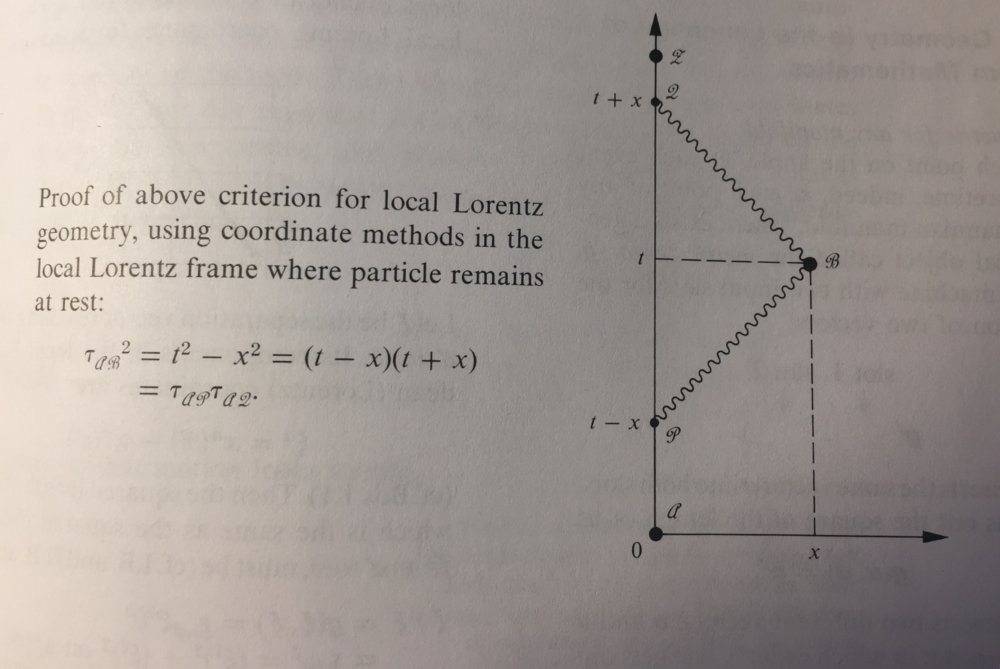
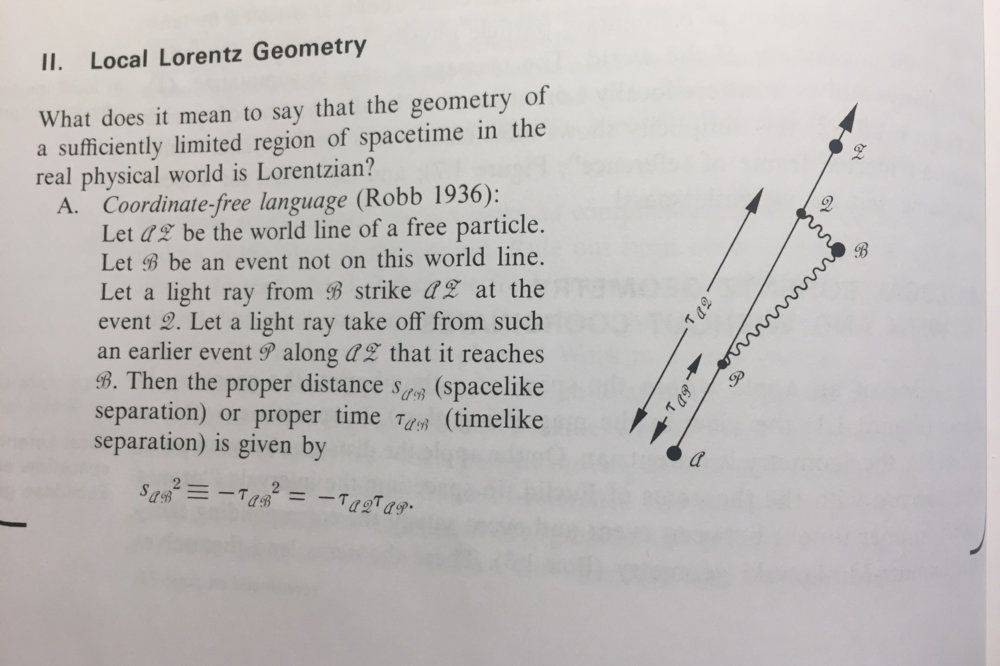
The discussion centers on the mathematical formulation of proper time in Lorentz geometry, specifically why the invariant interval is expressed as t² - x² rather than t² + x². The scope includes theoretical aspects of special relativity and the implications of Minkowski geometry.
Discussion Character
- Technical explanation
- Conceptual clarification
- Debate/contested
Main Points Raised
- Some participants assert that the use of t² - x² is due to the properties of Minkowski geometry, contrasting it with Euclidean geometry.
- Others propose that the Lorentz transformations preserve the quantity Δt² - Δx², suggesting it is the physically significant invariant interval.
- A participant questions the derivation of the invariant interval and seeks graphical representation to understand the relationship between intervals in different frames.
- Some participants discuss the limitations of Euclidean diagrams in accurately representing Minkowski spacetime, noting that the Pythagorean theorem does not apply.
- There is a suggestion that the invariance of Δt² - Δx² can be shown through algebraic manipulation of the Lorentz transformations.
- One participant highlights the distinction between two theoretical frameworks: one where a universal speed exists (as in relativity) and another where it does not (as in Galilean transformations).
Areas of Agreement / Disagreement
Participants express differing views on the derivation and interpretation of the invariant interval, with no consensus reached on the underlying reasons for the choice of t² - x² over t² + x².
Contextual Notes
Some participants note the limitations of using Euclidean geometry to represent Minkowski spacetime, indicating that certain assumptions and conditions may affect the interpretation of the invariant interval.