Why is the electric field within a conducting sphere 0?

Click For Summary

Discussion Overview

The discussion revolves around the question of why the electric field within a conducting sphere is zero. Participants explore various theoretical perspectives, including symmetry arguments, Gauss's law, and the behavior of electric fields in different configurations of charged spheres, including conductors and dielectrics.

Discussion Character

  • Exploratory
  • Technical explanation
  • Debate/contested
  • Mathematical reasoning

Main Points Raised

  • Some participants assert that the electric field within a charged conducting sphere is zero due to the symmetry of charge distribution on the surface.
  • Others argue that if the electric field were not zero, it would create a net force on the charges, causing them to move until equilibrium is reached, resulting in a zero field.
  • A participant introduces the concept of Gauss's law, suggesting it applies to any inverse square law and supports the argument for a zero electric field inside a conductor.
  • Some participants discuss the behavior of electric fields in dielectric materials, questioning whether a uniformly charged dielectric shell also has a zero field inside.
  • There is a contention regarding the claim that all dielectrics, regardless of their permittivity, would have zero electric fields inside, with some participants challenging this assertion.
  • One participant mentions that the electric field inside a rigid sphere with a uniform charge distribution would vary, depending on whether the sphere is conducting or not.

Areas of Agreement / Disagreement

Participants express multiple competing views regarding the behavior of electric fields in conducting versus dielectric spheres, and the discussion remains unresolved on certain points, particularly concerning the implications of dielectric materials.

Contextual Notes

Some arguments depend on assumptions about charge distribution and the nature of the materials involved (conductors vs. dielectrics). The discussion highlights the complexity of electric field behavior in different configurations without reaching a consensus.

jackrc11
Messages
6
Reaction score
0
Given a charged sphere, the electric field within it is zero at every point. Why is this? Why is not merely zero only at the center? If a sphere is conducting, then its charge is all across the surface. If electric field is inversely proportional to distance from charge squared, won't the field be greater at a point that isn't in the center, as it will be closer to one side of the sphere?

My attempt to visualize this question: http://[PLAIN]http://i.imgur.com/nhvZjNh.png
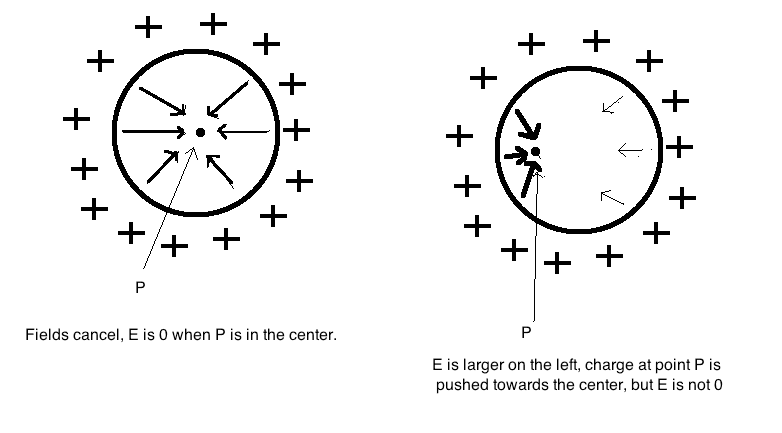
nhvZjNh.png
 
Last edited by a moderator:
Physics news on Phys.org
In your second diagram, what about all the charges on the right side that would contribute arrows generally opposite to those you drew?
 
There is another way of looking at it. Suppose that the electric field is not zero[/color] inside the sphere. In what direction would it point? Answer: By symmetry, it can only point radially in because there is as much charge on the left as on the right and towards us and away from us. Now imagine you start moving radially in towards the center. It follows that at any point along your path the field is directed towards the center and gets weaker and weaker until it is zero at the center. Now what would happen if you go past the center? The field will reverse direction and get stronger and stronger as you move outwards. Now this would be the case if you start at any other point inside the sphere and if you sketch typical field lines, they should all be drawn radially inwards and stop at the center. Now you know that electric field lines start at positive charges and end at negative charges. The ones in the sketch start at positive charges alright, but there is no negative charge at the center to stop them. We reached this impossibility because we assumed that the field is not zero inside the sphere and because of symmetry. Assuming that the charge distribution is spherically symmetric, we must accept that the field is zero inside.

If you have studied Gauss's law, you will recognize it as the basis of this argument. Note that if the charges are on the surface of a conductor, the electric field is zero inside the conductor regardless of the symmetry of their distribution.
 
Gauss's law applies for any inverse square law.
Why?
Consider the situation in your right figure. The charges on the left are closer to P, but there are more charges to the right of P. Look at an infinitesimal solid angle pointing directly left of P, and another one pointing directly right. The right solid angle subtends a larger surface area than the left solid angle. The amount of surface area subtended increases with distance squared (for uniform charge distribution). Therefore, the number of charges per unit solid angle increases with distance squared. The force per charge decreases by 1/distance squared. Distance cancels and the force per solid angle is independent of distance.

Similarly, the brightness of a surface is independent of distance. That's because intensity drops off as 1/distance squared.
 
The shortest explanation I have heard is that, if there was any field remaining, the charges in it would move since they experience a net force. So, the only stable situation is where the charges arranged themselves to experience no field.
 
rumborak said:
The shortest explanation I have heard is that, if there was any field remaining, the charges in it would move since they experience a net force. So, the only stable situation is where the charges arranged themselves to experience no field.
That is correct if the charged sphere is a conductor in which charges are free to move. However, the electric field is also zero inside the cavity of a uniformly-charged spherical dielectric shell in which the charges are not free to move.
 
That sounds like a dubious claim to be honest. Any dielectric, no matter its epsilon_r? I will certainly agree with a conducting shell having no field inside, but since air itself is a dielectric, a shell of air certainly has a field inside.
 
rumborak said:
That sounds like a dubious claim to be honest. Any dielectric, no matter its epsilon_r? I will certainly agree with a conducting shell having no field inside, but since air itself is a dielectric, a shell of air certainly has a field inside.
It looks like you do not understand dielectrics. A shell of air has zero net charge on its surface and there is no field inside it. I am talking about a uniformly-charged[/color][/color] spherical dielectric shell. The key to the argument is spherical symmetry. Imagine charges being pasted uniformly over the surface of the sphere. If there were a field inside, in what direction would it point? There is nothing in the physical situation (the spatial disposition of the charges) to make one direction in space more preferred than some other direction. Of course, if the distribution on the surface is not spherically symmetric, then there could be an electric field inside the shell.

See .
 
@kuruman , I'm talking about these kinds of spheres being able to compensate for *external* fields. Just a charged hollow sphere on its own will obviously have no field inside simply out of symmetry. The difference between dielectric and conductor is that the latter is able to compensate for external fields, and still have no internal field. That's why Faraday cages won't work with wood, but only metal.
 
  • #10
jackrc11 said:
Given a charged sphere, the electric field within it is zero at every point. Why is this?
Your original question has no mention of the sphere being conducting. The assumption then is that it is not necessarily conducting and I replied accordingly.
rumborak said:
@kuruman , I'm talking about these kinds of spheres being able to compensate for *external* fields. Just a charged hollow sphere on its own will obviously have no field inside simply out of symmetry. The difference between dielectric and conductor is that the latter is able to compensate for external fields, and still have no internal field. That's why Faraday cages won't work with wood, but only metal.
I pointed out as much in post #6 which you labeled " ... a dubious claim to be honest." Well, OK.
 
  • #11
rumborak said:
The shortest explanation I have heard is that, if there was any field remaining, the charges in it would move since they experience a net force. So, the only stable situation is where the charges arranged themselves to experience no field.
Why wouldn't that argument apply equally to the space outside the sphere? There needn't be any actual charges inside the space contained by the sphere
 
  • Like
Likes   Reactions: tellmesomething
  • #12
There are several configurations which the sphere internal field will depend on:

1. The sphere is rigid and has a given uniform charge distribution and the charges cannot move. In this case the electric field is linearly increasing from the center up to the surface and then decreasing inversely proportional to square of distance from center. This can be easily calculated from Gauss' law.

2. The sphere is rigid and perfectly conducting. Then all the charges are uniformly distributed across the surface and the field is zero inside the sphere and inversely proportional to square of distance from center outside. This is valid in case of zero outer field. If the outer field is non-zero, then the charges are complexly distributed across the surface, and again, the resulting field inside would be zero, but the outside E-vectors at the surface are always normal to the surface at any point.
 

Similar threads

  • · Replies 5 ·
Replies
5
Views
1K
  • · Replies 11 ·
Replies
11
Views
4K
  • · Replies 3 ·
Replies
3
Views
2K
  • · Replies 4 ·
Replies
4
Views
2K
  • · Replies 16 ·
Replies
16
Views
2K
  • · Replies 4 ·
Replies
4
Views
2K
  • · Replies 1 ·
Replies
1
Views
1K
  • · Replies 3 ·
Replies
3
Views
7K
  • · Replies 29 ·
Replies
29
Views
2K
Replies
12
Views
2K