Why you need a integration constant

Click For Summary
SUMMARY

The discussion focuses on the necessity of including an integration constant when performing integration in calculus. Participants clarify that the derivative of a constant is zero, which means that any indefinite integral is valid only up to a constant. Specifically, the integration of the expression RTlnC results in RTlnC + cte, emphasizing that potential energy is arbitrary and can be set to zero at infinity. This understanding is crucial for accurately determining potential energy variations in physics and mathematics.

PREREQUISITES
  • Understanding of basic calculus concepts, particularly integration and differentiation.
  • Familiarity with the concept of potential energy in physics.
  • Knowledge of logarithmic functions and their derivatives.
  • Experience with mathematical notation and expressions involving constants.
NEXT STEPS
  • Study the Fundamental Theorem of Calculus to understand the relationship between differentiation and integration.
  • Explore the concept of potential energy in classical mechanics, focusing on its arbitrary nature.
  • Learn about the properties of logarithmic functions and their applications in integration.
  • Practice solving integration problems that involve constants to reinforce understanding.
USEFUL FOR

Students and professionals in mathematics, physics, and engineering who seek to deepen their understanding of integration techniques and the implications of integration constants in various applications.

Vdslaur
Messages
2
Reaction score
0
Can someone help me with this integration?
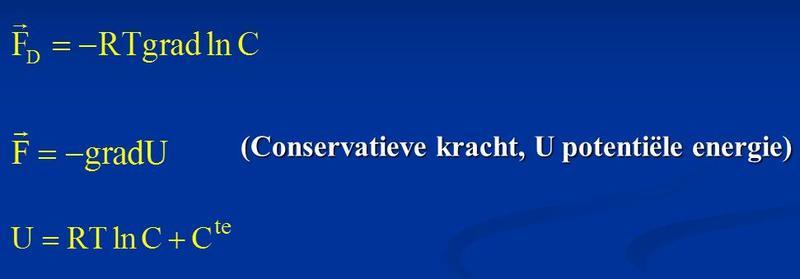
fysica3.jpg


Don't understand why you need a integrationconstant.

I would do : RTlnC = U but this isn't correct, you have to put + cte

Why?
 
Physics news on Phys.org


Hallo Vdslaur
The derivative of a Cte is 0
When you integrate something, the result is always true up to a cte, since if you derive you will get the same answer back for any cte.
That tells you the potential energy '0' is undefined, it's arbitrary, all that matters are its variations. in general you want to set it 0 at infinity.


oli4 said:
Hallo Vdslaur
The derivative of a Cte is 0
When you integrate something, the result is always true up to a cte, since if you derive you will get the same answer back for any cte.
That tells you the potential energy '0' is undefined, it's arbitrary, all that matters are its variations. in general you want to set it 0 at infinity.

I know that you integrate the U but

for exmple : the integration of dx = x + cte

But here the integration gives you : RTlnC +cte

So : dU = d(RTlnC)

Solution after integration of dU = U
Solution after integration of d(RTlnC) = RTlnC + cte

This is right no?

d(RTlnC) = RT d(lnC)

And d(lnC) is the same as dx , so x + cte --> here : lnC + cte

yes, I get it!
 

Similar threads

Replies
4
Views
1K
  • · Replies 5 ·
Replies
5
Views
1K
Replies
9
Views
3K
  • · Replies 3 ·
Replies
3
Views
2K
  • · Replies 9 ·
Replies
9
Views
2K
  • · Replies 2 ·
Replies
2
Views
1K
  • · Replies 16 ·
Replies
16
Views
3K
  • · Replies 1 ·
Replies
1
Views
2K
  • · Replies 5 ·
Replies
5
Views
2K
  • · Replies 2 ·
Replies
2
Views
2K