Gabriele99
- 5
- 0
Complete question:
Will flow ever reverse or stop if we increase resistance in this pipe scenario?
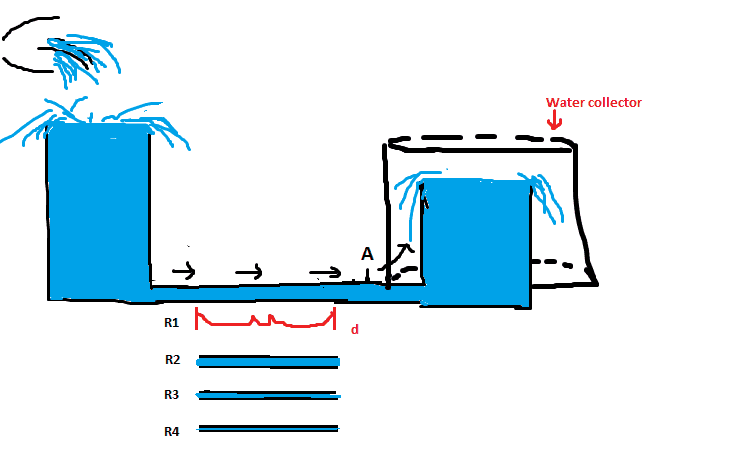 There are 2 comunicating vessels. The highest vessel is coninuosly alimented with new water. Water in excess flows down on the sides.
Water will try to reach the same height in both vessels, so some water will pour out of the shortest one and will be collected by the water collector.
The pipe distance d and the point A are our elements of interest.
The pipe distance d can be considered our main resistance to the flow, and it increases as the pipe become of a smaller diameter ( R1, R2, R3, R4 ).
In the first scenario, the pipe distance d doesn't get restricted so the pressure at point A should be the pressure exerted by the left vessel's water column minus the pressure exerted by the right vessel's water column.
Flow should be from left to right since the right vessel is higher, shouldn't?
What does it happen if we restrict the pipe distance d, given that some water is always able to flow through it ( Resistance it's not infinity )?
If we restrict the pipe distance d shouldn't pressure exerted by the water coming from the restricetd pipe too weak respect at point A to overcome the presssure exerted by the right vessel's water column?
If this is correct, shouldn't flow stop,or reverse and then stop?
Will flow ever reverse or stop if we increase resistance in this pipe scenario?
Water will try to reach the same height in both vessels, so some water will pour out of the shortest one and will be collected by the water collector.
The pipe distance d and the point A are our elements of interest.
The pipe distance d can be considered our main resistance to the flow, and it increases as the pipe become of a smaller diameter ( R1, R2, R3, R4 ).
In the first scenario, the pipe distance d doesn't get restricted so the pressure at point A should be the pressure exerted by the left vessel's water column minus the pressure exerted by the right vessel's water column.
Flow should be from left to right since the right vessel is higher, shouldn't?
What does it happen if we restrict the pipe distance d, given that some water is always able to flow through it ( Resistance it's not infinity )?
If we restrict the pipe distance d shouldn't pressure exerted by the water coming from the restricetd pipe too weak respect at point A to overcome the presssure exerted by the right vessel's water column?
If this is correct, shouldn't flow stop,or reverse and then stop?
