Work Done on an object by 3 Forces (Very Confused)

Join the discussion
Registration is free. Ask a follow-up in this thread, or start your own.
4 replies · 2K views
Travis Enigma
Messages
13
Reaction score
4
Homework Statement
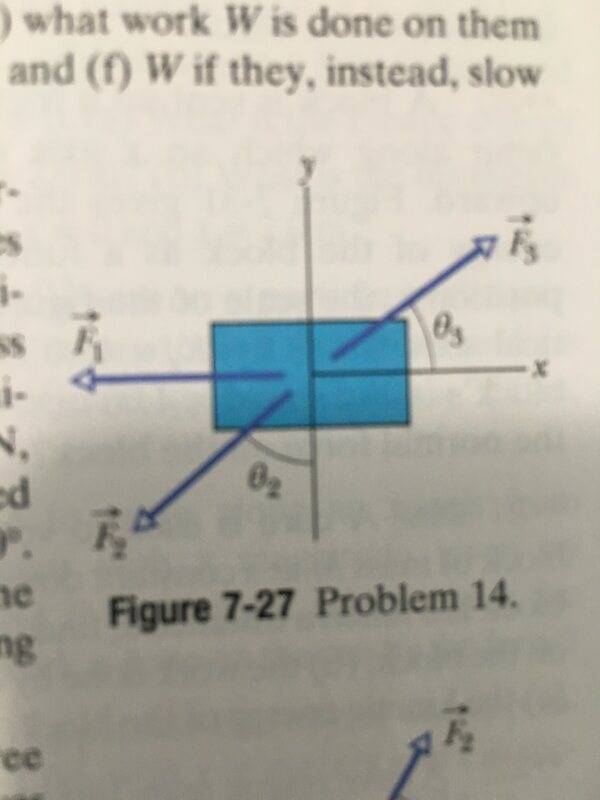
The figure shows an overhead view of three horizontal forces acting on a cargo canister that was initially stationary but now moves across a frictionless floor. The force magnitudes are F1 = 3.00 N, F2 = 4.00 N, and F3 = 10.0 N, and the indicated angles are θ2 = 50.0˚ and θ3 = 35.0˚. What is the net work done on the canister by the three forces during the first 4.00 m of displacement?
Relevant Equations
W= F*d*cos(theta)
Here's a diagram of the object
IMG_3156.JPG
My Question: My friend and I were solving this problem. We both found Fxnet and Fynet. However to find work I did W= Fnet*d whereas he did W= Fxnet* d. He claims that since it's sliding on the floor it can only go in the x-direction, and it can't go in the y-direction. Which one of us is right?

My 2nd Question: I always thought the following x-axis: left and right, y-axis: forward and backward, z-axis: up and down. Is this right? If so, then how come my friend is telling me it's impossible for it to go in the y-axis because it can't go up since it sliding on a horizontal plane?
 
Physics news on Phys.org
Maybe your friend doesn't realize that the figure shows an "overhead" view. So, the x-y plane is the floor. The canister is free to slide in both the x and y directions.
 
  • Like
Likes   Reactions: Travis Enigma and Lnewqban
Travis Enigma said:
My 2nd Question: I always thought the following x-axis: left and right, y-axis: forward and backward, z-axis: up and down. Is this right? If so, then how come my friend is telling me it's impossible for it to go in the y-axis because it can't go up since it sliding on a horizontal plane?
There are no specific rules concerning the directions of the x, y, and z axes. If the axes are not specified in a problem, then you are free to choose the orientation of the axes as you wish. If the axes are given, as in this problem, then you need to make sure you see how the axes are oriented in 3D space. The 3 forces are given to be horizontal. So, the x-y plane is horizontal; i.e., parallel to the floor.
 
  • Like
Likes   Reactions: Lnewqban, Travis Enigma and jbriggs444
Travis Enigma said:
Homework Statement:: The figure shows an overhead view...

My Question: My friend and I were solving this problem. We both found Fxnet and Fynet. However to find work I did W= Fnet*d whereas he did W= Fxnet* d. He claims that since it's sliding on the floor it can only go in the x-direction, and it can't go in the y-direction. Which one of us is right?
The first sentence of the problem statement says "The figure shows an overhead view".
My 2nd Question: I always thought the following x-axis: left and right, y-axis: forward and backward, z-axis: up and down. Is this right?
It is purely a matter of convention. If you are working in two dimensions with one of them vertical (for instance, a child carrying a sled up a hill) then one would normally use x for horizontal and y for vertical.

If one is working in two dimensions with both of them horizontal (for instance, a race car on a circular course), one might well use x for east-west and y for north-south.

If one is using three dimensions, you are correct that the usual convention is x for east-west, y for north-south and z for up-down.

That said, unless the problem has already stated them, you are free to define axis directions and coordinate variable names as you please. Just clearly state your choices so that the teacher can understand what you are doing.

More generally...

Often, a good choice of coordinate system can simplify a problem significantly. Changing variable names can be a way to keep track of which coordinate system you are using.
 
  • Like
Likes   Reactions: Lnewqban and TSny
Thank you both so much for your help, I understand now!