Timtam
- 40
- 0
The problem statement
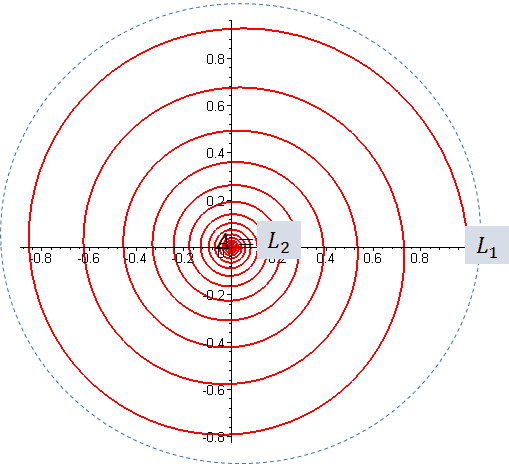 Example 1 A single particle
I have a particle being forced by a radial centripetal force onto a smaller radius
$$l_1=m_c.v_1.r_1$$
$$L_1=L_2$$
$$L_2=m_c.v_2.r_2$$
$$m_c.v_1.r_1=m_c.v_2.r_2$$
$$v_1.r_1=v_2.r_2$$
$$v_2=v_1\frac{r_2}{r_1}$$
Its increase from ##v_1## to ##v_2## is explained by Conservation of Angular Momentum
Example 2 The bathtub vortex-A particle in a fluid
I have the same particle entering a control volume- with the same angular momentum ##L_1=m_c.v_1.r_1## as its drawn towards the drain its angular velocity increases as radius decreases ##v=\frac{1}{r}##
$$v_1=\frac{1}{r_1}$$
$$v_1.r_1=1$$
$$v_2=\frac{1}{r_2}$$
$$v_2.r_2=1$$
$$v_2.r_2=v_1.r_1$$
$$v_2=v_1\frac{r_2}{r_1}$$
So in both examples the increase in velocity is explained just by Conservation of Angular momentum
Yet applying Bernoulli's and Energy conservation the increase in velocity is explained by a proportional decrease in pressure ...and we do see a pressure decrease in a vortex . (This pressure gradient ,once created is also explained to be the radial force)
My question
If the increase in Angular velocity is explained just by Conservation of Momentum - Why does the pressure decrease?
Shouldn't such a velocity change, due to a pressure change, be in addition of the radius change and the pressure change ?
Where does that decrease in potential energy go if not into an additional increase in velocity (kinetic energy) over the one expected by Angular Momentum Conservation ?
I have a particle being forced by a radial centripetal force onto a smaller radius
$$l_1=m_c.v_1.r_1$$
$$L_1=L_2$$
$$L_2=m_c.v_2.r_2$$
$$m_c.v_1.r_1=m_c.v_2.r_2$$
$$v_1.r_1=v_2.r_2$$
$$v_2=v_1\frac{r_2}{r_1}$$
Its increase from ##v_1## to ##v_2## is explained by Conservation of Angular Momentum
Example 2 The bathtub vortex-A particle in a fluid
I have the same particle entering a control volume- with the same angular momentum ##L_1=m_c.v_1.r_1## as its drawn towards the drain its angular velocity increases as radius decreases ##v=\frac{1}{r}##
$$v_1=\frac{1}{r_1}$$
$$v_1.r_1=1$$
$$v_2=\frac{1}{r_2}$$
$$v_2.r_2=1$$
$$v_2.r_2=v_1.r_1$$
$$v_2=v_1\frac{r_2}{r_1}$$
So in both examples the increase in velocity is explained just by Conservation of Angular momentum
Yet applying Bernoulli's and Energy conservation the increase in velocity is explained by a proportional decrease in pressure ...and we do see a pressure decrease in a vortex . (This pressure gradient ,once created is also explained to be the radial force)
My question
If the increase in Angular velocity is explained just by Conservation of Momentum - Why does the pressure decrease?
Shouldn't such a velocity change, due to a pressure change, be in addition of the radius change and the pressure change ?
Where does that decrease in potential energy go if not into an additional increase in velocity (kinetic energy) over the one expected by Angular Momentum Conservation ?
Last edited: