Maximizing Efficiency: The Role of Feedback in Boost Converter Switch Design

Click For Summary
SUMMARY

The discussion focuses on the design of feedback control circuits for MOSFETs in boost converters, emphasizing the necessity of feedback to maintain a stable output voltage despite variations in input voltage and load conditions. It clarifies that the output voltage (Vout) is influenced by the duty cycle, which must be adjusted to counteract drooping voltage under load. The conversation also highlights the role of Verror in regulating the duty cycle and maintaining the desired output voltage, particularly in continuous conduction mode (CCM). The use of a Zener diode for voltage stabilization is mentioned as less efficient compared to a switching regulator.

PREREQUISITES
  • Understanding of MOSFET operation in power electronics
  • Knowledge of feedback control systems and op-amp analysis
  • Familiarity with boost converter principles and continuous conduction mode (CCM)
  • Basic circuit design skills, particularly with DC-DC converters
NEXT STEPS
  • Study the principles of feedback control in power electronics
  • Learn about continuous conduction mode (CCM) in boost converters
  • Explore the design and application of op-amps in voltage regulation
  • Investigate the efficiency differences between linear regulators and switching converters
USEFUL FOR

Electrical engineers, power electronics designers, and anyone involved in the design and optimization of boost converters and feedback control systems.

TheRedDevil18
Messages
406
Reaction score
2
I'm looking into the design of the control circuit for the mosfet. If I know the output voltage and input voltage then I can find the duty cycle required. I found this schematic that uses feedback
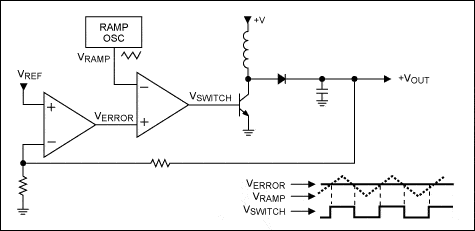
2031Fig07.gif

Source
https://www.maximintegrated.com/en/app-notes/index.mvp/id/2031

Why would I need feedback that changes the duty cycle like above ?, if the output voltage is dependent on the duty cycle and Vin and if those are fixed values then Vout should be constant regardless of load ?, also I'm a bit confused on the working of the above schematic, is it trying to maintain Verror of 0V regardless of changes in Vout ?
 
Engineering news on Phys.org
What makes you think that the Vin would be fixed? This is not often the case. There are other things that will cause the output voltage to droop when a load is applied also. You are thinking it backwards concerning the output voltage and the Verror. Verror does whatever it has to in order for the inverting and noninverting inputs of the opamp to remain virtually the same. This is a basic rule in opamp analysis. So if the reference is stable, can you see how the rest of the circuit will behave?
 
  • Like
Likes   Reactions: davenn
DC to DC converters behaves just like a ideal "DC" transformer. And for the boost converter n = Vout/Vin = 1/(1 - D) but this is true only when the inductor is working in continuous conduction mode (CCM), the inductor current never reaches 0A. And all component are ideal also Vin is kept constant.
And because we are living in non ideal world we need to change duty cycle to kept Vout at fixed value.
 
Averagesupernova said:
What makes you think that the Vin would be fixed? This is not often the case. There are other things that will cause the output voltage to droop when a load is applied also. You are thinking it backwards concerning the output voltage and the Verror. Verror does whatever it has to in order for the inverting and noninverting inputs of the opamp to remain virtually the same. This is a basic rule in opamp analysis. So if the reference is stable, can you see how the rest of the circuit will behave?

So basically Vref would be the max boost converter output voltage or voltage you are trying to maintain. So if for example we are trying to maintain 10V on the output and Vout drops to 9.7V then Verror is 10V-9.7V = 0.3V. If Verror increases then the duty cycle decreases. But if the voltage decreases then the duty cycle should increase since Vout = Vin/(1-D) ?
 
TheRedDevil18 said:
So basically Vref would be the max boost converter output voltage or voltage you are trying to maintain. So if for example we are trying to maintain 10V on the output and Vout drops to 9.7V then Verror is 10V-9.7V = 0.3V. If Verror increases then the duty cycle decreases. But if the voltage decreases then the duty cycle should increase since Vout = Vin/(1-D) ?
If Vout drops the voltage at Verror will rise, this means that as long as Verror > Vramp the voltage at Vswitch is high so the duty cycle increase.

170738_440698.jpg
 
Jony130 said:
If Vout drops the voltage at Verror will rise, this means that as long as Verror > Vramp the voltage at Vswitch is high so the duty cycle increase.

170738_440698.jpg

Ok, yes that makes sense. If I am designing a boost converter would I need a control system like this ?, What if I used a zener diode to fix the voltage regardless of current changes ?
 
TheRedDevil18 said:
What if I used a zener diode to fix the voltage regardless of current changes ?
It is wasteful of power, so you'd only use a zener to stabilize the output where the load draws low power. The attraction of a switching booster/regulator is that it can offer efficient operation at high power.
 

Similar threads

Replies
55
Views
6K
  • · Replies 14 ·
Replies
14
Views
2K
  • · Replies 23 ·
Replies
23
Views
5K
  • · Replies 17 ·
Replies
17
Views
3K
  • · Replies 10 ·
Replies
10
Views
3K
Replies
2
Views
2K
  • · Replies 14 ·
Replies
14
Views
7K
  • · Replies 1 ·
Replies
1
Views
2K
  • · Replies 3 ·
Replies
3
Views
7K
  • · Replies 31 ·
2
Replies
31
Views
9K