Calculate the distance travelled in a moving circumference?

Click For Summary

Discussion Overview

The discussion revolves around calculating the distance traveled by a point on a translating and rotating circumference. Participants explore the mathematical formulation needed to derive a function for the path taken by the point, considering both translational and rotational motion.

Discussion Character

  • Mathematical reasoning
  • Technical explanation

Main Points Raised

  • One participant clarifies that they are interested in a translating circumference that is also rotating, and seeks to derive a function for the path taken by a point on it.
  • Another participant suggests that knowing the velocity allows for the calculation of speed at every point in time, and that integrating this speed will yield the length of the path, although they note that the integral may be complex to evaluate analytically.
  • A further contribution discusses modifying the velocity components for the x and y axes, proposing that the total velocity can be expressed and integrated over a specified time period, while questioning whether elliptic integrals of the second type might be necessary for this integration.

Areas of Agreement / Disagreement

There is no consensus reached among participants, as they explore various approaches and considerations without settling on a definitive method or conclusion.

Contextual Notes

The discussion includes assumptions about the nature of the motion and the mathematical tools required, but these assumptions are not fully explored or resolved.

pabilbado
Gold Member
Messages
17
Reaction score
1
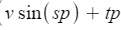
First of all I don't mean a rotating circumference, but rather a translating one which is also rotating. Like this one: https://www.desmos.com/calculator/4vdymlzgpp just play the p button. I understand that the x component of the movement is:
68a939b26317c5080be80eeb341f5591.png
and Y=
4d939c3651eddfe42a77fb0ccf1e852d.png
(where v is the radius, s is the angular frequency, p is time a t is the velocity of the circunference.) How can I derive a function that allows me to calculate the path the point has taken?
 
Physics news on Phys.org
You know the velocity, so you can calculate the speed at every point in time. Integrating this will give the length of the path. The integral might be hard to evaluate analytically.
 
  • Like
Likes   Reactions: pabilbado
mfb said:
You know the velocity, so you can calculate the speed at every point in time. Integrating this will give the length of the path. The integral might be hard to evaluate analytically.
So, if I just change some things like: The velocity on the x-axis =
339514d736b412d7db223e0f96038770.png
and the velocity on the y-axis =
929d2c743d37a5b0d45b2783d2ef838f.png
(v = maximun velocity, w is the angular frequency. x = time and m = the velocity of the circumference.) So can I write that the total velocity =
477694c6a1040292729ae86563edbbb9.png
and integrate between the periods of time I want? And to integrate this may I need to use elliptic integrals of second type?
 
Right.
 
  • Like
Likes   Reactions: pabilbado
mfb said:
Right.
Thanks a lot!
 

Similar threads

  • · Replies 11 ·
Replies
11
Views
4K
  • · Replies 30 ·
2
Replies
30
Views
5K
  • · Replies 32 ·
2
Replies
32
Views
3K
  • · Replies 9 ·
Replies
9
Views
3K
  • · Replies 17 ·
Replies
17
Views
4K
  • · Replies 11 ·
Replies
11
Views
2K
  • · Replies 21 ·
Replies
21
Views
2K
  • · Replies 20 ·
Replies
20
Views
4K
  • · Replies 35 ·
2
Replies
35
Views
5K
  • · Replies 1 ·
Replies
1
Views
3K