Can the intensity of soundwaves be affected by the size of a gap?

Click For Summary

Discussion Overview

The discussion centers on whether the intensity of sound waves can be influenced by the size of a gap, particularly in the context of sound propagation through an opening. Participants explore various factors such as frequency, wavelength, amplitude, and resonance, considering both theoretical implications and practical observations.

Discussion Character

  • Exploratory
  • Debate/contested
  • Technical explanation

Main Points Raised

  • One participant suggests that different frequencies may pass through a gap with varying intensity due to their wavelengths, questioning if a gap smaller than the wavelength affects sound intensity.
  • Another participant introduces the concept of resonance in the room, proposing that it could influence the sound available to pass through the gap.
  • A different viewpoint posits that neither wavelength nor amplitude affects intensity, suggesting that the situation resembles a wave interference pattern.
  • Some participants argue that higher frequencies should be louder as they are less diffracted compared to lower frequencies, while also noting that off-axis observations may yield different results.
  • Multi-path cancellation is discussed as a phenomenon that could affect sound intensity due to reflections and varying path lengths in the room.
  • One participant expresses a desire for an experimental setup to test these ideas, indicating a need for empirical data to clarify the effects of the gap size on sound intensity.

Areas of Agreement / Disagreement

Participants express differing views on the relationship between gap size, frequency, wavelength, and sound intensity. There is no consensus on how these factors interact, and the discussion remains unresolved regarding the specific effects of the gap size on sound propagation.

Contextual Notes

Participants acknowledge the complexity of sound wave behavior in three-dimensional spaces and the potential influence of room acoustics, such as resonance and multi-path effects, on sound intensity. Some assumptions about ideal conditions are not fully explored.

blake2
Messages
3
Reaction score
0
Ok so I was sitting out back one day listening to some music with some friends around.
We had some music playing on a stereo inside the house and we were out the back with the glass door open about 10 cm's.

I thought I noticed that some sounds with different frequencies seemed louder then other sounds with noticably different frequencies. So i suggested that perhaps the wavelength of some of the sounds with frequency x, was making it through the small gap whereas another sound at the same instance with wavelength and frequency y was not making it through the small gap.
Is this correct?

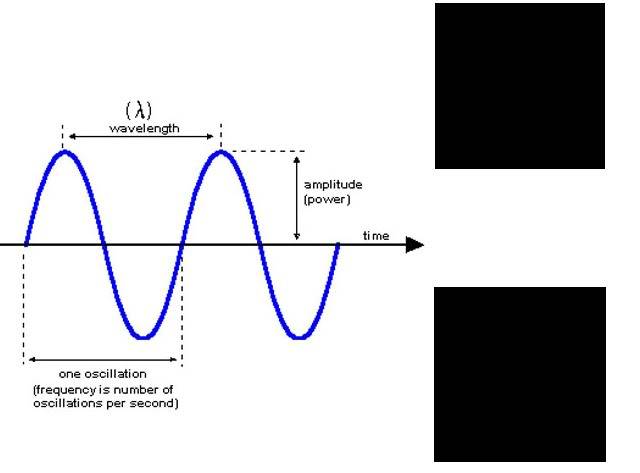
It sounded correct but the more i think about it the more complex it becomes. I cannot imagine a sound wave propagating through 3-dimensional area and where the amplitude comes into effect. I understand how a soundwave is simply compression of air and the distance between two compressions is the wavelength BUT where is the amplitude?

Would a gap smaller then the wavelength effect the intensity of the sound you are hearing or since the wavelength travels longitudinally then the gap would not effect it?
What about amplitude. If the amplitude is of a greater distance then the gap then would the resultant intensity become lesser then a sound with smaller amplitude then the gap?

Ignoring any sound coming through the barriers of course and think theoretically.
You could set up an experiment to emit sounds of differing frequency and amplitude to try and see if the gap effects the resultant intensity of the sound (if a soundwave travel through the gap un-hindered then it is going to be louder then a soundwave that hits the barrier and travels through that)

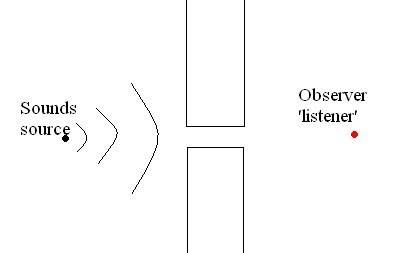
Its a slit experiment but in 3-dimensions;
soundwaves.jpg
soudnwave22.jpg
 
Physics news on Phys.org


Just to point out that the room in which the loudspeakers are sited may have a resonance which affects the amount of sound available to pass through the door/slit.


I think i understand it better now.
I found a definition of amplitude of sound waves and all it is is the "maximum change in position of the particles that make up the medium"so it is really just the amount the air molecules in the case are compressed.
So i think the answer would be that neither the wavelength or the amplitude would effect the intensities... Rather it would just be like a regular wave like interference pattern?


From your picture, the higher frequencies should be louder, because they aren't diffracted as much as the lower frequencies. If you move laterally away from the opening (i.e. your observer is off-axis from the gap), the lower frequencies should be louder.

Here is a website:

http://hyperphysics.phy-astr.gsu.edu/hbase/sound/diffrac.html

If you do not observe this behavior (i.e., the lower frequencies are louder to you), let us know so we can try to figure out the reason.


Hi again Blake 2

I still think that resonance may be an important part of the phenomenon.

Imagine that a single-frequency sound is being generated by a single speaker in a room with a slit. If the walls are reflective of sound, there will usually be a path for sound to bounce around the room and out through the slit. There will also be a direct path from the speaker to the slit. If 1 of the paths is 1/2 a wavelength longer, cancellation to some degree will occur. This is called multi-path cancellation and is a very important phenomenon in radio, for instance. For different frequencies different paths will be important and different cancellation patterns will result.
Multi-path cancellation (or reinforcement) occurs to some degree, for most frequencies, wherever multiple paths exist between signal source and any other point of interest. Think of the slit as being the point of interest. Most of the sound heard outside comes through the partly open door or slit, so cancellation at the slit will mean a lessening of sound intensity outside.


poor mystic said:
Hi again Blake 2

I still think that resonance may be an important part of the phenomenon.

Imagine that a single-frequency sound is being generated by a single speaker in a room with a slit. If the walls are reflective of sound, there will usually be a path for sound to bounce around the room and out through the slit. There will also be a direct path from the speaker to the slit. If 1 of the paths is 1/2 a wavelength longer, cancellation to some degree will occur. This is called multi-path cancellation and is a very important phenomenon in radio, for instance. For different frequencies different paths will be important and different cancellation patterns will result.
Multi-path cancellation (or reinforcement) occurs to some degree, for most frequencies, wherever multiple paths exist between signal source and any other point of interest. Think of the slit as being the point of interest. Most of the sound heard outside comes through the partly open door or slit, so cancellation at the slit will mean a lessening of sound intensity outside.

I think i know what your saying, although the room that the speakers where in had stairs to a second floor and another room attached to it and also a hall i think that this was probably part of it too since most of the walls where concrete. I would still like to see an experiment done like this.

RedX said:
From your picture, the higher frequencies should be louder, because they aren't diffracted as much as the lower frequencies. If you move laterally away from the opening (i.e. your observer is off-axis from the gap), the lower frequencies should be louder.

Here is a website:

http://hyperphysics.phy-astr.gsu.edu/hbase/sound/diffrac.html

If you do not observe this behavior (i.e., the lower frequencies are louder to you), let us know so we can try to figure out the reason.

That website was great and its obvious now that the higher frequencies where louder and any lower ones where the ones that i thought were less intense. This is why i initially thought that it was wavelength that was the factor of intensity because the higher frequencies had smaller wavelengths that i mistook as being able to squeeze through the gap.
 

Similar threads

  • · Replies 31 ·
2
Replies
31
Views
5K
  • · Replies 17 ·
Replies
17
Views
3K
Replies
20
Views
5K
  • · Replies 20 ·
Replies
20
Views
3K
  • · Replies 1 ·
Replies
1
Views
2K
  • · Replies 81 ·
3
Replies
81
Views
8K
  • · Replies 11 ·
Replies
11
Views
6K
Replies
3
Views
2K
  • · Replies 1 ·
Replies
1
Views
10K
  • · Replies 6 ·
Replies
6
Views
2K