Confusion with Nodal Analysis w/ Sources

Click For Summary

Discussion Overview

The discussion revolves around the application of nodal analysis in circuit analysis, specifically addressing confusion regarding the correct sign conventions when voltage sources are involved. Participants explore the implications of reference points and voltage polarities in the context of a specific problem.

Discussion Character

  • Technical explanation, Conceptual clarification, Debate/contested

Main Points Raised

  • One participant expresses confusion about the signs used in nodal analysis equations involving voltage sources, particularly questioning the terms related to a 24V source.
  • Another participant explains that the polarity of the voltage source is determined by its connection to the ground reference point, which influences the voltage at different nodes.
  • A question is raised about whether the direction of current affects the application of these voltage conventions.
  • Further clarification is provided that the direction of current does not impact the voltage polarity established by the voltage sources and reference points.

Areas of Agreement / Disagreement

Participants generally agree on the importance of reference points in determining voltage polarity, but there is ongoing confusion regarding the application of these concepts in specific scenarios, indicating that multiple views remain on the correct approach to nodal analysis.

Contextual Notes

The discussion highlights potential limitations in understanding how reference points affect voltage signs and the assumptions made about current direction in nodal analysis.

RiceKernel
Messages
17
Reaction score
0
Hi , I'm currently stuck on a problem that requires to be solved with nodal analysis.

I'm confused to what signs should I use when there's a voltage source in the loop.

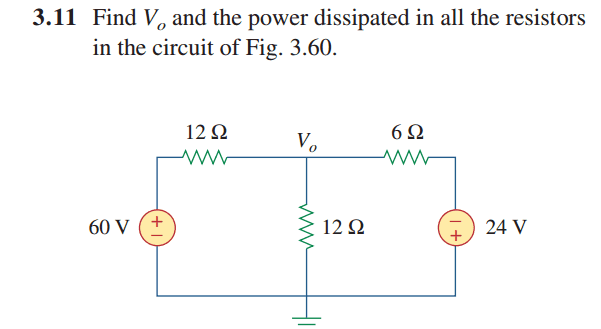
The problem:
lol2-1.png


I already know the answer from the solutions but what I found is at V_0 :

(V0 - 60V)/12 + V0/12 + (V0 -24V)/6 = 0

This is horrendously incorrect but I can't understand why . I know current flows from higher potential to lower so if that was the case then my first term would be correct (matches solution) ; the 2nd term is also correct (V0-0V)/12 but the last term is incorrect. The correct term would be (VO - (-24V))/6 and I really don't know why? Can someone explain that to me? Even for the first term, I just got lucky by putting the correct sign but I want to know why and how does the sign vary.

Oh and if anyone wants the answer , V0= 3V. Power in resistors are easy to find once the currents and voltages are found.

Thanks,
GT
 
Engineering news on Phys.org
Because 24V voltage source has a positive terminal connected to gnd and the minus terminal to 6 ohm resistor.
And this is why voltage at right side of a 6 ohm resistor is -24V ( 24 voltages lower than voltage at GND).

The reference point determines whether we have a positive or negative voltage.
See this example
32.PNG
 
Last edited:
Does this apply regardless of the direction of the current(s) ?
 
RiceKernel said:
Does this apply regardless of the direction of the current(s) ?
In this case the current direction doesn't matter here. Because only the voltage source and the reference point (GND) determines the voltage polarity.
And this is why we have -24V and 60V regardless of the direction of the currents.
 

Similar threads

  • · Replies 4 ·
Replies
4
Views
2K
  • · Replies 7 ·
Replies
7
Views
2K
  • · Replies 1 ·
Replies
1
Views
2K
  • · Replies 1 ·
Replies
1
Views
3K
  • · Replies 4 ·
Replies
4
Views
9K
  • · Replies 5 ·
Replies
5
Views
3K
Replies
20
Views
4K
  • · Replies 8 ·
Replies
8
Views
2K
  • · Replies 4 ·
Replies
4
Views
2K
Replies
5
Views
4K