Daisy-chained, parallel or series? (failed outlets in home)

  • Context: Electrical 
  • Thread starter Thread starter fog37
  • Start date Start date
  • Tags Tags
    Home Parallel Series
Click For Summary
SUMMARY

The discussion centers on troubleshooting non-functional electrical outlets in a kitchen, specifically three outlets connected in a daisy-chain configuration, including a GFCI outlet. Users emphasize the importance of checking circuit breakers, using outlet testers, and ensuring proper wiring connections. The consensus is that a loose connection or faulty wiring is likely the cause of the issue, especially since the GFCI outlet was replaced without resolving the problem. Participants recommend using a voltmeter to check for voltage and suggest that the refrigerator outlet may also be involved in the circuit.

PREREQUISITES
  • Understanding of GFCI outlet wiring and functionality
  • Familiarity with circuit breaker panels and troubleshooting techniques
  • Knowledge of basic electrical testing tools, such as voltmeters and outlet testers
  • Awareness of daisy-chain versus parallel wiring configurations
NEXT STEPS
  • Learn how to use a voltmeter for checking electrical connections
  • Research proper GFCI outlet installation and troubleshooting methods
  • Investigate the implications of daisy-chain wiring in residential electrical systems
  • Explore techniques for safely accessing and inspecting wiring in walls and attics
USEFUL FOR

Homeowners, DIY enthusiasts, and electricians troubleshooting electrical outlet issues, particularly those involving GFCI outlets and daisy-chain wiring configurations.

fog37
Messages
1,566
Reaction score
108
TL;DR
which connection is used for household electrical outlets
Hello Forum,

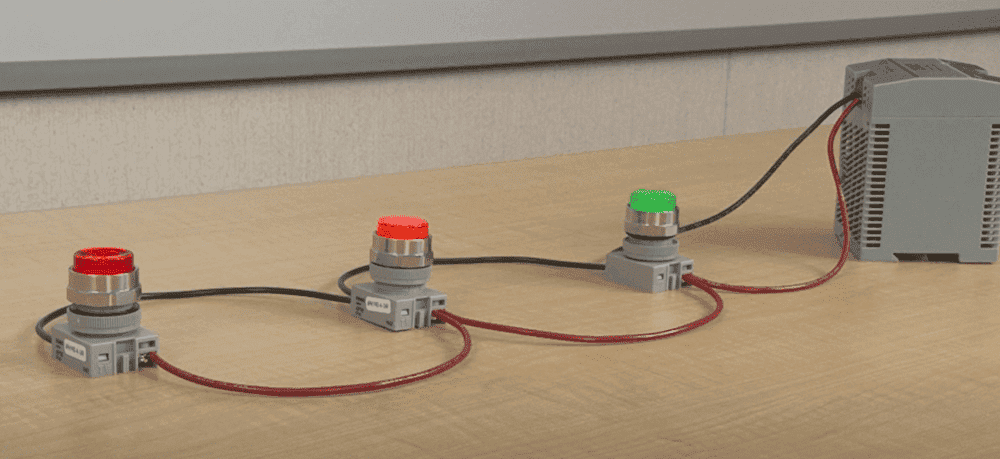
Some of my electrical outlets (3) in the kitchen stopped working (one of them is a GFCI outlet). Reading online, I found out that outlets are generally connect in a daisy-chain fashion and if one goes back they all stop working. See the figure below showing a daisy chain connection:
1610733275154.png


The connection in the figure above looks like a parallel connection (which in general assures that if a component breaks all other keep working).
But if the first device (green) in the figure break, then I believe the other two will also stop working. So this daisy chain connection is not a true parallel neither a series connection. It is more like a parallel connection but if one device breaks some of the other ones also stop functioning...

Is that correct? If so, I am trying to identify which of the three outlets is actually broken and replace it..

Thanks!
 
Physics news on Phys.org
Do the Test and Reset functions on the GFCI outlet still work, or is it refusing to reset? Do you have any GFCI breakers in your breakerbox?

Do you have an outlet tester with GFCI test capability? They are inexpensive, and very handy for debugging problems like this.

Have you ever replaced an outlet before? Do you know what-all you need to do in order to do it safely?

https://www.electricalbasics.com/electrical-testers/receptacle-outlet-gfci-tester

1610738636468.png
 
  • Like
Likes   Reactions: DaveE
Oh, and what-all was plugged into these outlets when the circuit failed? Is everything now unplugged as you try to get the circuit working again?
 
  • Like
Likes   Reactions: DaveE
GFCI outlets typically are wired to interrupt both the attached outlet and all downstream outlets. Those further away from the box.
The ground fault is also detected universally downstream.
 
  • Like
Likes   Reactions: DaveE
Hello and thanks for all the help.

  • There are 3 outlets in the kitchen. One of them is GFCI. None of them works.
  • I turned the specific breaker to OFF and the fridge also goes off so the fridge outlet must be part of the 3 outlet daisy chain but that works: when I turn the breaker ON, the fridge works but the 3 outlets do not.
  • Cell phones were typically attached to the GFCI outlet. I replaced the GFCI outlet with a new one but nothing works.
  • The GCFI has two hots wires and two white returns so it is line and load configuration.
 
Last edited:
How do you know there is only one circuit to the kitchen? My guess is that there may be another breaker controlling the GFCI outlet and its buddies? Possible? Its good practice to put the fridge on an isolated line.
The other handy tool for tracing circuits from a box is a plug -in radio...
 
dunno :)

I guess the specific switch that I turn ON/OFF at the breaker could control one, two, or more circuits.

My plan was to replace the other two outlets since I have already replaced the GFCI and things still don't work.

When I installed the new GFCI, I tried to press the test/reset but it was not working either. I am pretty sure I wired it correctly, the same way the previous GFCI was wired...
 
No I mean there may be more than one breaker (and circuit) running to the kitchen. Possible?
 
Yes. At the breaker, there are multiple switches for the kitchen (some are other outlets, etc.)
 
  • #10
It sounds like one of them is tripped still tripped. Why do you think the fridge and GFCI are on same breaker?
 
  • Like
Likes   Reactions: fog37
  • #11
hutchphd said:
It sounds like one of them is tripped still tripped. Why do you think the fridge and GFCI are on same breaker?
Because when I turn off the specific switch that I know controls the 3 outlet, the fridge turns off...
 
  • #12
How do you know it controls the 3 outlet?
 
  • #13
hutchphd said:
How do you know it controls the 3 outlet?
Because there are 3 not working outlets all located sequentially near each other, in the kitchen, by the backsplash...
 
  • #14
fog37 said:
Because there are 3 not working outlets all located sequentially near each other, in the kitchen, by the backsplash...
Hutch is asking how you know that specific breaker controls those outlets. Are you familiar with how to check your breakerbox for a popped breaker? It may not look tripped visually (depends on the type of breaker). The best way is to push each breaker arm toward the ON position firmly, and see if any of them feel springy. For many of the breakers I deal with, they only move a small amount when tripped. The only way to check them is to see if they feel springy. If one does feel springy, turn it OFF and then back to ON.

Are there any other outlets in the house that are not working? At least in the US, as far as I know it would be a code violation to use the refrigerator circuit to also power other outlets -- by code it is supposed to be a dedicated circuit, AFAIK...
 
  • Like
  • Informative
Likes   Reactions: Klystron, hutchphd, fog37 and 1 other person
  • #15
I am confident I pushed the breaker arm towards OFF and towards ON firmly. Will try again. When on OFF, also the refrigerator turns off hence its outlet is connected to the other 3 outlets that are not working...
 
  • #16
No, my point was to check all of the *other* breakers in the panel.

If the outlets kept "not working" when you turned the fridge breaker OFF and ON, that does not mean they are on the same circuit...
 
  • Like
Likes   Reactions: hutchphd
  • #17
Ok. I see. Wil try and report back. Thanks!
 
  • Like
Likes   Reactions: berkeman
  • #18
berkeman said:
No, my point was to check all of the *other* breakers in the panel.

If the outlets kept "not working" when you turned the fridge breaker OFF and ON, that does not mean they are on the same circuit...
Hello, I tried all other breaks and no luck. Also, now I remember, the outlets stopped working for 5-6 hrs. Then worked again. No don't work at all...Something loose? Would replace the other two outlets possibly solve it? One of them may be damaged. I already replaced the GFCI one but no luck...
 
  • #19
I wouldn't replace other outlets right now. It does sound like a wire connection came loose somewhere.

What room is in the other side of the wall with the dead outlets? Living room, bathroom, etc.? Do the outlets on the other side of that wall all work?

Do you have access to the attic? What kind of house/apartment is this? Multi-story or one story?

If you have access to the attic, you may be able to trace the power cables from the breaker box (in the garage?) to the top of the kitchen wall. If you can do that, you can check the the junction box at the top of the wall to see if it looks like all the wire nut connections are okay.
 
  • #20
fog37 said:
One of them may be damaged.
I missed this. What do you mean by "damaged"?
 
  • Like
Likes   Reactions: fog37
  • #21
[Mentor Note -- Moved the thread from EE to the DIY forum]
 
  • #22
berkeman said:
I missed this. What do you mean by "damaged"?
Just using "damaged" loosely for "not working". Why wouldn't a loose connection be a possibility given that they did not work, then work, then stop working again?
 
  • Like
Likes   Reactions: sophiecentaur
  • #23
Did the other GFCI ever indicate with a light a ground fault?
So you are certain the wire goes... breaker box-----fridge------GFCI----outlet-----outlet?
If so the problem is somewhere in red and you may now have a spare GFCI. Start at the easiest spot to open and start checking the wires in red for volts. Probably at a connection.
 
  • Like
Likes   Reactions: fog37
  • #24
hutchphd said:
The other handy tool for tracing circuits from a box is a plug -in radio.
OK, I've been a bona-fide Analog & PS EE for 40 years. I completely rewired my kitchen and garage without any complaints from the building inspectors. But, I never knew this trick. I always used lamps, then I had to walk back and forth to see if they were on or not. Thanks, you simultaneously saved me a bunch of work someday in the future and made me feel like an idiot!
 
  • Like
  • Informative
Likes   Reactions: hmmm27, jim mcnamara, hutchphd and 2 others
  • #25
I saw it on TV about 30 yrs ago. I had exactly the same DOH! response. I never forget a labor saving tip.
 
  • Like
Likes   Reactions: DaveE and Klystron
  • #26
OK, my apologies if I have misunderstood. But... If you don't know all about how normal GFCI outlets are wired, via web searches or DIY books, then you shouldn't be messing with this. I don't think the wiring is at all difficult to understand. By skipping the research and education part of this project you are taking unnecessary risk. Honestly the basic concepts are easy to apply, and we may misunderstand your question and give bad advice or think we know more than we do. Some things are easy to understand and HAVE TO be done correctly.

OTOH, I haven't seen bad advice in this thread (yet).
 
  • Like
Likes   Reactions: berkeman and hutchphd
  • #27
hutchphd said:
Did the other GFCI ever indicate with a light a ground fault?
So you are certain the wire goes... breaker box-----fridge------GFCI----outlet-----outlet?
If so the problem is somewhere in red and you may now have a spare GFCI. Start at the easiest spot to open and start checking the wires in red for volts. Probably at a connection.
That is what I thought: a faulty GFCI. But when I replaced it with a new one the problem remained. I will get a voltmeter and check the volts...
 
  • #28
Could be the connection at the fridge outlet too. No other junctions, probably. But I lived in one house where I found aluminum wires twisted onto copper wires inside the wall cavity with no box. So you never know.
 
  • Wow
  • Like
Likes   Reactions: berkeman and fog37
  • #29
hutchphd said:
Could be the connection at the fridge outlet too. No other junctions, probably. But I lived in one house where I found aluminum wires twisted onto copper wires inside the wall cavity with no box. So you never know.
Could be. Need to move the fridge. Hard for me to know the exact wiring. It came with the house so I am not sure. I see how GFCI work: it senses small difference between the current in (hot wire) and the current out (white wire). If there is a difference, the GFCI interrupts the circuit.

That is why it would makes sense that the problem was the GFCI outlet. Unless the refrigerator is also connected to a GFCI (need to move the fridge) and that is faulty...But how would the refrigerator work while the other daisy chained outlet don't?
 
  • #30
fog37 said:
Unless the refrigerator is also connected to a GFCI (need to move the fridge) and that is faulty
No, unless the electrician who wired the house was a complete idiot and did not have the installation inspected for code approvals, that would not be possible.
 

Similar threads

Replies
10
Views
1K
  • · Replies 14 ·
Replies
14
Views
1K
  • · Replies 31 ·
2
Replies
31
Views
5K
  • · Replies 25 ·
Replies
25
Views
5K
  • · Replies 7 ·
Replies
7
Views
2K
  • · Replies 9 ·
Replies
9
Views
3K
  • · Replies 14 ·
Replies
14
Views
3K
  • · Replies 9 ·
Replies
9
Views
5K
  • · Replies 1 ·
Replies
1
Views
3K
  • · Replies 18 ·
Replies
18
Views
3K