SUMMARY
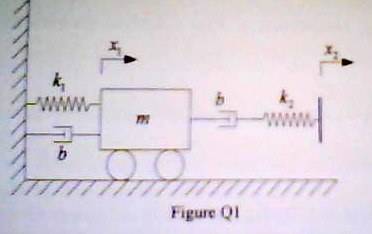
The equation for a damper and spring in series can be derived by recognizing that the force applied is the same across both components. This force results in a change in length for the spring and a variation in velocity for the damper. The discussion draws an analogy to electric circuits, where force corresponds to current, velocity to voltage, and displacement to magnetic flux. The relationship can be expressed as velocities resulting from the force applied, specifically \(\frac{1}{b}f\) for the damper and \(\frac{1}{k}\frac{df}{dt}\) for the spring.
PREREQUISITES
- Understanding of basic mechanics, specifically forces and motion.
- Familiarity with the concepts of dampers and springs in mechanical systems.
- Knowledge of analogies between mechanical systems and electrical circuits.
- Basic calculus for understanding derivatives and rates of change.
NEXT STEPS
- Study the principles of mechanical vibrations and damping ratios.
- Learn about the mathematical modeling of mechanical systems using differential equations.
- Explore the analogy between mechanical and electrical systems in greater depth.
- Investigate the effects of varying damping coefficients and spring constants on system behavior.
USEFUL FOR
Mechanical engineers, physics students, and anyone involved in the analysis and design of mechanical systems with dampers and springs.