DC Motor Circuit: Predicting Vehicle Distance

Click For Summary

Discussion Overview

The discussion revolves around the design and analysis of a circuit for an electric vehicle, specifically focusing on predicting the distance the vehicle will travel based on the circuit's configuration and components. Participants explore the roles of various elements in the circuit, including the motor, transistor, and RC components, while considering the underlying physics and mathematics involved.

Discussion Character

  • Technical explanation
  • Exploratory
  • Debate/contested

Main Points Raised

  • One participant describes a circuit design where an RC circuit controls the operation of a motor via a transistor, questioning how to predict the vehicle's travel distance based solely on the motor's power output.
  • Another participant presents an improved equation for the RC side of the circuit using Ebers-Moll theory, expressing uncertainty about finding a closed solution but mentioning approximations made with SPICE.
  • A participant raises a question about the clarity of the schematic, specifically asking for clarification on the components and connections, indicating potential missing elements.
  • Further clarification is provided by another participant who suggests a more traditional schematic layout for better understanding, emphasizing the arrangement of the voltage source and transistor.
  • There is a discussion about the initial conditions of the circuit, particularly concerning the base capacitor and its impact on the time constant for the motor drive output.

Areas of Agreement / Disagreement

Participants express differing views on the clarity and completeness of the circuit schematic, with some seeking clarification while others propose revisions. There is no consensus on the best approach to predict the vehicle's distance or the effectiveness of the proposed models.

Contextual Notes

Participants note limitations in the schematic's clarity and the complexity of the equations involved, indicating that assumptions about component behavior and interactions may not be fully resolved.

Who May Find This Useful

Individuals interested in electric vehicle design, circuit analysis, and the application of theoretical models in practical scenarios may find this discussion relevant.

TMM
Messages
92
Reaction score
0
So I've designed this simple circuit for an electric vehicle. The inductor and resistor that are boxed off are the motor. The way it works, as you can probably figure out from the diagram, is that the RC circuit on the left controls how long the right side of the circuit runs (via the transistor). The resistor in the RC circuit is a potentiometer, and the time that the whole circuit runs is easy: t = -R*C*ln(actV/V) where actV is the minimum base-emitter voltage drop on the transistor.

My question is about the second half of the circuit. Is there an easy way to predict how far the vehicle will travel if the only thing powering it is that motor? Does the transistor act as an amplifier as well as a switch?

My attempt to predict the outcome was to say that the power applied to moving the vehicle was proportional to that dissipated in the motor. I treated the motor as a resistor and found the Power = V^2/R = F*v. Is this realistic?

Here is the diagram:
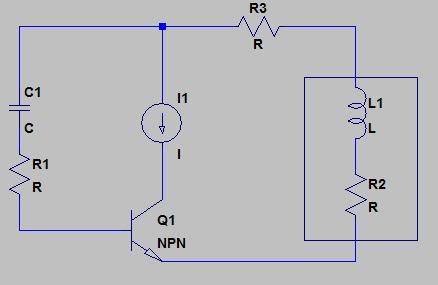
Circuit.jpg


The goal of this is to have an electric vehicle that will run on its own for a distance dependent only on the two variable resistors.
 
Engineering news on Phys.org
I improved on the RC side of the equation using the Ebers-Moll stuff:

V = Gain*ln((k*T*dq/dt)/e) + R*dq/dt + q/C

which I can't find a closed solution to, but I've gotten some approximations using SPICE.

For the DC motor side, I did some research and found a model for it:

V = LdI/dt + IR + Kv/r

cI = kdv/dtr + Fv/r

where c, k, and K are constants, v/r is the angular velocity, F is the frictional load, I is current, V is voltage, R is resistance, etc. So basically I've treated the dc motor as an inductor and resistor in series with a back emf proportional to the angular velocity, which is related to the current and frictional load.

Am I sort of maybe kind of moving in the right direction? Just a little feedback from someone with some experience with this would be awesome.
 
I don't understand your schematic. What is I1? Is that the power source somehow? There would appear to be some connections, bias paths, and power sources missing from the schematic?
 
I've revised the schematic since then.

Thrown together in paint just now:

schematic2.jpg
 
It would be more traditional (and easier to understand) if you drew the schematic with the DC voltage source facing with + upwards, all by itself on the lefthand side of the schematic, and then the PNP transistor to the right, with the emitter connecting to the upper + power rail, and the collector facing down and the motor RL components below the PNP collector, and then your final R return to the negative power rail (show a ground symbol on that). The RC from the base of the PNP then goes down to that common ground rail.

So back to your original question, you have some initial condition (base capacitor shorted?), and then you unshort the cap and want to know the time constant of the output drive to the motor?
 

Similar threads

  • · Replies 9 ·
Replies
9
Views
2K
  • · Replies 3 ·
Replies
3
Views
3K
  • · Replies 11 ·
Replies
11
Views
2K
  • · Replies 3 ·
Replies
3
Views
3K
  • · Replies 14 ·
Replies
14
Views
4K
Replies
11
Views
3K
  • · Replies 7 ·
Replies
7
Views
2K
  • · Replies 41 ·
2
Replies
41
Views
8K
  • · Replies 11 ·
Replies
11
Views
101K
  • · Replies 1 ·
Replies
1
Views
2K