Designing a Damper: Needing Guidance

Click For Summary

Discussion Overview

The discussion revolves around the design of a damper for a mechanical system, focusing on the calculations needed to determine the damper's requirements, including energy absorption, frequency, and damping ratio. Participants are exploring the theoretical and practical aspects of the design, including the effects of gravity and the configuration of the components involved.

Discussion Character

  • Exploratory
  • Technical explanation
  • Debate/contested

Main Points Raised

  • One participant is seeking guidance on calculating damper requirements and damping ratio (ζ) based on given parameters such as energy absorption (4500 J), stroke (15 mm), and maximum loading (400 kN).
  • Another participant questions the role of gravity in the problem and asks for clarification on the configuration of the components, including the presence of a spring and the nature of the pivot points.
  • A participant provides additional dimensions for the setup, confirming that gravity acts downwards and that a spring is involved, which influences the rotation of the bar.
  • There is a discussion about the attachment points of the damper and whether they relate to the moving parts of the system, with participants expressing differing views on this configuration.

Areas of Agreement / Disagreement

Participants have not reached a consensus on several aspects, including the role of gravity, the configuration of the damper, and the assumptions made regarding the system's frequency. Multiple competing views remain regarding the attachment points and their implications for the damper's design.

Contextual Notes

Limitations include the lack of precise measurements for some components, assumptions about the system's configuration, and unresolved questions about the initial velocity and frequency calculations.

mholland
Messages
5
Reaction score
0
Hi I'm a bit stuck on a problem I'm trying to figure out.
I am trying to design a damper, the layout is show below:
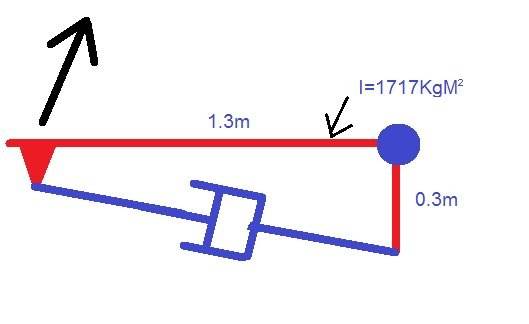
damperlayout.jpg

(apologies for the poor 'cad' drawing!)
So far i know:
I for the beam, how much energy needs to be absorbed by the damper (4500j) and the stroke (15mm). The maximum loading allowed on the fixings is 400kN
From these I've figure out that that ω of the beam is 2.289rad/s. I do not know the initial velocity.
I'm just after some pointers to calculate damper requirements/ζ
I'm a bit confused as to how to calculate the frequency of the system as it is to absorb a single impact effectively, and have a hard stop
 
Engineering news on Phys.org
Does gravity act in this problem? Which way? Is there any spring? What is the black arrow? How high is the red post at the left end where the damper is connected? Is the 0.3 m leg fixed? Is the disk a fixed pivot?

It would help if you would show how you have figured out the beam frequency and what your assumptions were.
 
Thanks for taking the time to reply, for the red bar, say 20cm (i'm still waiting on cad drawings for accurate measurements), and yes the .3m post is fixed
Yer gravity acts downwards and there is a spring, which is the main slider tube shown below, forcing the bar to rotate as it extends.
The only data I've been given to work off is what i gave in the first post
 

Attachments

  • mlg.jpg
    mlg.jpg
    17.9 KB · Views: 606
It looks to me like the left end of the damper goes to a fixed point on the frame, not related in any particular way to the moving red lever. Do you agree, or not?
 
The short .3m vertical red strut is stationary, and the long 1.3m (and the red triangular attachment) are rotating clockwise, with the ends of the damper attached where shown
 

Similar threads

  • · Replies 31 ·
2
Replies
31
Views
4K
  • · Replies 1 ·
Replies
1
Views
3K
  • · Replies 20 ·
Replies
20
Views
4K
  • · Replies 4 ·
Replies
4
Views
3K
Replies
1
Views
7K
Replies
21
Views
2K
Replies
2
Views
1K
  • · Replies 6 ·
Replies
6
Views
2K
  • · Replies 7 ·
Replies
7
Views
5K
  • · Replies 5 ·
Replies
5
Views
2K