Do current sources stack with current?

  • Thread starter Thread starter ainster31
  • Start date Start date
  • Tags Tags
    Current Sources
Click For Summary

Discussion Overview

The discussion centers on the behavior of current sources in a circuit, particularly whether they can be stacked in series and the implications of doing so. Participants explore theoretical and practical aspects of current sources, including ideal versus real-world behavior.

Discussion Character

  • Debate/contested
  • Technical explanation
  • Conceptual clarification

Main Points Raised

  • Some participants assert that I1 must be 3 amps if a 3A current source is added, claiming that ideal current sources cannot be placed in series without causing contradictions.
  • Others question the real-life implications of adding a current source in series, asking whether it would lead to circuit failure or a transition from ideal to non-ideal behavior.
  • One participant explains that real current sources have a compliance range and that stacking current sources with different ratings would result in the higher-rated source going out of compliance, limiting the output to the lower current rating.
  • Another participant expresses confusion over the analogy comparing voltage sources to gravitational potentials, seeking clarification on the relationship between voltage and current sources.
  • One participant suggests that a current source can be viewed as being in series with a voltage source, indicating a different perspective on the configuration.

Areas of Agreement / Disagreement

Participants generally disagree on the validity of stacking current sources in series, with some insisting it leads to contradictions while others explore the practical implications of real current sources. The discussion remains unresolved regarding the theoretical versus practical behavior of current sources.

Contextual Notes

Limitations include the assumption of ideal versus real current sources and the lack of consensus on the implications of combining them in a circuit. The discussion does not resolve the mathematical or theoretical aspects of current source behavior.

ainster31
Messages
158
Reaction score
1
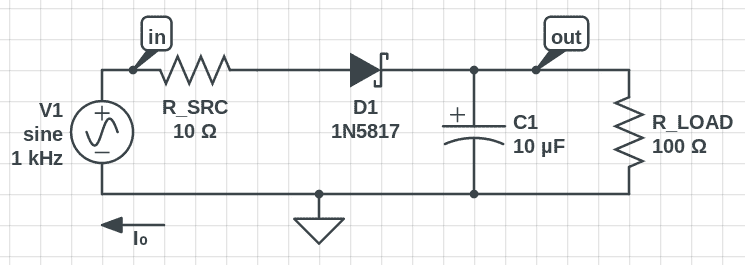
Consider the following circuit:

h_1390408792_3749447_6c069ce658.png


Now imagine that I add a 3A current source:
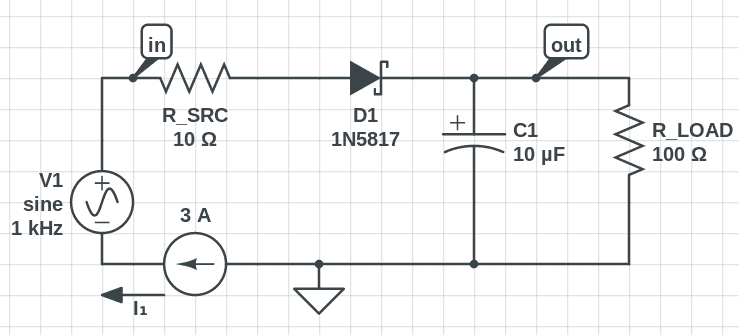
h_1390408821_1096865_026c3809ba.png


Is the following equation correct? $$I_1=I_0+3$$
 
Engineering news on Phys.org
No, I1 is by definition 3 amps. You cannot put ideal current sources in series just as you cannot put ideal voltage sources in parallel. Doing either one causes a contradiction.
 
phinds said:
No, I1 is by definition 3 amps. You cannot put ideal current sources in series just as you cannot put ideal voltage sources in parallel. Doing either one causes a contradiction.

What would happen in real life if I did add the current source? Will the circuit explode? Or will it just become non-ideal? Will it convert from current source to voltage source? How do voltage sources and current sources even work?

If we use the analogy of comparing electric potentials to gravitational potentials, are voltage sources like ladders or slides?
 
ainster31 said:
What would happen in real life if I did add the current source? Will the circuit explode? Or will it just become non-ideal? Will it convert from current source to voltage source? How do voltage sources and current sources even work?

Real current sources have a range of voltage that can be applied across them and still work. This voltage range is often called the "compliance" range. If you try to operate a real current source outside of this range, it no longer is a constant current source, and usually will put out less than the intended current.

If you stack 2 current sources that have different current ratings, generally the higher current one will go out of compliance, and will output only the current that the lower current source is rated at. Thus, both current sources in series are passing the same (lower) current.

You can see this for youself -- look up common circuits for a current sink and a current source. Then stack the two schematics and figure out what will happen... (fun exercise) :smile:

If we use the analogy of comparing electric potentials to gravitational potentials, are voltage sources like ladders or slides?

Sorry, I have no idea what that means.
 
ainster31 said:
What would happen in real life if I did add the current source? Will the circuit explode? Or will it just become non-ideal?

In real life, current sources are NEVER ideal so the question you seem to be asking (what would happen if I put ideal current source in series) doesn't make sense. Berkeman has explained what will likely happen if you put real current sources in series.
 
I see the circuit posted as a current source in series with a voltage source. There is no reason that cannot be done.
 

Similar threads

  • · Replies 19 ·
Replies
19
Views
4K
Replies
29
Views
3K
  • · Replies 5 ·
Replies
5
Views
2K
Replies
7
Views
2K
  • · Replies 44 ·
2
Replies
44
Views
8K
  • · Replies 7 ·
Replies
7
Views
2K
Replies
20
Views
4K
  • · Replies 12 ·
Replies
12
Views
5K
  • · Replies 19 ·
Replies
19
Views
6K
  • · Replies 6 ·
Replies
6
Views
8K