Do Plate Materials Affect Capacitor Performance?

Click For Summary

Discussion Overview

The discussion revolves around whether the material of the plates in a capacitor, excluding the dielectric, affects its capacitance, particularly at different frequencies and dimensions. Participants explore the implications of using various conductive materials, such as aluminum and silicon, on the electrostatic properties and performance of capacitors.

Discussion Character

  • Exploratory
  • Technical explanation
  • Debate/contested
  • Mathematical reasoning

Main Points Raised

  • One participant questions if the plate material affects capacitance, particularly at the fringing level.
  • Another participant argues that the conductive material does not affect capacitance as long as certain conditions regarding equipotential surfaces and electric field behavior are met.
  • A participant raises a concern about aluminum being a "better conductor" and whether this affects electric field distribution and charge accumulation.
  • It is noted that capacitance is an electrostatic quantity and that the behavior of charges at different frequencies can influence whether equipotential surfaces are maintained.
  • A later reply suggests that while better conductors may extend the quasi-static approximation to higher frequencies, there are limits due to finite propagation velocity.
  • One participant discusses the implications of series resistance in silicon compared to aluminum at micrometer dimensions and KHz frequencies, suggesting minimal difference in performance.

Areas of Agreement / Disagreement

Participants express differing views on the impact of plate material on capacitance, with some asserting that it does not matter under certain conditions, while others question this assumption. The discussion remains unresolved regarding the extent to which material properties influence capacitor performance at various frequencies.

Contextual Notes

Participants mention specific conditions and assumptions, such as frequency ranges and dimensions, that may affect their claims. The discussion includes rough estimates and calculations that have not been fully validated.

Aladdin123
Messages
16
Reaction score
0
Hi
I was wondering about an issue i thought about while attending a masters thesis dissertation earlier

does the material of the plate (not the filling dielectric) affect capacitance (even if in the fringing level) ?
Check the attached picture , for a better explanation
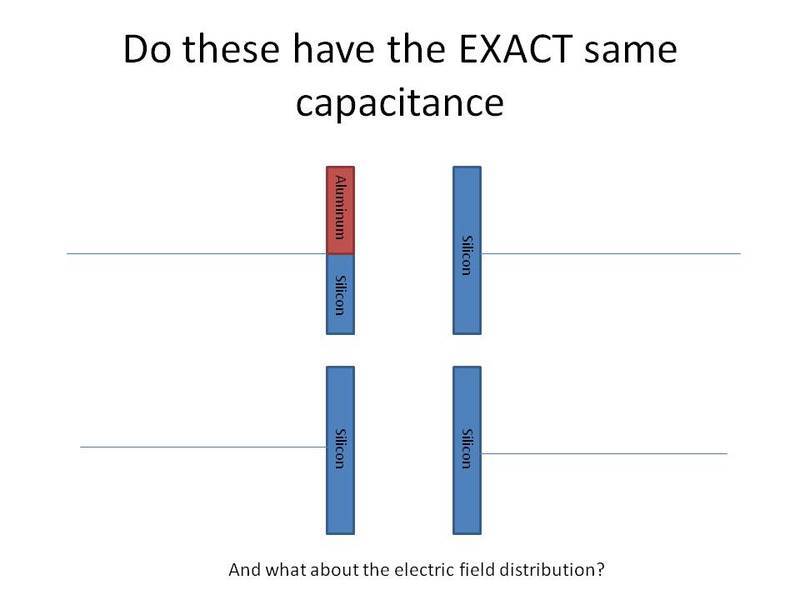
attachment.php?attachmentid=49392&stc=1&d=1343490172.jpg
 

Attachments

  • Do these have the EXACT same capacitance.jpg
    Do these have the EXACT same capacitance.jpg
    18 KB · Views: 578
Engineering news on Phys.org
The conductive material will not effect capacitance so long as:

1 - Each conductor enforces an equipotential condition across its surface.

2 - The conductive material is well behaved in the presense of the required E-field.

A violation of (1) would be a capacitor with 1 square foot plate used for 1GHz signal.

A violation of (2) would be very high surface charge density, say from combination of high voltage and sharp edge on conductor, causing corona discharge.
 
But isn't aluminum a "better conductor" ?
isnt having a higher conductivity something that will upset the electric field distribution, since more charges will accumulate on the metal than on the silicon ?
 
"Better conductor" only matters if current is flowing through the conductor.

Capacitance is an electrostatic quantity. Charges are not in motion; they have arrived at their equilibrium positions which, in turn, creates the E field distribution that leads to the measured voltage between plates.

If your frequency is low enough that the charges are able to be, at any frozen moment in time, close to their electrostatic equilibrium positions, then the capacitance will be correspondingly close to the electrostatic capacitance ("quasi-static" approximation).

If your frequency is high enough that the charges are not able to keep up and reach their electrostatic equilibrium positions, then you no longer have equipotential surfaces.

Perhaps what you are saying is that we can extend the quasi-static approximation to higher frequencies in a given geometry if we use better conductors. This is true, but only to a certain extent. Part of the issue is finite propagation velocity. If I had a parallel plate capacitor made with superconducting plates 1 square foot in area, I would not expect to have equipotential surfaces at 1GHz.

Check out the free field solvers available at: http://www.fastfieldsolvers.com. or http://www.rle.mit.edu/cpg/research_codes.htm.
 
Last edited:
So for micrometer level dimensions , running at the KHz speed :
The only issue I will see is a "series" resistance with the silicon part that is about 0.5 ohms ( Aluminum has resistivity 28.2 nΩ·m, while silicon 1KΩ·m) more than that of the aluminum part which will mean each part will behave as a low pass filter , with cutoff frequencies in the THz (RC=0.5*C , and Cap is ~ 10^-11 ) , so ... no difference at running in the KHz
BTW my calculations are just rough estimates

Am I right ?
 

Similar threads

  • · Replies 3 ·
Replies
3
Views
3K
Replies
34
Views
7K
  • · Replies 17 ·
Replies
17
Views
2K
  • · Replies 15 ·
Replies
15
Views
5K
  • · Replies 12 ·
Replies
12
Views
5K
Replies
5
Views
1K
  • · Replies 1 ·
Replies
1
Views
3K
Replies
9
Views
3K
  • · Replies 6 ·
Replies
6
Views
7K
  • · Replies 5 ·
Replies
5
Views
4K