Does a charged particle rotate when traveling through a static Bf?

Click For Summary

Discussion Overview

The discussion revolves around the behavior of charged particles, particularly in the context of mass spectrometers and their interaction with static magnetic fields (B fields). Participants explore whether charged particles, such as electrons or protons, exhibit rotation when moving through these fields, and the implications of magnetic dipole moments in this scenario.

Discussion Character

  • Exploratory
  • Technical explanation
  • Conceptual clarification
  • Debate/contested

Main Points Raised

  • Some participants suggest that the interaction of a charged particle with a static B field could mediate a rotation about an axis, depending on the force acting on the particle.
  • Others argue that real charged particles, such as electrons or protons, are more complex than simple models and have magnetic dipole moments that influence their behavior in magnetic fields.
  • One participant notes that while charged particles can have a magnetic dipole moment, this effect may not manifest in a mass spectrometer due to quantum mechanical considerations.
  • There is a discussion about the classical image of charge distribution and how it relates to the concept of current loops and electromagnetism.
  • Some participants express uncertainty about the relationship between rotation and angular momentum in quantum mechanics, questioning whether particles can be said to "actually" spin.
  • A later reply emphasizes that while classical models may suggest rotation, modern quantum mechanics provides a different framework for understanding angular momentum without implying physical rotation.

Areas of Agreement / Disagreement

Participants do not reach a consensus on whether charged particles rotate in a static B field, with multiple competing views and interpretations of quantum mechanics and classical physics present throughout the discussion.

Contextual Notes

Participants highlight limitations in classical models when applied to fundamental particles, indicating that the assumptions made may not be adequate for explaining observed phenomena. There is also mention of unresolved mathematical steps and the complexity of quantum mechanical effects.

Who May Find This Useful

This discussion may be of interest to those studying physics, particularly in the areas of electromagnetism, quantum mechanics, and the behavior of charged particles in magnetic fields.

mesa
Gold Member
Messages
694
Reaction score
36
I have been looking at mass spectrometers, in particular the interactions between the Bf ind of a charged particle in motion in a static Bf of the spectrometer.

Figure 1 and 2 shown below are a basic 2 dimensional slice of the problem from the top (fig 1) and from the inside of the radius looking out (fig 2) to establish our F.o.R.

Figure 3 is a view of the charged particle moving towards us at velocity vq- with the 'direction' of the Bf ind shown along 8 symmetrically spaced points.

[URL=[PLAIN]http://s1332.photobucket.com/user/ian5576g/media/crossproductpage1_zps8daf6515.jpg.html][PLAIN]http://i1332.photobucket.com/albums/w606/ian5576g/crossproductpage1_zps8daf6515.jpg

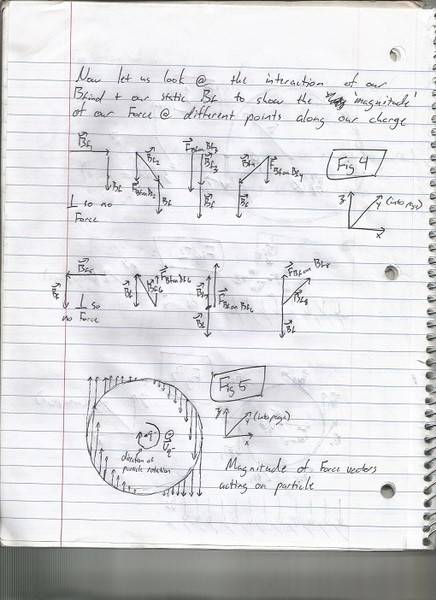
Figure 4 below shows the interaction of the Bf ind with our static Bf along these 8 points and the resultant Force at those points. Figure 5 uses this information to draw a 'representative' magnitude for the Force along different points acting on our moving charged particle in the static Bf. To me this looks like the Force at these points would mediate a rotation about an axis drawn through a charged particle in the direction of 'y' if moving through a static Bf as shown, is this correct?
crossproductpage2_zps0b497dc0.jpg
 
Last edited by a moderator:
Physics news on Phys.org
You diagram appears to assume a uniform spherical charge distribution for the charged particle or a planetary model for an atom. Real charged particles are more complicated than that but this is a good effort - well done.

Charged particles that have a non-zero magnetic dipole moment (look it up) will rotate in a magnetic field - yes.
 
Simon Bridge said:
You diagram appears to assume a uniform spherical charge distribution for the charged particle or a planetary model for an atom. Real charged particles are more complicated than that but this is a good effort - well done.

Charged particles that have a non-zero magnetic dipole moment (look it up) will rotate in a magnetic field - yes.

I was thinking the particle as being a single electron or proton moving through a static Bf. Will they rotate in a mass spectrometer as well?
 
Simon Bridge said:
...Look up "Stern-Gerlach Experiment"

With special reference to electrons:
http://digitalcommons.unl.edu/cgi/viewcontent.cgi?article=1031&context=physicsgay

So this rotation creates only one of two states leading to the discovery that electrons in motion behave like a dipole as shown by a modified Stern-Gerlach Experiment.

I have been drawing this one up but am not seeing how a rotating Ef would create a dipole perpendicular to that of the motion. Should I look at it from the standpoint of the rotating Bf ind of the particle instead?
 
In the classical image, the charge of the particle is thought of as being distributed in space - much as you drew.
Recall that moving charges are an electric current, and an electric current has an associated B field.
If the charge distribution is rotating, then the charge element a distance r from the axis of rotation is moving in a circle - so it is a current loop - so it is a little electromagnet. Since all the charge elements rotate the same direction, they add up.
You can do the math for a rotating sphere of charge Q and radius R if you like.

But the math doesn't agree with experiment.

The modern description is statistical - via quantum mechanics.
A particle may have a non-zero magnetic moment as if it were spinning - but we do not imagine the particle actually spinning ... more that it "carries" angular momentum with it much as it may carry linear momentum and charge and kinetic energy and so on.

If a particle has angular momentum and charge, then it also has a magnetic dipole moment.

The reason I brought this up is that you have managed to explore a bit of theory where the model you are using is not adequate to the task... so you have just hit the next level. It will feel very strange for a while but you get used to it.

What you have been doing would be appropriate for a classical charged insulator fired through a B field rather than a fundamental particle.
 
Last edited:
Simon Bridge said:
In the classical image, the charge of the particle is thought of as being distributed in space - much as you drew.
Recall that moving charges are an electric current, and an electric current has an associated B field.
If the charge distribution is rotating, then the charge element a distance r from the axis of rotation is moving in a circle - so it is a current loop - so it is a little electromagnet. Since all the charge elements rotate the same direction, they add up.
You can do the math for a rotating sphere of charge Q and radius R if you like.

But the math doesn't agree with experiment.

The modern description is statistical - via quantum mechanics.
A particle may have a non-zero magnetic moment as if it were spinning - but we do not imagine the particle actually spinning ... more that it "carries" angular momentum with it much as it may carry linear momentum and charge and kinetic energy and so on.

If a particle has angular momentum and charge, then it also has a magnetic dipole moment.

The reason I brought this up is that you have managed to explore a bit of theory where the model you are using is not adequate to the task... so you have just hit the next level. It will feel very strange for a while but you get used to it.

What you have been doing would be appropriate for a classical charged insulator fired through a B field rather than a fundamental particle.

I got past the sticking point from yesterday, nice to see your suggestion is in line with it. The figures above are illustrating a point charge in motion with the Bf ind some distance 'R' from it giving me trouble spotting a dipole induced by a rotation of an electron.

I redrew the problem with a distribution of charge for an electron from the point of view of the surface so that it is easier to see how a rotation will induce a dipole. Unfortunately (as you pointed out here) it seems the Stern Gerlach experiments show that the dipole can only face in one of two possible directions which wouldn't make sense for this type of system.

So QM uses angular momentum but there is no actual rotation? This should be fun although I still have more to explore in classical mechanics before diving into the deep end of the pool. Thanks for the help, I should probably not add any more to this thread as I have already strayed far from the initial topic.
 
What QM does is tell us that the phenomena that we classically label "angular momentum" may not always be sensibly talked about in terms of the phenomena that we classically label "rotation".

We don't think of an electron, say, as physically spinning any more than we think of an electron in an atom as physically "orbiting" the nucleus like a planet... although we do say it has orbital angular momentum.

It is possible to fire a whole bunch of particles with the same "spin" at a macroscopic object - thus transferring angular momentum to that object, to see if it tries to rotate. And it does.
Maybe this means that the particles are actually" spinning? But how would you tell?
It just doesn't make sense to talk about what a particle is "actually" doing.

But it is exciting to think that you are at a place in your studies now where you are hitting the limits of what conventional knowledge can deal with. Have fun - there's lots to be had :D
 
Simon Bridge said:
What QM does is tell us that the phenomena that we classically label "angular momentum" may not always be sensibly talked about in terms of the phenomena that we classically label "rotation".

We don't think of an electron, say, as physically spinning any more than we think of an electron in an atom as physically "orbiting" the nucleus like a planet... although we do say it has orbital angular momentum.

It is possible to fire a whole bunch of particles with the same "spin" at a macroscopic object - thus transferring angular momentum to that object, to see if it tries to rotate. And it does.
Maybe this means that the particles are actually" spinning? But how would you tell?
It just doesn't make sense to talk about what a particle is "actually" doing.

Amazing, so even though QM says there is no actual rotation when it is brought back into the macro the behavior reverts to classical physics. WOW!

Simon Bridge said:
But it is exciting to think that you are at a place in your studies now where you are hitting the limits of what conventional knowledge can deal with. Have fun - there's lots to be had :D

I can't wait! I took this summer off to spend more time with my kids and dig deeply into the previous semesters topics while preparing for what is to come.
 

Similar threads

  • · Replies 10 ·
Replies
10
Views
2K
Replies
4
Views
6K
  • · Replies 12 ·
Replies
12
Views
3K
  • · Replies 1 ·
Replies
1
Views
2K
Replies
3
Views
6K
Replies
16
Views
15K
Replies
3
Views
3K
  • · Replies 30 ·
2
Replies
30
Views
5K
  • · Replies 1 ·
Replies
1
Views
3K
Replies
13
Views
22K