Does Hyugen's principle apply in three dimensions?

Click For Summary

Discussion Overview

The discussion revolves around the applicability of Huygens' principle in three dimensions, particularly in the context of wave propagation, including surface waves and mechanical waves. Participants explore theoretical implications and examples, as well as the nature of wavefronts in different media.

Discussion Character

  • Exploratory
  • Technical explanation
  • Debate/contested

Main Points Raised

  • One participant questions whether Huygens' principle applies in three dimensions, specifically regarding the propagation of surface waves and the nature of wavefronts in the z-axis.
  • Another participant asserts that Huygens' principle does apply in three dimensions, citing examples such as Bragg scattering in crystals and suggesting its relevance to various scenarios.
  • A follow-up inquiry asks if mechanical waves are included under this principle, suggesting that fluids, which cannot sustain shear, would propagate disturbances in all directions.
  • One participant posits that Huygens' principle is fundamentally about linearity, stating that if the governing partial differential equation is linear, then the principle applies.
  • Another participant expands on Huygens' principle, explaining that it involves considering a wavefront as consisting of infinitesimal sources radiating forward, while questioning the justification for the suppression of backward waves.
  • Concerns are raised regarding the complexity introduced when wavelets have varying amplitudes, particularly in scenarios involving apertures.

Areas of Agreement / Disagreement

Participants express differing views on the justification and implications of Huygens' principle in three dimensions, with no consensus reached on its application to mechanical waves or the nature of wavefronts in various media.

Contextual Notes

Some discussions hinge on the linearity of the wave equation and the assumptions regarding wavefront behavior, particularly in relation to amplitude variations across wavefronts.

Tom79Tom
Messages
45
Reaction score
3
Does Hyugens principle apply in three dimensions ?

If a surface wave (for simplicity an ocean wave) is propagating along the x-axis we know that this wave ray is a point source for wavelets on the y-axis but what about the z axis?

If this diagram was 3d would we see a spherical wave front expanding from each point
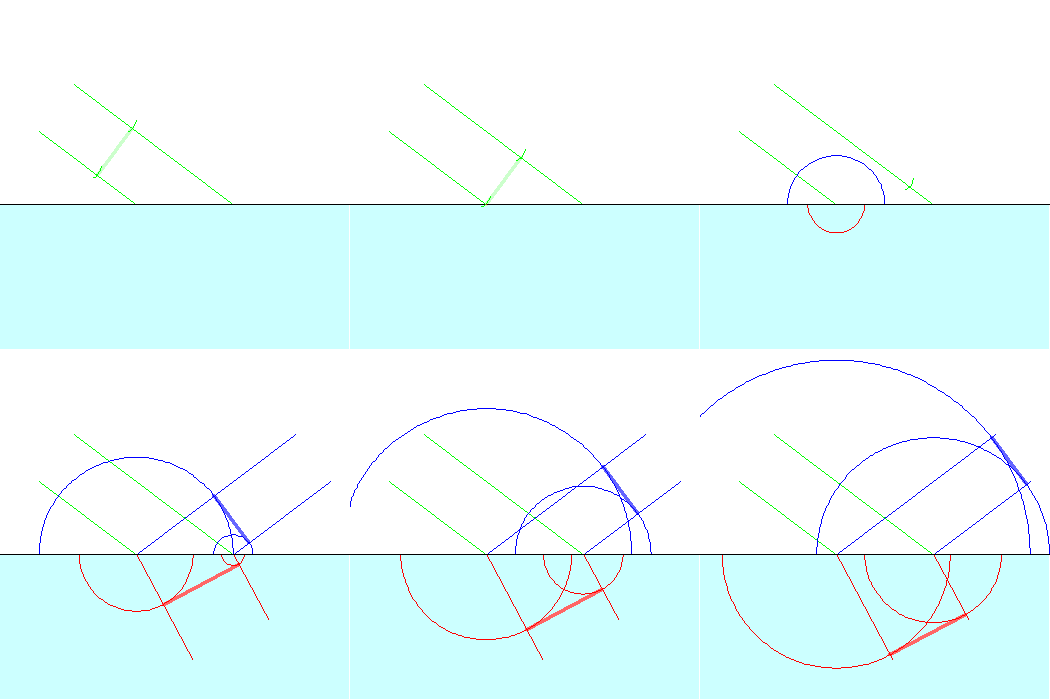
7HGTk.gif


http://physics.ucdavis.edu/Classes/Physics9B_Animations/ReflRefr.html
 

Attachments

  • 7HGTk.gif
    7HGTk.gif
    222.2 KB · Views: 801
Science news on Phys.org
Charles Link said:
but the theory holds in 3 dimensions for quite a variety of scenarios.

Thanks Charles would this include mechanical waves ?
Intuitively this makes sense in fluids as they are unable to sustain shear any disturbance would be in all directions is this the logic ?
 
Tom79Tom said:
Thanks Charles would this include mechanical waves ?
Intuitively this makes sense in fluids as they are unable to sustain shear any disturbance would be in all directions is this the logic ?
I think it is likely that similar principles apply, but I don't have any expertise with the propagation of sound waves in fluids.
 
Isn't Huygens principle merely a statement about linearity? I'd say if your partial differential equation is linear, then Huygens principle applies. The wave equation is linear in all three directions.
 
Huygens principle in many ways is more than that. Huygens principle says that you can pick any plane of a wavefront and consider the plane as consisting of infinitesimal sources that radiate in all directions, ( i.e. in all directions into the forward direction, but not in the reverse direction). ## \\ ## To the OP: Waves in liquids behave in many ways like other waves, and even in some ways like E&M waves, but again, I do not have expertise in this area of waves in liquids.
 
Charles Link said:
i.e. in all directions into the forward direction, but not in the reverse direction).
This is how the original Huygens principle was stated. On its own, that sounds too arbitrary to me and could do with some justification. I don't think there's an arm waving justification but an 'obliquely factor' was proposed, which suppresses the backward wave (in this link). A more formal source gives a reason for the backwards wave not existing.
The first stab at Huygens involves dealing with a flat (/plane) wavefront and this would involve all wavelets having the same amplitude. In a beam that's passed through some aperture, the amplitude will vary over the width, which makes things more complicated. The wavelets would have to be given appropriate amplitudes across the wave front.
 
  • Like
Likes   Reactions: Charles Link

Similar threads

  • · Replies 1 ·
Replies
1
Views
2K
  • · Replies 5 ·
Replies
5
Views
2K
  • · Replies 2 ·
Replies
2
Views
2K
  • · Replies 7 ·
Replies
7
Views
2K
  • · Replies 18 ·
Replies
18
Views
5K
  • · Replies 3 ·
Replies
3
Views
2K
  • · Replies 22 ·
Replies
22
Views
8K
  • · Replies 3 ·
Replies
3
Views
7K
  • · Replies 10 ·
Replies
10
Views
2K
  • · Replies 1 ·
Replies
1
Views
1K