Electric Field Proof: Can Point A Have a Higher Field Than Point B?

Click For Summary

Discussion Overview

The discussion revolves around the behavior of electric fields generated by point charges, specifically whether a point near a charge can exhibit a stronger electric field than a point located at a midpoint between two charges. Participants explore mathematical relationships, the nature of electric fields, and the conditions under which these fields are evaluated.

Discussion Character

  • Exploratory
  • Mathematical reasoning
  • Debate/contested

Main Points Raised

  • One participant suggests that a point near charge ##2q## could have a stronger electric field than point ##B##, which is located midway between charges ##q## and ##2q##.
  • Another participant asserts that the electric field strength increases as one approaches either charge, implying that the maximum field strength does not occur at the midpoint.
  • There is a question about the location where the electric field becomes zero, indicating interest in the overall configuration of the electric field.
  • Some participants discuss the mathematical complexity of finding the point where the electric field is strongest, with one noting the emergence of complex numbers in their calculations.
  • Concerns are raised about the clarity of the mathematical terms used in the equations, particularly regarding the origin of specific terms in the electric field equations.
  • One participant emphasizes the need to evaluate the electric field within a defined range, avoiding points that lead to infinite field strengths.

Areas of Agreement / Disagreement

Participants express differing views on the behavior of electric fields near point charges, with some agreeing that the field strength increases as one approaches a charge, while others question the implications of this observation. The discussion remains unresolved regarding the specific conditions under which one point may exhibit a stronger electric field than another.

Contextual Notes

Participants mention the complexity of the mathematical relationships involved and the potential for complex solutions, indicating that assumptions about the distances and configurations of the charges may not be fully resolved.

Biker
Messages
416
Reaction score
52
I had a thought about electric fields created by charges
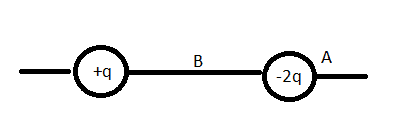
Look at this picture:
Ba73rOX.png

Point ##B## is at the half the distance between ##q## and ##2q##. What I am trying to prove/disprove
That there might be actually a point (##A##) near of charge ##2q## that might have an electric field stronger than the electric field at point ##B##

It seems rational that this could happen

Assume that the distance is ##r##

By equaling the magnitude of the electric field at both points, We will have this equation
$$ \frac{2}{x^2} = \frac{12}{r^2} +\frac{1}{(r+x)^2} $$

The math becomes difficult here, Is there is a way to perhaps simplify the math here? Should I put some random value of r?
Useful notes: x should be really smallAnother question here, does the field have the maximum magnitude at the r/2? Is there is a way to prove that too?
 
Physics news on Phys.org
The field becomes stronger and stronger, tending to infinity, as you approach either charge. Obviously, this means the field is not the strongest at the midway point.
 
  • Like
Likes   Reactions: Biker
Orodruin said:
The field becomes stronger and stronger, tending to infinity, as you approach either charge. Obviously, this means the field is not the strongest at the midway point.
Dummy me, forgot that :/
Now just going to wait for the 1st quiz
 
Here's a question using this setup...

Where is the electric field zero?
 
Orodruin said:
The field becomes stronger and stronger, tending to infinity, as you approach either charge. Obviously, this means the field is not the strongest at the midway point.
How about finding the point where the Electric field is strongest between for example x m from the right of q to x m from the left of 2q ?
robphy said:
Here's a question using this setup...

Where is the electric field zero?
On the left side of q, Why would you need that?Note: Forgot to say, that I want x to be bigger than a value. I don't want x to be inside the charge because that will prove it wrong.
 
Biker said:
How about finding the point where the Electric field is strongest between for example x m from the right of q to x m from the left of 2q ?
The closer to a charge you go, the stronger the field gets.
 
Orodruin said:
The closer to a charge you go, the stronger the field gets.
Yea that is pretty much obvious.
So when we get closer to ##-2q## charge its contribution increases and ##q##'s contribution decreases. However the increment of ##-2q## is bigger than the decrements of ##q## so the closer I get to 2q the stronger it gets. If I go to ##q## instead, I should get less values at every point.

P.S I know we could just get really close to q and get the same thing above. But just asking as if we have a range where we can measure the electric field intensity.

How about the first question?
I got a quartic equation when I substituted r with a value and I ended up with complex numbers. Is that normal? and Why can I get a real number answer?
 
Biker said:
If I go to qqq instead, I should get less values at every point.
No, this is not correct. As you go towards the q charge, the field from the other charge goes to a constant value, but the field from the charge you approach still goes to infinity.

Regarding your equation for equal field, it is unclear where the 12/r^2 term comes from. Also note that you placed one charge at x=0 and the other at x=-r.
 
Orodruin said:
No, this is not correct. As you go towards the q charge, the field from the other charge goes to a constant value, but the field from the charge you approach still goes to infinity.

Regarding your equation for equal field, it is unclear where the 12/r^2 term comes from. Also note that you placed one charge at x=0 and the other at x=-r.
P.S I know we could just get really close to q and get the same thing above. But just asking as if we have a range where we can measure the electric field intensity.

I said that in the thread about 3 times sir :c, I just want to compare it in a range where we don't go to infinity as for example a range from 1 meter of q to 1 meter of -2q.
and I know what you are referring two since the beginning :c

I will write the steps for the equation after a while. Thanks in advance.
 

Similar threads

  • · Replies 6 ·
Replies
6
Views
532
  • · Replies 2 ·
Replies
2
Views
2K
  • · Replies 7 ·
Replies
7
Views
2K
  • · Replies 1 ·
Replies
1
Views
2K
  • · Replies 7 ·
Replies
7
Views
2K
  • · Replies 1 ·
Replies
1
Views
2K
  • · Replies 3 ·
Replies
3
Views
2K
  • · Replies 2 ·
Replies
2
Views
1K
  • · Replies 11 ·
Replies
11
Views
2K
  • · Replies 8 ·
Replies
8
Views
2K