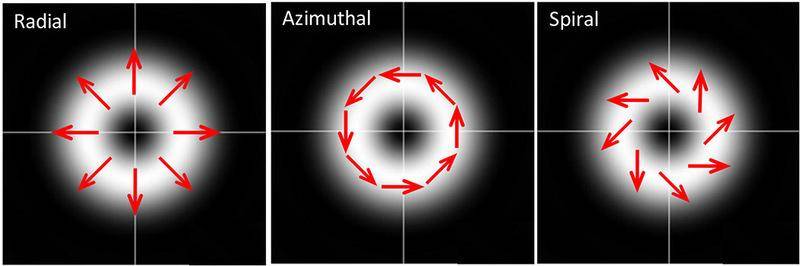
Could I re-word your idea a bit? You appear to be concerned that your image would appear to be focussed at a single point but that would involve the beam energy all being canceled out and it has to go somewhere so wtf?
Diffraction comes to your rescue. There is a limit to how small your 'single point' can be.
Addition of the field vectors depends on their direction and also on the exact point at which you are doing the calculation. The resultant of focussing all the parts of the beam will be the vector sum of all the elemental parts of the beam, at any point. But there is no single point where all the beam will focus; there is always a 'sinx/x' type pattern around the nominal focus point. If it's all symmetrical (for all three examples), I would expect to find a zero but, off axis, you will not get total cancellation and the energy would be diverted. However 'tight' you try to make the optics, there is always a finite beam width and the resulting image will have places where there is no cancellation
But the beam has a zero at its centre in any case, in your diagrams. Its image must also have zero value at the centre if it has circular symmetry. You will get a bright diffraction ring around the centre with a radius that's related to 1/d, where d is the aperture of your optics.