Find Current Through 40 Ohms Resistor Using Thevenin

Click For Summary

Discussion Overview

The discussion revolves around finding the current through a 40-ohm resistor using Thevenin's theorem. Participants explore methods for calculating the Thevenin voltage (Vth) and resistance (Zth), and share their approaches to solving the problem, including nodal analysis and mesh analysis.

Discussion Character

  • Homework-related
  • Technical explanation
  • Debate/contested

Main Points Raised

  • One participant calculated the Thevenin resistance (Zth) as 10 ohms but struggled to find the Thevenin voltage (Vth).
  • Another participant suggested using the nodal method but did not provide their attempt due to discrepancies with the correct answer.
  • Some participants emphasized the importance of showing attempted solutions to receive guidance and identify mistakes.
  • A participant outlined a method for finding Vth by removing the load resistor and calculating the voltage between nodes, followed by a short circuit analysis.
  • Another participant proposed using mesh analysis, noting that one loop's current is fixed by a current source, simplifying the problem to a single equation with one unknown.

Areas of Agreement / Disagreement

Participants generally agree on the need to show attempted solutions for effective guidance. However, there is no consensus on the best method to find Vth, with multiple approaches being discussed.

Contextual Notes

Participants have not resolved the specific calculations for Vth, and there are indications of differing methods and assumptions regarding the analysis techniques.

Special One
Messages
32
Reaction score
1
Homework Statement
current
Relevant Equations
ohm law
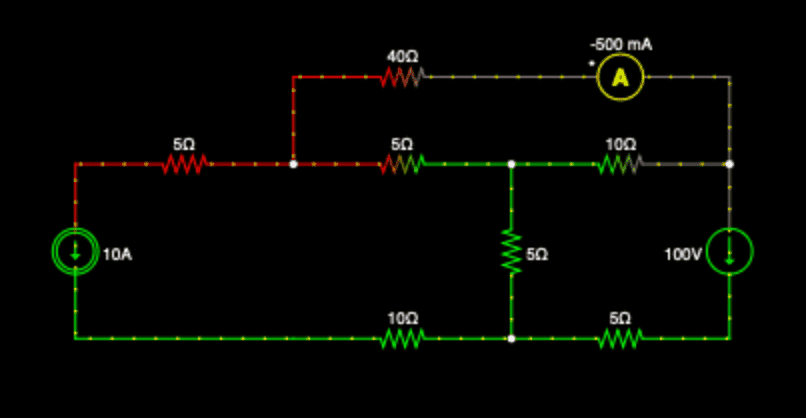
Find the current through the 40ohms resistor using the Thevenin?
I have calculated the Zth = 10 ohms. And I couldn't find the Vth.
Screenshot 2020-10-17 at 19.05.40.png
 
Physics news on Phys.org
So what have you tried?
 
gneill said:
So what have you tried?
Nodal method
 
Special One said:
Nodal method
Okay, possibly not the simplest way forward but let's see your attempt. Where did you get hung up?
 
gneill said:
Okay, possibly not the simplest way forward but let's see your attempt. Where did you get hung up?
I would prefer not to share it here because the correct answer doesn't match with my solution. Let's say you solving the problem, Can you tell what you're going to do to solve for Vth?
 
Special One said:
I would prefer not to share it here because the correct answer doesn't match with my solution. Let's say you solving the problem, Can you tell what you're going to do to solve for Vth?
Sorry, that's not the way it works here at PF. You need to show your own efforts before we can offer guidance, which includes pointing out missteps in your attempt. No one here will do your homework for you.

If you show your attempted solution then we can spot where it might have gone wrong.
 
  • Like
Likes   Reactions: cnh1995 and Vanadium 50
So @Special One if you take the Thevenin Equivalent as across the 40Ω resistor, you would remove that from the circuit, then figure the voltage between those 2 nodes. That is the Thevenin Voltage. Once you have that, then you draw a short circuit between the nodes, and calculate the current through that short.

To find the Thevenin equivalent resistance, just divide: (Thevenin Voltage) ÷ (short circuit current).

As others have said, the way PhysicsForums works, you put what you have attempted, and the other contributors will look and point out where you may have mistakes. That way, you can learn from your mistakes.

https://practicalee.com/thevenin-equivalent/#:~:text=Steps to Find the Thevenin and Norton Equivalent,and series reduction combinations. ... More items...
 
Special One said:
What next? How can I find Vth?
Above you mentioned attempting nodal analysis. You could show us that attempt, or consider another approach. Here's a thought that might get you thinking along other lines:

Looking at the circuit with the load removed you can pick out three essential nodes. That implies three equations in three unknowns for a nodal analysis approach. However, with the load resistor removed there are only two loops, so you're down to two equations and two unknows.

But it gets better! For a mesh analysis one of the loops has its mesh current fixed by the 10 A current source, so that loop is already solved and you're down to a single equation with one unknown. Find that current then do a little "KVL walk" between the output leads and you're done.
 
  • Like
Likes   Reactions: Special One and scottdave

Similar threads

  • · Replies 1 ·
Replies
1
Views
2K
  • · Replies 10 ·
Replies
10
Views
4K
  • · Replies 42 ·
2
Replies
42
Views
7K
Replies
2
Views
2K
  • · Replies 17 ·
Replies
17
Views
3K
Replies
15
Views
3K
  • · Replies 1 ·
Replies
1
Views
2K
  • · Replies 7 ·
Replies
7
Views
2K
  • · Replies 5 ·
Replies
5
Views
2K
  • · Replies 10 ·
Replies
10
Views
3K