Find Lagrangian: Morin's Classical Mechanics Q6.10

  • Thread starter Thread starter Abhishek11235
  • Start date Start date
  • Tags Tags
    Lagrangian Motion
Click For Summary

Homework Help Overview

The discussion revolves around finding the Lagrangian for a system described in Morin's Classical Mechanics, specifically problem 6.10. The original poster explores the implications of different coordinate choices on the resulting equations of motion, particularly in relation to simple harmonic motion.

Discussion Character

  • Exploratory, Assumption checking, Conceptual clarification

Approaches and Questions Raised

  • The original poster attempts to derive the Lagrangian and equations of motion, questioning why different coordinate choices yield different results. Some participants suggest examining the equilibrium point from a Newtonian perspective and clarify the definitions of terms used in the equations.

Discussion Status

Participants are actively engaging in clarifying assumptions and definitions, with some guidance provided regarding the Taylor series expansion and the nature of potential energy terms. There is a recognition of mistakes made by the original poster, but the discussion remains open-ended without a definitive resolution.

Contextual Notes

Participants note potential misunderstandings regarding the equilibrium point and the implications of coordinate choice on the resulting equations. The original poster has indicated a desire for further assistance in resolving the problem, suggesting ongoing uncertainty.

Abhishek11235
Messages
174
Reaction score
39
Moved from a technical forum, so homework template missing
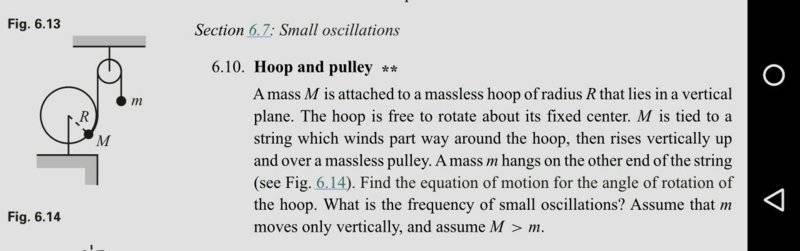
Q)6.10 in Morin's Classical Mechanic. All that I have to do is find Lagrangian here. After that only simple motion.

Finding Lagrangian:
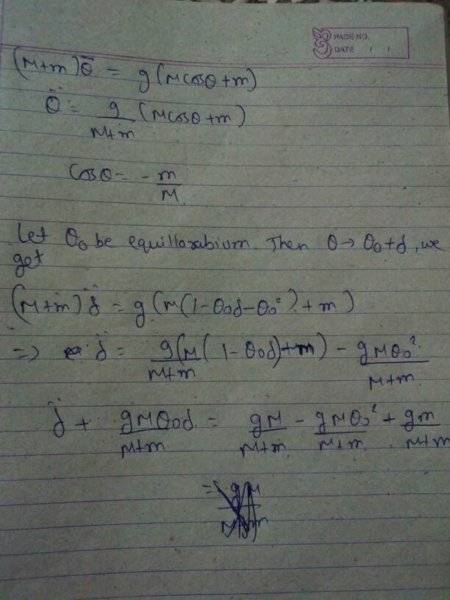
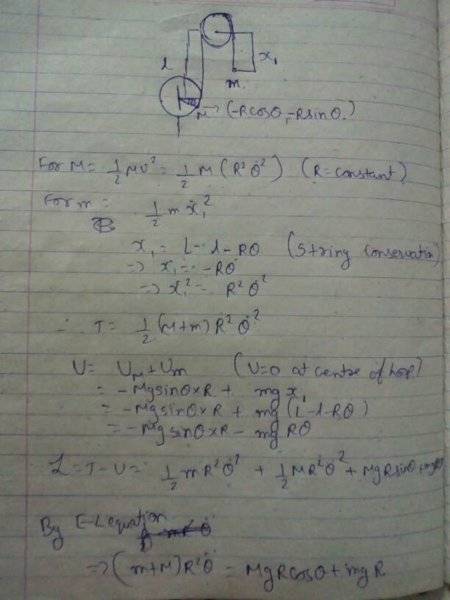
Choose the coordinate system at the centre of hoop as shown in 2nd attachment. Then,I found out Lagrangian of the system. Invoking E-L Equations to find the equation of motion, I got equation like shown in 2nd attachment. After solving,I found out equillarabium point i.e ##\ddot \theta## =0. Then ,to find the motion about this point substitute $$\theta \arrow \theta_{0} +\delta$$ and I got equation like in 3rd attachment. Clearly this is not simple harmonic and I gave up.

So,I found out solution through my friend. He got simple harmonic motion by taking angle measuring from downwards vertical. So the change was just cos##\theta## appearance in third term and everything was same.

So my question: Why by choosing ##\theta## measuring from horizontal gives different result when measured from vertical?
IMG_20190125_083153_731.jpeg
1548387913959.jpeg
1548388426100.jpeg
 

Attachments

  • IMG_20190125_083153_731.jpeg
    IMG_20190125_083153_731.jpeg
    29.4 KB · Views: 371
  • 1548387913959.jpeg
    1548387913959.jpeg
    29 KB · Views: 343
  • 1548388426100.jpeg
    1548388426100.jpeg
    32.8 KB · Views: 380
Physics news on Phys.org
The equation you derived is of the form ##\ddot d +Ad=B## where ##A## and ##B## are constants. Why is this not the harmonic oscillator equation? For a vertical spring-mass system the equation of motion is ##\ddot y +(k/m)y=mg##. Is the motion of a vertical spring-mass system not harmonic oscillations?
 
Abhishek11235 said:
So my question: Why by choosing ##\theta## measuring from horizontal gives different result when measured from vertical?
Of course, it shouldn’t. You must be making a small mistake somewhere.

You wrote ##\cos\theta = -m/M## but I’m pretty sure you meant ##\cos\theta_0 = -m/M##, for the equilibrium point, right?

Think about the equilibrium point from a Newtonian (forces) perspective, do you get the same answer?

You defined ##\theta## to be positive when it’s below the horizontal, right? (You could do it either way just be consistent.) So then does an increasing ##\theta## mean ##m## moves up or down? Does your potential energy term seem correct?
[Edit: I should’ve gone a step back; you said ##U_m = mgx_1## ... so larger x means larger potential energy? Is that right?:wink:]
 
Last edited:
kuruman said:
For a vertical spring-mass system the equation of motion is ##\ddot y +(k/m)y=mg##. Is the motion of a vertical spring-mass system not harmonic oscillations?
Such a system oscillates, but not about y=0.
“δ” is assumed small in their equation.
 
One more thing... you seem to be have replaced cosθ by the approximation ##\cos(\theta _0 + \delta) \approx 1 - \theta _0\delta - \theta _0^2## ??

That is very different than the Taylor series of cosine!
 
Hiero said:
Of course, it shouldn’t. You must be making a small mistake somewhere.

You wrote ##\cos\theta = -m/M## but I’m pretty sure you meant ##\cos\theta_0 = -m/M##, for the equilibrium point, right?

Think about the equilibrium point from a Newtonian (forces) perspective, do you get the same answer?

You defined ##\theta## to be positive when it’s below the horizontal, right? (You could do it either way just be consistent.) So then does an increasing ##\theta## mean ##m## moves up or down? Does your potential energy term seem correct?
[Edit: I should’ve gone a step back; you said ##U_m = mgx_1## ... so larger x means larger potential energy? Is that right?:wink:]
The increase in ##\theta## in negative direction is taken positive. Can you spot the mistake?
 
Abhishek11235 said:
The increase in ##\theta## in negative direction is taken positive. Can you spot the mistake?
I’ve already mentioned your two mistakes. One mistake is in your potential energy term (does ##U_m = mgx_1## make sense to you?) and the other mistake is your Taylor expansion of ##\cos(\theta_0 + \delta)## about ##\delta = 0##
 
Hiero said:
I’ve already mentioned your two mistakes. One mistake is in your potential energy term (does ##U_m = mgx_1## make sense to you?) and the other mistake is your Taylor expansion of ##\cos(\theta_0 + \delta)## about ##\delta = 0##
Ok. I rectified my mistake but still I didn't get solution. Taking zero of potential at centre of hoop, let h be distance of small mass from rope. In terms of string parameters, the height ##h= c+R\theta## where c is constant. The total potential energy is:
$$U= mgh -MgRsin\theta$$
So,E-L equations give:

$$(M+m)R^2\ddot\theta =Mgrcos\theta-mgR$$

Now,this is not simple harmonic even if we expand cos using Taylor's series.

Can you provide solution by taking the origin as I have taken?
 
Abhishek11235 said:
So,E-L equations give:

$$(M+m)R^2\ddot\theta =MgRcos\theta-mgR$$
Good! So then the equilibrium point is actually at ##\cos\theta_0 = m/M## which hopefully makes more sense! (If it was negative m/M, that would mean ##\theta_0## is greater than 90 degrees, and so tension and gravity would be in the same (tangential) direction and couldn’t cancel.)
Abhishek11235 said:
Now,this is not simple harmonic even if we expand cos using Taylor's series.
It does give simple harmonic motion! Are you using the correct form of a Taylor series? You’ll only want the linear approximation:
$$f(x_0+\Delta x) \approx f(x_0) + \frac{df(x)}{dx}\Bigg |_{x=x_0}\Delta x$$
If you think you did this correctly then tell me how it looks for ##\cos(\theta_0 + \delta)##
 
  • #10
Hiero said:
Good! So then the equilibrium point is actually at ##\cos\theta_0 = m/M## which hopefully makes more sense! (If it was negative m/M, that would mean ##\theta_0## is greater than 90 degrees, and so tension and gravity would be in the same (tangential) direction and couldn’t cancel.)

It does give simple harmonic motion! Are you using the correct form of a Taylor series? You’ll only want the linear approximation:
$$f(x_0+\Delta x) \approx f(x_0) + \frac{df(x)}{dx}\Bigg |_{x=x_0}\Delta x$$
If you think you did this correctly then tell me how it looks for ##\cos(\theta_0 + \delta)##
Thanks for the support. I got the answer
 

Similar threads

Replies
9
Views
2K
  • · Replies 6 ·
Replies
6
Views
1K
Replies
3
Views
1K
  • · Replies 7 ·
Replies
7
Views
1K
  • · Replies 9 ·
Replies
9
Views
3K
Replies
9
Views
3K
  • · Replies 1 ·
Replies
1
Views
1K
  • · Replies 1 ·
Replies
1
Views
955
Replies
5
Views
1K
  • · Replies 6 ·
Replies
6
Views
4K