Find the voltage gain, input and output resistance amplifier

Click For Summary

Discussion Overview

The discussion revolves around finding the voltage gain, input resistance, and output resistance of an amplifier circuit using the equivalent-circuit model of the uA 741 operational amplifier. Participants explore theoretical concepts, practical calculations, and the implications of feedback in amplifier design.

Discussion Character

  • Technical explanation
  • Homework-related
  • Debate/contested

Main Points Raised

  • One participant expresses difficulty in solving for voltage gain, input resistance, and output resistance, indicating confusion about the relationship between V1 and the other parameters.
  • Another participant notes that voltage gain (Av) and op amp gain (Avo) are distinct concepts and questions the input/output resistance of an ideal op amp.
  • It is suggested that to find input and output resistances, independent sources should be zeroed out, and a dependent source equation is provided.
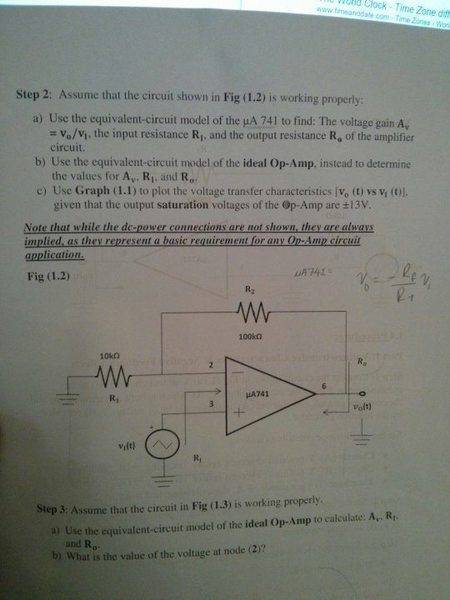
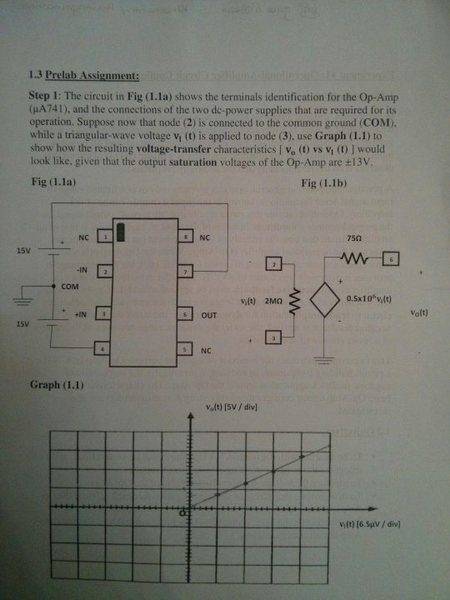
  • Several participants mention the specific input and output resistances of the op amp itself as 2 megaohms and 75 ohms, respectively, while expressing uncertainty about their relevance to the circuit in question.
  • One participant clarifies that the input and output resistances being asked may differ from those of the op amp itself, emphasizing the need to analyze the specific circuit drawn.
  • Another participant highlights the role of two additional resistors in the circuit and their contribution to negative feedback, which affects the output resistance of the op amp.
  • A formula for the resulting output resistance using feedback is introduced, indicating that feedback drastically reduces the output resistance.

Areas of Agreement / Disagreement

Participants generally agree on the need to analyze the specific circuit to determine input and output resistances, but there are competing views regarding the relationship between the op amp's inherent resistances and those in the circuit. The discussion remains unresolved regarding the exact calculations and implications of feedback.

Contextual Notes

Participants express limitations in their understanding due to the early stage of their course, indicating that some concepts may not have been fully covered yet. There is also a dependence on definitions and assumptions regarding the circuit configuration and feedback mechanisms.

sugz
Messages
110
Reaction score
0
I am having a difficult time solving the question in Step 2 of the attachment. The question is "Use the equivalent-circuit model of the uA 741 to find: The voltage gain Av=vo/v1, the input resistance R1, and the output resistance Ro of the amplifier circuit.
lab step 1.jpg
lab step 2.jpg

Attempt at solution:

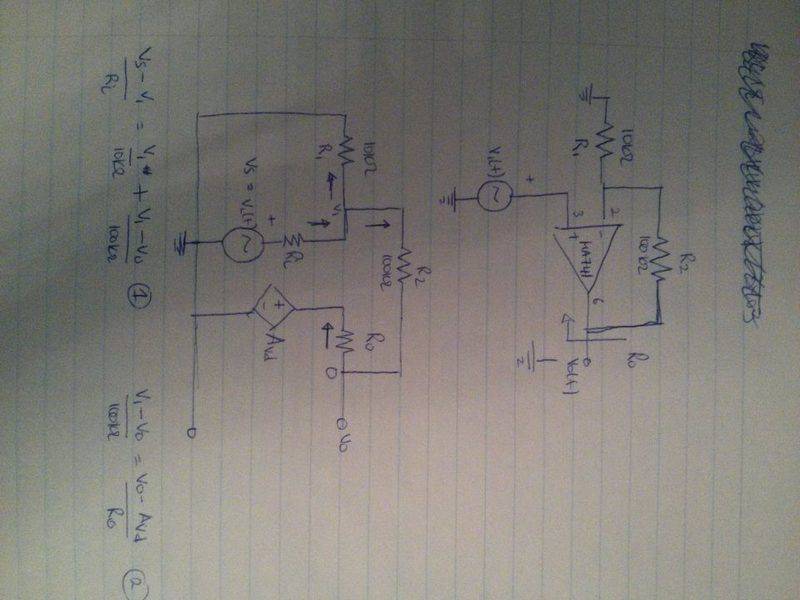
I used the equivalent circuit model of the uA 741 to create two equations. My understanding is that I solve for V1 in the first equations and substitute it into the second equation to get the voltage gain Av=Vo/V1, where Vs is V1 in my equations. The problem I am having is how am I supposed to find the input and output resistance, where I don't know V1,
steps.jpg
 
Physics news on Phys.org
A few things to note...

The voltage gain Av and the op amp gain Avo are two very different things.

What is the input/output resistance of an ideal Op-amp (not this circuit, just the op amp).
What is the gain of an ideal op amp?
To find input and output resistances you zero out all independent sources.

Also the dependent source on the output of your op amp should be
AVD=Avo*(Vin+ - Vin-)

another question... with negative feedback in an ideal amplifier, what is the relationship between Vin- and Vin+
 
  • Like
Likes   Reactions: sugz
donpacino said:
A few things to note...

The voltage gain Av and the op amp gain Avo are two very different things.

What is the input/output resistance of an ideal Op-amp (not this circuit, just the op amp).
What is the gain of an ideal op amp?
To find input and output resistances you zero out all independent sources.

Also the dependent source on the output of your op amp should be
AVD=Avo*(Vin+ - Vin-)

another question... with negative feedback in an ideal amplifier, what is the relationship between Vin- and Vin+
The input and output resistance of the op amp itself is 2 megaohms and 75 ohms, respectively. The gain of the op amp 0.5x10^6. This is the second week of this course, where we haven't learned much of this. I am confused if I am missing something. I am not sure I quite follow what you mean when you say to "to find the input and output resistance you zero out all independent sources. Please help!
 
sugz said:
The input and output resistance of the op amp itself is 2 megaohms and 75 ohms, respectively. The gain of the op amp 0.5x10^6. This is the second week of this course, where we haven't learned much of this. I am confused if I am missing something. I am not sure I quite follow what you mean when you say to "to find the input and output resistance you zero out all independent sources. Please help!
to find the input and output resistances set all independent sources (read Vs) to zero..
so set Vs=0
 
donpacino said:
to find the input and output resistances set all independent sources (read Vs) to zero..
so set Vs=0
Is the input and output resistance being asked in part (a) different from the input and output resistance of the op amp itself (i.e. 2 MegaOhms and 75 Ohms, respectively)?
 
sugz said:
Is the input and output resistance being asked in part (a) different from the input and output resistance of the op amp itself (i.e. 2 MegaOhms and 75 Ohms, respectively)?
For part (a) you must analyse the circuit you have drawn. As donpacino says, you set Vs to zero, and apply a voltage to the circuit's output. Determine the current that flows from this, and their quotient tells you the circuit's output impedance.
 
sugz said:
Is the input and output resistance being asked in part (a) different from the input and output resistance of the op amp itself (i.e. 2 MegaOhms and 75 Ohms, respectively)?
yes they are different. remember that there are two resistors in the circuit in addition to the op amp
 
donpacino said:
yes they are different. remember that there are two resistors in the circuit in addition to the op amp
Most important: These two resistors provide negative feedback!
The ouput resistance Ro of the opamp is reduced drastically using feedback .
The resulting output resistance is r,out=Ro/(1+LG)
with Loop gain LG= Aol*beta (beta: feedback factor).
 

Similar threads

  • · Replies 2 ·
Replies
2
Views
3K
  • · Replies 5 ·
Replies
5
Views
2K
  • · Replies 1 ·
Replies
1
Views
2K
  • · Replies 23 ·
Replies
23
Views
5K
  • · Replies 13 ·
Replies
13
Views
3K
  • · Replies 2 ·
Replies
2
Views
4K
  • · Replies 7 ·
Replies
7
Views
2K
Replies
15
Views
3K
  • · Replies 4 ·
Replies
4
Views
6K
  • · Replies 2 ·
Replies
2
Views
3K